



In this article
- What are media agency fees, and how are they structured?
- How much does a media agency cost?
- Gross, net, agency commission: what is in the rate?
- Which fees should you actually negotiate in a media agency selection?
- What should a media agency selection return, beyond the fee?
- How media agency fees interact with market complexity
- What happens to fees after the appointment?
- Frequently asked questions
Media agency fees are the visible fee components an advertiser pays and/ or rebates an agency can keep, in exchange for its services. They can be expressed as a percentage of spend, a fixed retainer, a cost-per-output, or a hybrid of those structures. Understanding what you are paying for, and what a rigorous selection process should secure in return, is the single most effective lever you have for protecting the value of your media investments.
You are probably reading this because you are about to appoint or re-appoint a media agency, and the fee conversation is making you uneasy. That is a rational response. Agency remuneration has historically been opaque, and the industry’s shift from simple commission to multi-layered hybrid contracts has made it harder, not easier, to know whether you are paying a fair price. On top of that, media may be a commodity, but it sure is not as straight forward as buying milk or water. This article gives you the framework to assess every fee model, negotiate with confidence, and define what a selection should measurably return.
A note on intent. This article is not a manual for squeezing your agency dry. Agencies should make money - including a healthy profit margin. An underpaid agency staffs your account thin, rotates its best people elsewhere, and looks for margin in places you cannot see. What this article argues for is something else: a fee that is fair, transparent, and openly agreed - where the agency earns well, and earns it from the remuneration you both signed, not from the parts of the deal you never got to see. We believe in transparency.
What are media agency fees, and how are they structured?
Agency fees are the agreed compensation for the services a media agency delivers on your behalf. They are distinct from your working media budget, the money that actually reaches publishers, platforms, tech fees and commissions, though they are often conflated in agency proposals.
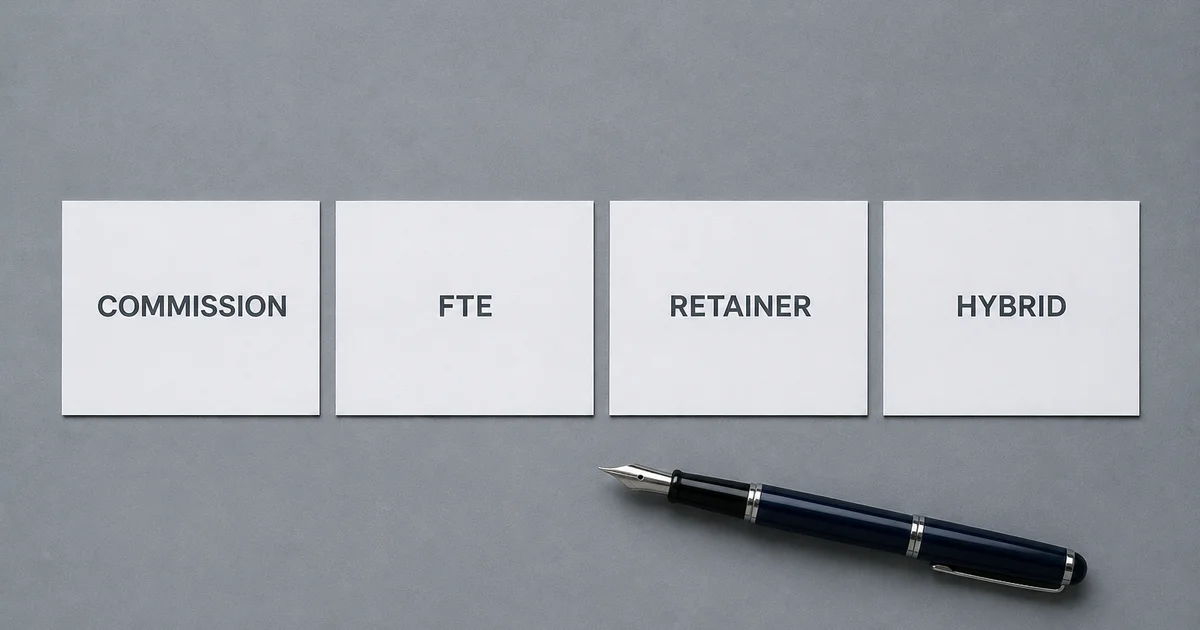
In practice, media agency fees take four primary forms:
- Commission on spend. The agency earns a percentage of the gross media budget it places. Historically 15%, the market rate has compressed to between 1% and 8% for most advertisers (this varies per market), depending on budget scale and scope.
- FTE-based retainer. You pay for a defined number of full-time equivalent staff. Transparent on paper, but the blend of seniority and the number of hours actually allocated to your account is rarely audited.
- Output- or deliverable-based pricing. A fixed fee per media plan, per campaign, or per brief. This works well when volume is predictable; it breaks down when scope expands.
- Hybrid models. A base retainer covering strategy and planning, with commission or performance uplift on activation. Most large agency relationships now operate on some variant of this.
For a detailed breakdown of how each model is constructed, see How do agency fee models work: commission, FTE, output and hybrid?
The structure you choose will shape every commercial conversation for the duration of the relationship. Pick the wrong model and you create misaligned incentives, most visibly in a commission-only arrangement that rewards spend growth rather than spend efficiency.
How much does a media agency cost?
There is no single answer, but there are reliable benchmarks. Media agency fees as a proportion of managed spend typically fall within certain ranges. The range depends per market, but rest assured that agencies look at the bottom line revenue per client.
The right fee for your account depends on the scope of services, the complexity of your channel mix, the number of markets & brands covered, and the seniority of the team you require.
One benchmark worth scrutinising: the World Federation of Advertisers publishes periodic remuneration surveys that provide category-level data on how leading advertisers structure and size their agency fees. That external anchor is useful in any fee negotiation.
What the percentage does not show is the cost of ancillary services, data, technology, attribution modelling, research, that agencies increasingly charge separately. A headline fee of 4% can conceal a total effective cost well above for example 6% once add-ons are included. The article on what a media agency selection actually costs and should return addresses this in detail.
Gross, net, agency commission: what is in the rate?
Two numbers matter in any media price — three, in markets that distinguish them: the gross rate, the net rate, and the net-net rate. Definitions vary by market, which is itself part of the problem. Net can mean the rate after deduction of agency commission, while net-net refers to the actual purchase price after all discounts. The difference between those levels can be commission — and who keeps it is the question.
In several markets, media is still traded on gross rate cards that carry a built-in agency commission, traditionally 15%. In those markets, an agency can in theory retain that commission on top of whatever fee you agreed. This structure has disappeared from many markets, but not from all of them. Where it survives, an advertiser who negotiates only the visible fee pays twice: once through the commission embedded in the gross rate, and again through the fee on top.
The principle that protects you is market-independent: all commissions, discounts, and rebates generated by your spend — directly or indirectly — belong to you, or should at the very least be transparently discussed. That includes the classic agency commission where it still applies.
The agency’s compensation should consist of the remuneration you explicitly agreed — nothing else. Your contract should state this in plain terms: gross/net distinctions disclosed, all agency income from your budget itemised, and everything beyond the agreed fee flowing back to you.
Beyond the commissions tied directly to your spend, there is a second layer: income linked to the agency’s total buying power. Year-end bonuses, research contributions, and similar arrangements are only indirectly related to your budget, yet they can form a meaningful part of agency income — and because they reward volume with particular vendors, they can influence media recommendations. They belong in the same conversation, and the same contract.
Which fees should you actually negotiate in a media agency selection?
Not all fee components deserve equal negotiating attention. Focusing purely on the headline percentage is a common mistake. Agencies can agree to a lower commission while recovering margin elsewhere. Closing the door but opening a window.
The components worth negotiating systematically are:
The effective total cost. Define the fee as a share of total managed investment, inclusive of technology, data, and any third-party costs the agency passes through. This could address hidden margins through ancillary charges.
Scope definition. Every hour spent on work outside the agreed scope is either unbilled, destroying agency margin and, eventually, team quality, or charged at punitive rates. A precise scope of work is the most important document in the relationship, and it should be agreed before the fee is set.
Performance linkage. A portion of the fee, typically 10–20%, can be linked to agreed KPIs: reach efficiency, cost-per-outcome, or audit-validated buying quality. This aligns incentives and provides a lever if performance deteriorates.
Audit rights. The right to conduct a third-party financial audit of the agency’s trading position, including rebates, AVBs (agency volume bonuses), and principal trading, should be a non-negotiable clause in every contract above a material threshold.
Transition and exit terms. These are rarely discussed at the start of a relationship and almost always matter at the end. Agree on notice periods, data ownership, and transition support costs before you sign.
For a structured view of which of these to prioritise in your specific situation, see which media agency fee you should actually negotiate.
What should a media agency selection return, beyond the fee?
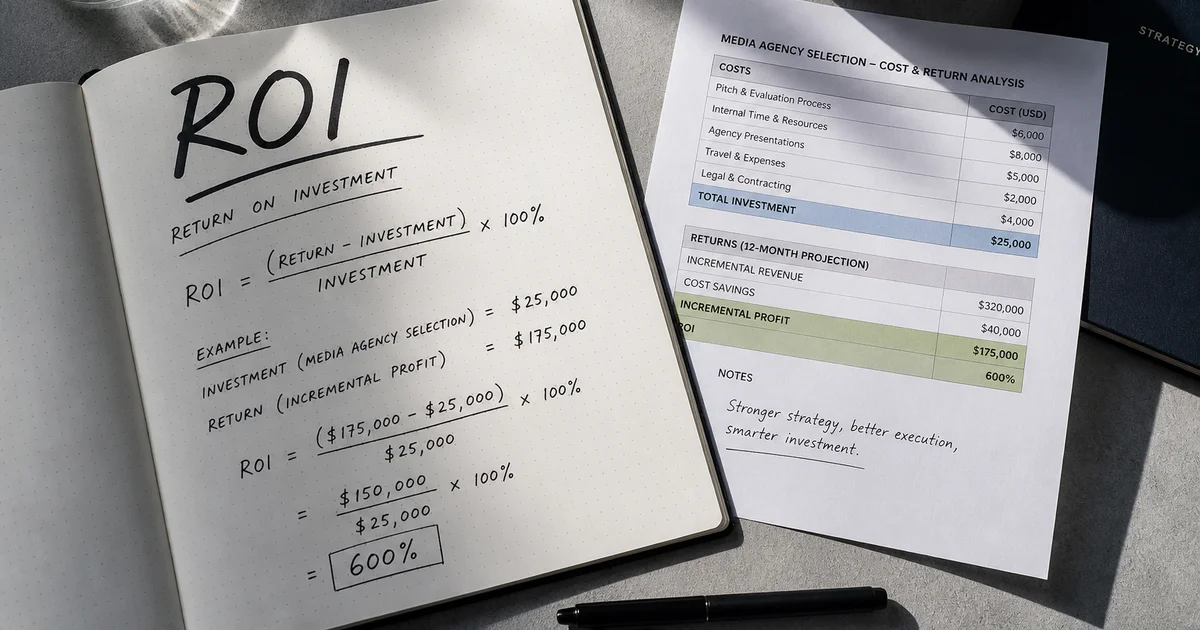
A selection process is not primarily a fee exercise. It is a decision about who will steward a significant portion of your marketing investment for the coming years. The fee is the cost of entry; the outcome is the value.
A well-run selection should deliver measurable returns across three dimensions.
Commercial improvement. A competitive pitch creates leverage that a renewal conversation simply does not. Advertisers who conduct a structured selection routinely achieve enhanced overall conditions. Period. However keep in mind the actual media rates are by far the most important to impact. The agency fee is only a small part of your media investment.
Strategic uplift. The pitch process forces agencies to articulate their strategic thinking in a comparable format. You learn not just who is cheapest, but which agency has the most credible plan for your business. A rigorous level playing field, identical briefs, identical assessment criteria, structured scoring, is what makes that comparison valid.
Contractual clarity. Many incumbent agency relationships operate on contracts that have not kept pace with the market: they predate programmatic trading, lack audit rights, and do not define data ownership. A selection resets the contract on current market terms.
The selection criteria you use to evaluate agencies should extend far beyond fees. Media agency selection criteria that predict a good partnership provides a scoring framework that balances commercial, strategic, and cultural dimensions.
How media agency fees interact with market complexity
Fee structures do not exist in a vacuum. The market in which you operate, its media concentration, the maturity of digital infrastructure, the availability of independent audience measurement, directly affects what you can and cannot negotiate.
In markets where a single agency group controls the majority of inventory relationships, commission transparency is harder to achieve. In markets where programmatic buying is the dominant channel, the distinction between agency fees and technology fees becomes critical. Who owns the DSP seat, who controls the data, and who retains the platform rebate are questions that belong in the commercial negotiation, not the technology conversation.
Advertisers operating across multiple geographies, where a single agency relationship spans markets with fundamentally different media landscapes, should be especially careful about applying a single global fee structure without market-level adjustments. A commission rate that is reasonable in a large, liquid market may be inadequate or excessive in a smaller, less competitive one.
What happens to fees after the appointment?
Agreeing a fee at the point of selection is necessary but not sufficient. Fee structures erode over time. Scope expands without corresponding fee adjustment, agencies introduce new cost lines for services that were previously bundled, and the seniority of the team allocated to your account tends to decline as the relationship matures and becomes less commercially active for the agency.
Protecting the commercial value of a selection over the course of the relationship requires:
- Annual scope reviews that formally assess whether the agreed work has changed and whether the fee reflects current scope
- Periodic financial audits or vendor management programs that verify the agency’s trading position, rebate disclosures, and compliance with contract terms
- Performance reviews (usually part of vendor management) that link the performance-linked portion of the fee to audited outcomes, not self-reported metrics
Vendor management after the pitch and media transparency and governance cover the governance structures that sustain the value of a well-negotiated arrangement.
Frequently asked questions
What hidden income streams can a media agency have beyond its fee? Beyond the agreed fee, an agency can earn from commissions embedded in gross media rates, rebates and volume bonuses from media vendors, technology and data mark-ups, and arrangements linked to its total buying power, such as year-end bonuses and research contributions. Some of these are tied directly to your spend; others only indirectly. All of them should be disclosed. Such fees could even influence the advice you receive.
How much does a media agency cost? There is no fixed rate. Fees scale with budget size — larger advertisers pay a lower percentage of managed spend, smaller budgets a higher one, and small accounts often work on a flat monthly retainer instead. Fees also vary per market. The right number depends on scope, market complexity, local situation and the services included, and should always be benchmarked against current market data before you agree to it.
How much should an agency charge? There is no universal correct answer. A fair agency fee is one that funds the agreed scope of work at appropriate staffing levels, is benchmarked against comparable accounts in the market, and is structured to align the agency’s incentives with the advertiser’s outcomes. The question to ask is not “how much?” in isolation, but “how much for what, measured how?”
What are agency fees? Agency fees are the agreed compensation paid to a media agency for strategy, planning, buying, and managing paid media on an advertiser’s behalf - including any rebates, commissions or other forms of income the agency is permitted to retain under the contract. They are separate from the working media budget, the money spent on actual advertising, and can take the form of a commission on spend, a fixed retainer, a per-output fee, or a hybrid of these structures.