In this article
A fair agency pitch produces better agencies at the table through two mechanisms: it attracts agencies that compete on substance rather than relationships, and it makes the differences between those agencies visible. A disorganised process rewards the best navigator; a structured, transparent one rewards the best agency.
You are probably running a pitch because you want genuine choice. You have shortlisted credible agencies, built a brief, and set aside time for presentations. What happens next, who actually turns up and how seriously they engage, is shaped more by your process design than by your invitation list. The agencies that read your pitch carefully decide quickly whether your process is real or theatre. That decision changes who you get in the room.
What a fair agency pitch actually means in practice
A level playing field is not a procedural courtesy. It is the mechanism that separates signal from noise.
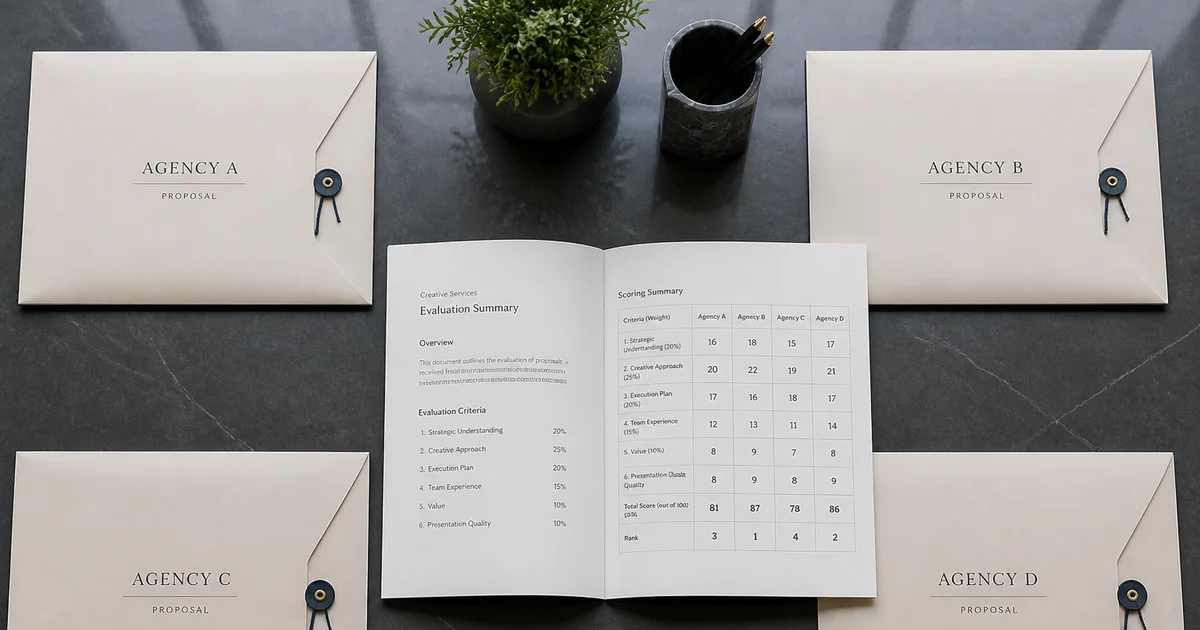
Every agency on your shortlist receives the same written brief at the same time, including any financial and scope chapters. They have access to the same background information. They face the same response format, the same submission deadline, and the same evaluation criteria, criteria that are fixed and weighted before any response arrives. When these conditions hold, the differences you observe in the proposals can only come from the agencies themselves: their thinking, their planning logic, their pricing discipline, their senior commitment.
Remove any one of those conditions and the differences partly reflect your process. An agency that received an informal briefing from a well-connected contact looks different on paper than one working from the written brief alone. But that difference tells you nothing about their capabilities.
Self-selection: the first benefit of a structured process
A transparent, rigorous process signals to every agency that the work will be evaluated on merit. That signal sorts your respondent pool before a single presentation takes place.
Agencies confident in their thinking, their pricing, and their senior team welcome a structured process. They know their work holds up under direct comparison. Agencies that rely on relationship ambiguity, on knowing the right people, navigating informal conversations, positioning for advantage through access rather than ability, find a structured pitch less comfortable. They are not excluded. They simply self-select differently.
The practical effect is straightforward: the agencies that invest most seriously in a fair process are usually the ones worth investing in. They commit senior time, they price with care, and they start the relationship on a professional footing. A well-structured media agency pitch typically runs between three and five months. That is a material investment from any agency. The ones who make it willingly, under clear conditions, are telling you something.
Shared information, shared Q&A
Information asymmetry is one of the most common sources of a compromised pitch. It is usually unintentional: a contact follows up with a question, receives a helpful answer, and that answer never reaches the rest of the shortlist.
The remedy is straightforward. Any question submitted by one agency is answered in writing and shared with the entire group. Who asked the question is noted, but the answer belongs to everyone. An alternative model, in which only the asking agency receives the response, is legitimate if announced upfront, but it creates unequal information depth and generates disputes that are entirely avoidable. The strong preference is to share everything.
Noting who asked what also preserves an honest record of the process.
For advertisers operating across multiple markets, where briefing conditions and media landscapes vary considerably by country, shared Q&A discipline is especially important. Information asymmetry compounds across geographies quickly.
The incumbent: mechanics matter here
Treating the incumbent agency fairly is an explicit professional responsibility, and it should be stated to them directly: this is not a disguised farewell. They participate in the same rounds, the same briefing, and the same response formats as every other shortlisted agency. That is not a small commitment to ask of a partner who already holds the account.
There is one legitimate adjustment. The first round of a pitch often serves to learn who agencies are, their structure, their planning approach, their team composition. The incumbent is already known on those dimensions. You may tell them upfront that round one is not a qualifier for them, meaning they know its outcome in advance. They do not skip the round; they participate and they know where they stand.
Their position carries a genuine advantage, deep knowledge of your business, your markets, your media history, and a genuine disadvantage: fixed paradigms, established habits, the difficulty of seeing your account with fresh eyes. A process designed well takes both into account.
Genuine intent is a precondition
A level playing field binds the advertiser as much as the agencies. The process only functions if the outcome is genuinely open.
If a client has already decided who will win and wants the pitch as a formal exercise, a serious process consultant declines the engagement. Agencies invest real money and senior time in a pitch response. Calling a process fair while pre-determining its outcome is a professional breach, not a procedural shortcoming. This is a standard, not an accusation. The vast majority of pitches are run in good faith. Stating it clearly, at the outset, is part of what makes the process credible.
The involvement of a specialised external pitch consultant is itself a signal to the market. Agencies reading a process brief know that a neutral third party means the information, timeline, and criteria are real. That signal changes the quality of who engages.
For a deeper look at how fees and financial terms fit into this process, the overview of media agency fees and outcomes sets out what a well-run selection should produce commercially.
What fairness costs and what it returns
Designing and enforcing a level playing field takes more discipline than running an informal pitch. You invest time in the written brief, in Q&A management, in criteria weighting before responses arrive, and in keeping the process clean when informal contact happens. And it will happen.
The return is concrete. Agencies that are treated seriously pitch more seriously. They price with greater care because they know the financial chapter will be evaluated on the same basis as everyone else’s, see which media agency fee you should actually negotiate for what that evaluation should cover. They commit senior people because they believe the process merits it. And they start the working relationship, if they win, without resentment toward a process they experienced as arbitrary.
A fair process is not just ethically right. It is an instrument that serves the advertiser, producing better thinking, more honest pricing, and a stronger foundation for the partnership that follows.
Frequently asked questions
What is a fair agency pitch? A fair agency pitch is a structured selection process in which every shortlisted agency receives the same brief, the same information, the same timeline, and is evaluated against the same criteria, fixed before any response arrives. The purpose is to ensure that observable differences between proposals reflect the agencies themselves, not advantages in the process.
Does the incumbent agency have an unfair advantage in a pitch? The incumbent holds a genuine advantage, deep knowledge of your business, your markets, and your media history. It also carries a genuine disadvantage: fixed paradigms and the difficulty of seeing the account with fresh eyes. A well-designed process acknowledges both. The incumbent participates in the same rounds and formats as everyone else; in some cases they may be told upfront that round one is not a qualifier, because that round typically serves to learn who agencies are, something already known.
How do agencies pitch to brands, and what signals a serious process to them? Agencies read the process design closely before committing senior resource. A clear written brief, a shared Q&A protocol, fixed evaluation criteria, and, where applicable, a neutral external consultant managing the process all signal that the pitch is real. That signal determines which agencies engage most seriously.
What are the key elements of a fair pitch process? The core elements are: an identical written brief distributed simultaneously to all shortlisted agencies; shared Q&A (every question and answer goes to the full group); fixed, weighted evaluation criteria set before responses arrive; consistent response formats including financial chapters; and a genuinely open outcome. Each element removes a category of noise from the comparison.