In this article
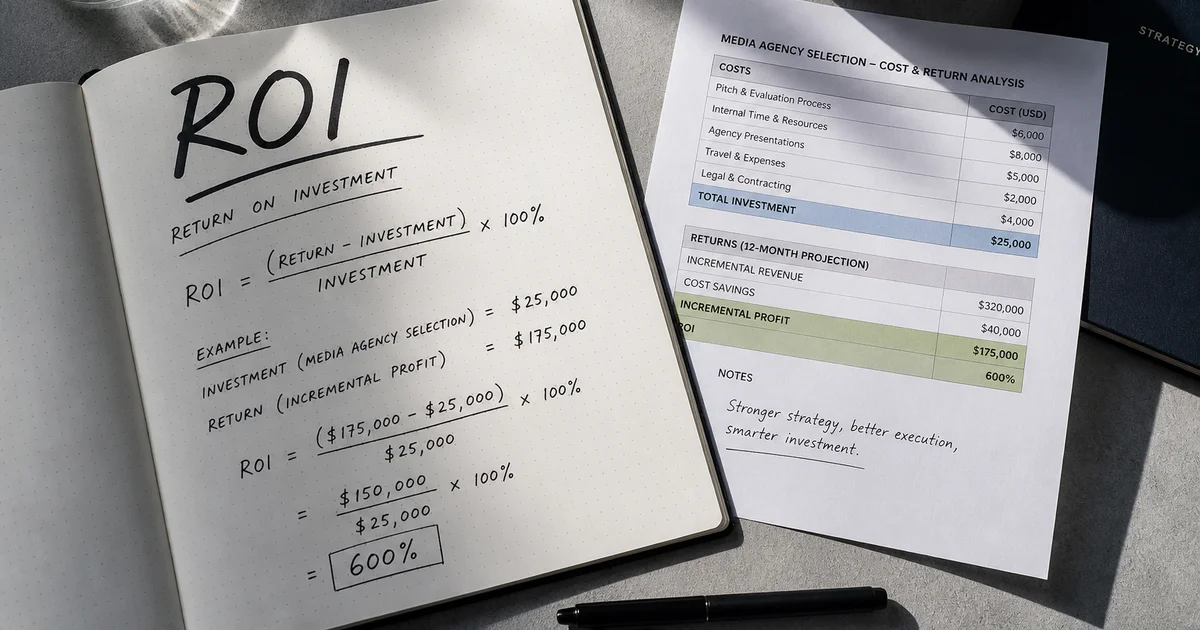
A media agency selection is an investment in the quality of your media investments, and in our experience, a well-executed selection process pays for itself many times over in virtually all cases. The media agency selection cost is not a fixed number: it is shaped by the geography, the media mix and the structure of the process. Understanding what drives that investment is the starting point for deciding whether to proceed and how to scope the engagement correctly.
You are considering a selection, or you are partway through one. Either way, the question in front of you is not just “what will this cost?” but “what will this return, and in what form?” Those are different questions, and both deserve a clear answer.
What determines the media agency selection cost
There is no single price tag on a selection process. Any consultant who offers one without asking a series of questions first is not giving you a serious answer. The scope varies - the arrangement should not: agree a lump sum for the full engagement once the scoping is done. The investment is a function of three variables.
Geography is the most consequential. A single-market selection and a ten-market selection are fundamentally different engagements. But geography is not simply a headcount of countries. Belgium behaves commercially almost like two countries, because Flanders and Wallonia have distinct media markets and partly distinct buying structures. Thailand, depending on the media mix, can often be bought centrally. Japan behaves more regionally depending on the mix, and a national campaign there is considerably more substantial in scale. For a brand launch, a regional approach is worth serious consideration. China involves buying at multiple levels: city, provincial and national. Each of these realities affects the scope of the request, the agency input that must be evaluated, and the complexity of the commercial comparison
The media mix is the second driver. Out-of-home requires a different request than digital, and digital requires a different request than television or audio. When the mix is not yet known at the outset, which is more common than most advertisers expect, the request must be broader to cover realistic scenarios. A broader request enlarges the process. One practical alternative is a structure with a strategy round first and a pricing round after: agencies respond to the strategy brief before the media investment detail is finalised, and the commercial round follows once the mix is clearer. That approach adds a phase but avoids the waste of pricing something that may change.
The structure of the process is the third variable. How many rounds, how many agencies in each round, whether credentials are evaluated before the full brief is issued, and how the commercial round is designed: each decision shapes the scope. See the overview of media agency fees and outcomes: what a selection should return for the full picture of what a well-constructed process is expected to deliver on the conditions, contract and strategic side.
The honest summary: what the client needs, and the set-up designed around that need, is what determines the scope. A good process is built from the real requirement of the advertiser, not from a standard template applied uniformly.
The return: media mileage improvement, not savings
The question most advertisers carry into a selection is “how much will I save?”. That framing understates what a selection is actually for. The better question is: how much more media pressure can you realise with the same media investment, at the same or better quality?
The concept is Media Mileage Improvement: more reach, more visibility, more brand impact from a budget that does not change. Agencies that compete seriously in a well-structured pitch sharpen their commercial proposals in ways that would not happen in a bilateral negotiation. Better buying conditions, clearer fee structures, stronger planning commitments and more accountable performance terms are the output. And those improvements compound over the life of the contract.
To give a sense of scale without overstating it: in one engagement spanning ten geographies, the cumulative improvement came to roughly 15-20% across the total media investment. It could represent a monetary saving; but usually it represents a measurable gain in what that investment produces. We have seen engagements go beyond 30% savings. A finding like that tends to provoke two reactions at once: frustration about the past, and genuine satisfaction about everything that changes from here. Not every engagement produces an identical result. Market conditions, incumbent relationships and the starting quality of existing agreements all matter. But the directional finding is consistent: a well-executed process returns substantially more than its cost.
For guidance on how fee models and commission structures translate into commercial conditions, the article on how agency fee models work covers that in detail.
For advertisers who already buy sharply
Not every advertiser begins a selection from a weak position. Some have been through various previous pitches. Some have active benchmarking programmes. Some have recently renegotiated their agency agreements and secured genuinely competitive terms.
For those advertisers, the case for a selection is different. But it is not weaker. The process is the mechanism for keeping the advantage. Without periodic competitive pressure, even well-negotiated agreements drift. Agencies understand market movement before their clients do. Maintaining discipline through a structured review, benchmarking conditions against current market rates and keeping the incumbent agency aware that the relationship is actively managed: these are the functions a selection serves for a sharp buyer. It is about protecting a competitive position, not closing a gap that has opened.
This connects directly to the question of what should be negotiated and where the leverage lies. The article on which media agency fee to actually negotiate addresses that question specifically.
What the process asks of the advertiser
A well-guided selection process is reasonably turnkey for the advertiser. The core requirement is attending the relevant meetings and preparing a limited number of inputs: support information for the brief, internal alignment on priorities, and the final decision. The pitch consultant manages the process design, agency communication, evaluation structure, commercial analysis and negotiation support. The advertiser’s time commitment is real but bounded.
Those considering a selection and wanting to understand how the approach works in practice can bekijk meer about the engagement model and how a process is scoped from the first conversation.
The article on what a media agency contract should include covers how the outcomes of a selection are secured in writing. Because the value of a pitch is only protected if the commitments made during it are properly documented.
Frequently asked questions
What determines the cost of a media agency selection? The three main drivers are geography (how many markets, and how commercially distinct each is), the media mix (which channels are included and whether the mix is somewhat known upfront), and the structure of the process (number of rounds, number of agencies, whether a strategy round precedes the pricing round). There is no fixed fee: the scope is designed around the specific needs of the advertiser. Once that is known a lump sum is proposed and agreed.
How much should a media agency selection return? The return usually takes the form of Media Mileage Improvement: more reach, visibility and brand impact from the same media investment. In one engagement covering ten geographies, the cumulative improvement across the total media investment came to roughly 15-20%. Results vary by market conditions and starting position, but in our experience, a well-executed selection pays for itself many times over in virtually all cases.
How long does a media agency selection take? A well-structured media agency pitch typically runs between three and five months from first brief to appointment. The active process from brief to signed contract usually runs ten to sixteen weeks. A longer runway almost always produces a better result, particularly in the commercial negotiation phase.
Is a selection relevant if we already have competitive agency terms? Yes. For advertisers who already buy sharply, a selection process is the mechanism for maintaining that advantage: benchmarking current conditions against the market, keeping the incumbent agency commercially alert, and managing the relationship with clear expectations. It protects a competitive position rather than recovering one.
Should you agree a fixed price for a media agency selection? Yes. A professional pitch consultant scopes the engagement upfront - geography, media mix, process structure - and agrees a lump sum for the full process. That protects the advertiser from open-ended consulting fees and aligns both sides on scope before the work begins. Treat a consultant who cannot commit to a fixed amount after a proper scoping conversation with the same caution you would apply to an agency quoting “competitive rates”.