In this article
- The four models in brief, and why fit matters more than form
- When commission is a reasonable fit
- FTE and output pricing: predictability versus flexibility
- The hybrid model: what makes it work and what makes it fail
- The common mismatch: habit over fit
- Fairness is the argument that holds all of this together
- Frequently asked questions
The right agency commission model is not the cheapest one, it is the one that creates the right incentives for both sides, given the specific shape of your budget, your scope and your market. Choosing on price alone almost always produces a worse outcome than choosing on fit.
You are probably asking this question because you are entering a new agency relationship, renewing an existing one, or realising that what you agreed two years ago no longer matches how you actually work together. All three are good moments to think this through carefully.
The four models in brief, and why fit matters more than form
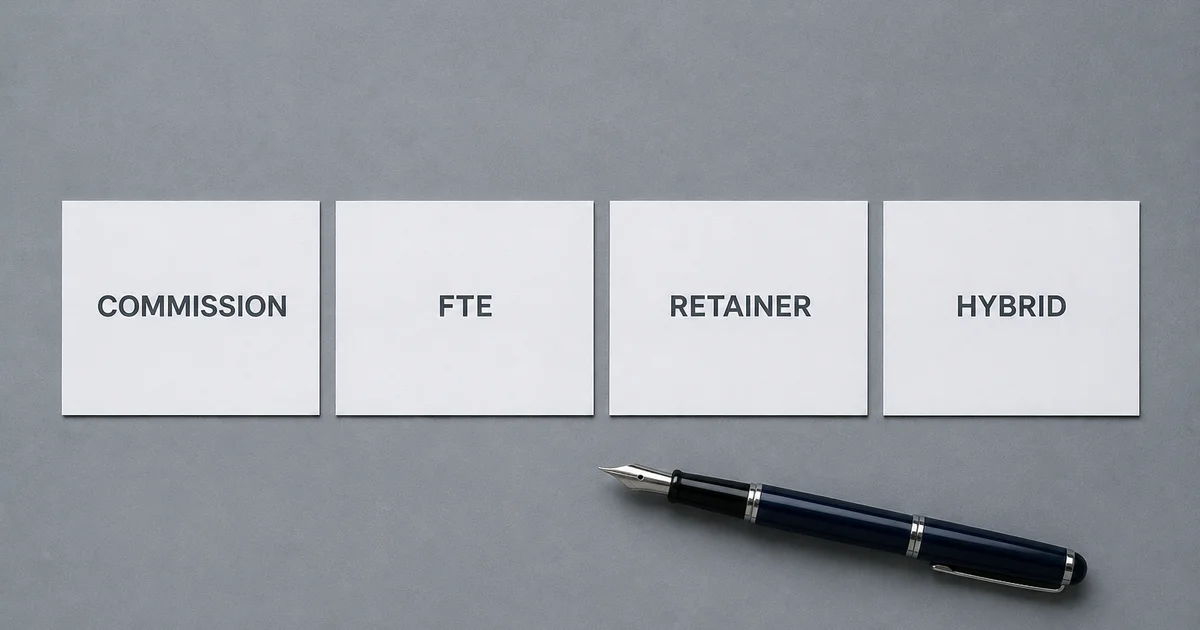
Agency fee structures generally fall into four categories: agency commission (a percentage of billed media spend), FTE-based fees (paying for named people and their time), output-based pricing (a fixed price per deliverable), and hybrid arrangements that combine a monthly retainer with an hourly rate for work outside it.
The pillar on media agency fees and outcomes: what a selection should return covers what each model contains. This article focuses on when each model fits and when it stops fitting. A well-described model applied to the wrong situation causes more friction than a less precise model applied to the right one.
The test behind every model is twofold: does it create the right incentive, and is it fair to both sides? Any model is defensible under that test. A model that rewards the agency for something other than the advertiser’s interest is not. And neither is a model under which the agency does real work without real compensation.
When commission is a reasonable fit
Commission is often mischaracterised as an outdated relic. For many mid-market advertisers with predictable buying activity, it is a perfectly sensible arrangement: self-adjusting, simple to administer and proportionate. It requires no verification apparatus on the advertiser’s side, which matters when internal audit capacity is limited.
The questions arise at the extremes. At very large budgets, each percentage point becomes a disproportionate number for what is effectively the same work. The arithmetic does not scale with effort, and at a certain threshold it becomes difficult to justify the fee on a deliverables basis.
The more important tension in a commission model concerns risk allocation. It is worth getting this exactly right. Commission is paid over what is actually bought. When an agency delivers substantial strategy and planning work but little or no media is ultimately purchased, the agency earns nothing over real work delivered. The risk in that scenario sits with the agency, not the advertiser. If this happens occasionally it could reasonably be accepted as part of the agency’s commercial risk. But if it becomes a structural pattern, much strategy, little buying, an agency that raises the matter is raising it rightly. That is precisely the scenario that tends to trigger a model review.
A less common but workable variant in commission structures is splitting the rate by phase: one percentage covering strategy and planning, a second covering the buying execution. This acknowledges that the two activities carry different cost bases and different risk profiles.
FTE and output pricing: predictability versus flexibility
FTE-based fees suit arrangements where the scope is stable, the campaign rhythm is consistent, and the relationship benefits from continuity in the people assigned to the account. You are, in effect, buying capacity rather than outcomes.
The limitation is transparency. An FTE model is only as honest as the advertiser’s ability to verify what seniority level is actually deployed and whether the hours are genuinely applied. Without that capability, which sits within the domain of vendor management rather than fee structure, an FTE arrangement can drift into a retainer that costs more than it delivers.
Output-based pricing works well for project-driven work: a campaign launch, a channel entry, a seasonal burst. When the deliverable is defined and the price is fixed, the agency has an incentive to deliver efficiently and the advertiser has a clear basis for comparison. For recurring, ongoing work it can become administratively burdensome. You end up negotiating every quarter.
The hybrid model: what makes it work and what makes it fail
A hybrid arrangement, a fixed monthly fee plus an hourly rate for work outside it, is in theory the most flexible and in practice the most frequently misapplied.
What makes it work is precision in the definition of what the monthly fee includes. Which channels, which markets, which campaign types, how many rounds of planning, what level of reporting. Without that definition, the retainer becomes a vague entitlement and every conversation about additional work becomes a dispute about whether it was already covered.
The definition is the model. A vaguely bounded retainer is not a hybrid. It is a source of ongoing disagreement with a monthly fee attached. When you consider a hybrid arrangement, the quality of the scope definition is the single best indicator of whether it will function as intended.
The common mismatch: habit over fit
The most frequent fee problem is not a bad model. It is a model that was right at one point and never revisited. Budgets shift. Channel mix changes, sometimes during a contract year, when spend moves between channel types. The relationship between strategy work and buying volume changes as markets mature or as in-housing decisions remove certain activities from the agency’s remit.
In markets where commission structures are embedded in how the local media ecosystem operates, working against the convention can be costly even when the logic would favour a different model. The pragmatic response in those cases is to accept the convention and arrange for the transparency and controls that make it work fairly. Forcing a model that creates operational friction for both parties is rarely worth it. The fee model deserves examination at every renewal. A media agency selection resets it by definition, and that reset is one of the selection’s less visible but genuinely important outputs.
Fairness is the argument that holds all of this together
The objective of choosing and negotiating a fee model is not to arrive at the lowest number the agency will accept. A fair fee is one under which the agency earns properly, with a reasonable profit margin. A well-run selection treats that as a precondition, not a concession.
The agency fee typically represents a few percentage points of total media investment. Compressing it to the minimum produces predictable consequences: thinner staffing, faster rotation of talent on the account, and an agency that seeks margin elsewhere. That is a poor trade. The negotiation questions worth asking are about which elements of the fee deserve scrutiny, not about whether the agency should earn at all.
A fair fee only stays fair, however, when it is the only margin the agency earns from the relationship. When undefined income streams remain open, rebates, undisclosed volume bonuses, data monetisation arrangements, a reasonable fee becomes an understatement of actual agency revenue. That is why transparency in the commercial arrangement matters: not as an expression of distrust, but as the mechanism that keeps a fair fee fair. Incentive misalignment is a feature of a poorly constructed model, not misconduct on an agency’s part. The media agency contract is where the model is given legal form, and where those income streams either get defined or stay undefined.
Frequently asked questions
Which agency fee model is best? None is best in the abstract. The right model is the one that fits the shape of your budget, your scope, your market convention and your internal capacity to verify what you are paying for. The equally important test is fairness: a model that leaves the agency unable to earn a proper margin is not a good deal. It simply moves the cost somewhere less visible.
Do agencies get commission? Many do, particularly in markets where commission-based structures are the established convention. Whether a given agency earns commission, a fixed fee, an FTE-based retainer or some combination of these depends on what was agreed in the contract and, in many cases, on market practice.
What does a 5% commission mean? A 5% commission means the agency earns five percent of the media value it buys on the advertiser’s behalf. Whether this is adequate depends on the volume: at high spend levels, 5% can be generous; at low spend levels, it may not cover the agency’s actual cost of service.
When should a fee model be renegotiated? Every renewal is a natural moment for review. Beyond the calendar, a model warrants revisiting whenever the relationship between strategy work and buying volume changes materially, when significant budget moves between channel types, or when in-housing decisions alter what the agency is actually being asked to do.