 United States
 Canada

In this article
- At a glance: where the region is one and where it is two
- How the region is organised
- What the markets share
- Where the two markets divide
- Measurement across the region
- Regulation across the region
- Running one plan across two markets
- Broadcast and television
- Print and newspapers
- Radio and audio
- Out-of-home
- Digital, social and influencer advertising
- Finding and managing a media agency
- Frequently asked questions
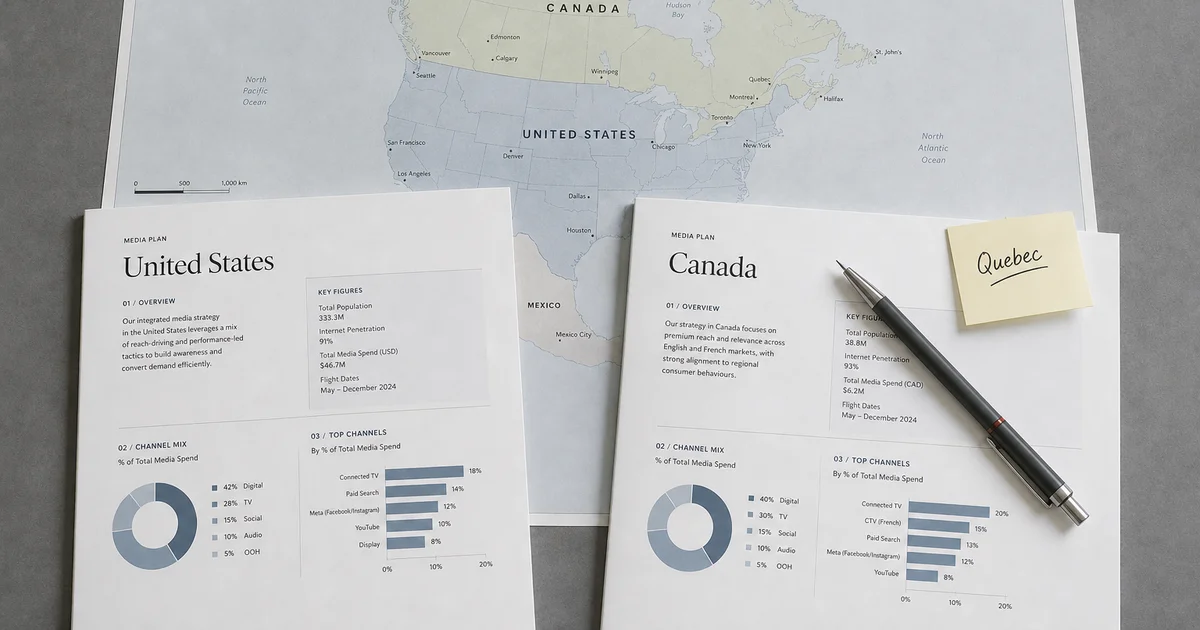
Advertising in North America means operating one region in the organisational chart and two distinct markets in the buying. The United States and Canada share the same holding companies, the same dominant platforms and a shared transparency agenda. But they operate under different currencies, different measurement systems, different languages and category rules that, in some cases, point in directly opposite directions. Knowing where the region is one and where it splits into two is the starting point for any plan.
Expanding into other regions? The full overview of media landscapes across markets covers the same framework applied globally.
At a glance: where the region is one and where it is two
| Topic | North America: one region or two markets? |
|---|---|
| Agency structure | One: the same holding companies operate across both countries, and regional appointments are common |
| Platform reach | One: the same global platforms dominate digital reach on both sides of the border |
| Transparency agenda | One: the same principal-trading and rebate disclosure questions apply across both markets |
| Language and planning units | Two: the United States plans nationally by Nielsen markets; Canada is English Canada and French Quebec |
| Measurement currency | Two: Nielsen in the United States, Numeris in Canada, with different accreditation status |
| Category rules | Two: prescription drug advertising, cannabis promotion and gambling rules differ materially |
| Privacy law | Two: a US state-law patchwork versus Canada’s federal law and Quebec’s stricter Law 25 |
| Pricing and demand cycles | Two: US broadcast pricing moves with election cycles; Canada does not share that dynamic |
How the region is organised
International advertisers typically manage the United States and Canada under a single regional structure: regional leadership, regional budgets and, in many cases, a single agency appointment. That structure is logical. It reflects how holding companies are organised, how global platform deals are negotiated and how regional brand mandates are administered. In practice, a great deal of day-to-day management treats North America as one unit, right up to the point where execution begins.
What the markets share
Digital channels take the large majority of advertising spend in both markets, with retail media among the fastest-growing lines. The same global platforms dominate reach, and the same agency holding companies operate across both countries. The completion of the Omnicom and Interpublic merger in November 2025 concentrated the regional buying market further. Streaming and connected TV carry a growing share of television money in both markets, importing programmatic verification questions into what was once a straightforward broadcast buy.
The transparency agenda is also shared. The issues built into the US advertiser record, from pervasive rebates to programmatic waste and the growth of principal trading, travel with the same holding companies into Canada.
Where the two markets divide
The United States plans as one national market organised into Nielsen-defined local markets. Canada is two markets in one country: English Canada and French Quebec. Quebec is not a translation exercise. It requires its own creative, its own media and its own consent practice under Quebec’s language rules, its prohibition on advertising directed at children under 13, and its privacy legislation under Law 25, which is stricter than the Canadian federal baseline.
Category rules diverge sharply. Direct-to-consumer prescription drug advertising is legal and standard in the United States and prohibited in Canada. Cannabis promotion is severely restricted in Canada while rules vary by state in the United States. Gambling advertising is regulated state by state in the United States and province by province in Canada. Since August 2023, Meta has blocked news links for Canadian users under the Online News Act, with no equivalent restriction in the United States, which changes reach and news-adjacency planning on one side of the border only.
Measurement across the region
In the United States, Nielsen remains the dominant national television currency, accredited by the MRC, while a joint industry committee has certified alternative currencies, making the measurement basis a per-deal negotiation. In Canada, Numeris, an industry-owned joint industry committee, provides the measurement. Its cross-platform VAM service launched in late 2025 but is not yet an established trading currency.
The discipline is the same in both markets: state the measurement basis per deal, in writing, before the plan is approved. A blended North American CPM hides more than it reveals.
Regulation across the region
The United States has no comprehensive federal privacy law. A patchwork of state laws applies instead, with varying scope and enforcement. Canada has federal privacy legislation, with a successor bill tabled, and Quebec’s Law 25 operating as a stricter regional baseline. US broadcast pricing moves with election cycles in ways that affect planning and pricing benchmarks; Canada does not share that dynamic. Compliance clearance must be done per country, not per region.
Running one plan across two markets
A regional plan that works in practice needs per-country measurement bases, per-country compliance clearance, a Quebec treatment that is its own workstream rather than a translation, and pricing benchmarks per market. A regional agency appointment can carry all of this. But the contract must specify it. Agent-versus-principal declarations, measurement bases, audit rights and compliance allocation should each be specified for the United States and for Canada separately, with named Quebec accountability.
For the country-level detail behind this regional picture, see the advertising in Canada and advertising in the United States articles.
Broadcast and television
Streaming and connected TV are reshaping how television money moves in both markets, bringing programmatic buying mechanics into channels that previously operated on fixed placements and broadcaster-issued reach guarantees. The implications for verification, viewability and measurement are the same questions that apply to digital, now arriving in television.
Print and newspapers
Print remains a channel with specific editorial environments and audience profiles in both countries, even as overall volume has shifted. The structures for buying, rate negotiation and performance tracking differ between the two markets.
Radio and audio
Radio remains a significant reach channel, particularly in local and regional markets, and the shift to streaming audio has added a programmatic layer to what was previously a direct-buy medium. Language market dynamics make audio planning in Quebec a separate exercise.
Out-of-home
Out-of-home covers everything from roadside billboards to transit networks and digital formats in urban centres. Programmatic OOH is growing, and audience measurement methodology is still developing. Buying structures and inventory ownership differ by market and by format.
Digital, social and influencer advertising
Digital channels carry the largest share of advertising investment in both markets. The same global platforms dominate, but platform-specific rules differ. The news-link restriction on Meta in Canada is the clearest example of a platform behaving differently on each side of the border. Influencer rules, disclosure requirements and retail media structures add further complexity.
Finding and managing a media agency
Regional appointments covering both the United States and Canada are common and often sensible. The logic is clear: one holding company relationship, one planning conversation, one set of global platform negotiations. The contract must, however, work per country. Agent-versus-principal declarations, measurement bases, audit rights and compliance allocation each need to be specified for the United States and for Canada separately, with named Quebec accountability.
For advertisers running multi-market reviews that extend beyond North America, the process is the same in structure, with additional layers for regulatory and measurement variation. How do you select and manage a media agency in North America? covers the full selection process, from brief to contract. The multi-market media agency selection article covers the same process applied across several markets simultaneously.
Frequently asked questions
Is North America one advertising market? In organisation, often yes: regional leadership, regional budgets and a single agency appointment are common. In execution, it is two distinct markets. The United States and Canada share holding companies and platforms but operate under different measurement currencies, different category rules and different privacy frameworks, with Quebec adding a third distinct layer within Canada.
Who measures audiences in North America? In the United States, Nielsen is the dominant national TV currency, MRC-accredited, with alternative currencies now also certified by a joint industry committee. In Canada, Numeris, an industry-owned joint industry committee, provides the measurement. Its cross-platform service launched in late 2025 but is not yet a standard trading currency. The measurement basis should be agreed per deal in both markets.
How do advertising rules differ between the United States and Canada? The differences are material. Direct-to-consumer prescription drug advertising is legal in the United States and prohibited in Canada. Cannabis promotion is severely restricted in Canada while rules vary by state in the United States. Gambling advertising is regulated differently in each jurisdiction. Quebec adds its own rules on language, advertising to children and privacy under Law 25. Compliance clearance must be done per country, not per region.
Should you appoint one media agency for the United States and Canada? A single regional appointment is common and often practical. The agency contract must nonetheless specify agent-versus-principal status, measurement bases, audit rights and compliance responsibilities separately for each country, with named accountability for Quebec. A regional appointment built on a contract that blurs these distinctions offers the appearance of regional management without the protections an advertiser needs.
Treat North America as one region in the organisation and two markets in the buying. Agree the measurement basis per country before the plan is approved. Set compliance clearance as a per-country task, not a regional assumption. Verify rather than trust. Vendor-MGT works with advertisers across North America on agency selection, media audits and ongoing vendor management, independently, on the advertiser’s side. If you would like to discuss how we can support your North America activity, the best starting point is vendor-mgt.com.