 Canada

In this article
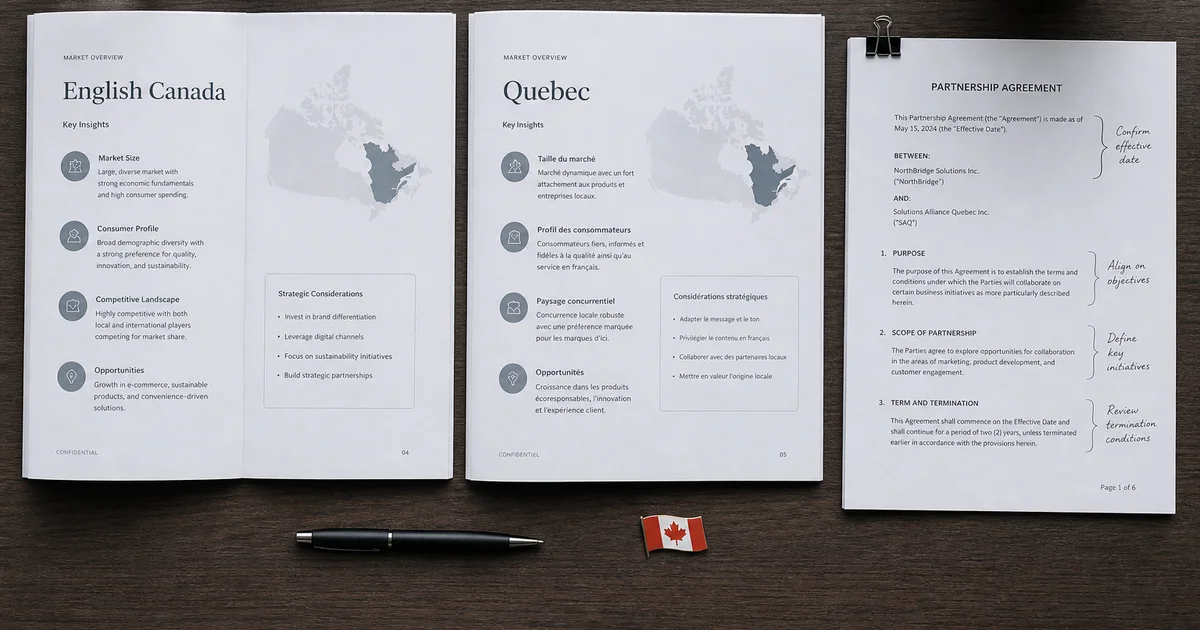
Advertising in Canada means operating in two markets at once. English Canada and French Quebec each have their own dominant media owners, their own regulatory obligations and their own audience measurement conventions. Canada is not a scaled-down version of the United States: prescription drug advertising that is standard practice south of the border is prohibited here, the second-largest broadcaster just completed a lender-led recapitalization, and the cross-platform video measurement the industry has worked toward only launched in late 2025. An advertiser who treats Canada as an extension of a US plan pays for that assumption twice: once in Toronto and once in Montreal.
At a glance
| Topic | Where to go |
|---|---|
| Television and broadcast ownership | Television section below |
| Cross-platform audience measurement | Measurement section below |
| Digital, social and the Online News Act | Digital section below |
| Quebec as a separate market | Quebec section below |
| Print and news media | Print and news section below |
| Radio and audio | Radio and audio section below |
| Out-of-home advertising | Out-of-home section below |
| Regulation by category | Regulation section below |
| Evaluating a media plan | Assessing a plan section below |
| Selecting and managing a media agency | Agency section below |
Market context
Canada had 38.2 million internet users in October 2025, equal to 95.1 percent of the population (DataReportal, Digital 2026 Canada). Digital takes over 80 percent of Canadian ad spend by eMarketer’s estimate, with internet advertising revenue of 18.2 billion Canadian dollars in 2024 (IAB Canada); retail media is among the fastest-growing lines within that figure. The country’s bilingual structure, the recent reshuffling of broadcast ownership, and a regulatory environment with category rules that diverge sharply from those in the United States all make Canada a market that rewards planning built on current, local knowledge. Assumptions carried over from elsewhere tend to be expensive.
Television
The major commercial groups in English Canada are Bell Media (CTV), Rogers (Citytv, Sportsnet) and Corus (Global). In French Canada, Quebecor’s TVA is the ratings leader. CBC/Radio-Canada, the public broadcaster, sells advertising on both TV and digital platforms. A 2025 ministerial proposal to remove advertising from CBC news programming remains a proposal only.
Two structural changes in 2025 and 2026 affect any forward media plan. Warner Bros. Discovery’s lifestyle and factual brands (HGTV, Food Network, Discovery) shifted from Corus to Rogers from 1 January 2025, with Corus rebranding the affected channels. Separately, Corus completed a lender-led recapitalization in 2026 that hands control of Global to its creditors; the CRTC approved the plan in September 2026. Counterparty and inventory questions around Global and the Corus specialty channels deserve explicit attention in any 2027 negotiation.
Rogers became the roughly 75 percent majority owner of MLSE in July 2025, concentrating Canadian sports media and sponsorship leverage within one group. In French Canada, TVA Sports renewed French-language NHL rights for twelve more years in 2026, reinforcing Quebecor’s position in sports.
Measurement
Numeris, the industry-owned joint industry committee, provides TV and radio audience measurement in Canada. Its national cross-platform Video Audience Measurement (VAM) service launched in late 2025, covering linear television, streaming and digital video. Prime Video was the first streamer to subscribe; YouTube and Snapchat followed in 2026. VAM is a meaningful step toward a single cross-platform number, but it is not yet an established trading currency. The measurement basis for each deal still needs to be stated explicitly.
For out-of-home, COMMB is the industry measurement body. Vividata provides readership and consumer data for print and cross-platform planning. Digital campaign reporting is largely platform-reported, which means the distinction between platform-reported figures, third-party-measured figures and modelled figures must be established per platform before a plan is approved.
Digital, social and the online news act
Meta has blocked news links for Canadian users on Facebook and Instagram since August 2023, in response to Canada’s Online News Act, and the block remained in effect through 2026. Meta’s advertising products operate normally. The block affects news publishers’ organic reach and any paid amplification of news content, and local news engagement has fallen sharply as a result. Google was exempted from the Act after agreeing to pay 100 million Canadian dollars annually, distributed through the Canadian Journalism Collective since early 2025.
The CRTC’s June 2024 order requiring large foreign streamers to contribute 5 percent of Canadian revenues never took effect: payments were stayed by the Federal Court of Appeal in December 2024, and in mid-2026 the government confirmed it will scrap the requirement and rework the framework. On pricing: Google introduced a 2.5 percent Canada surcharge on ads in October 2024 to recover the digital services tax, then removed it in July 2025 after Canada rescinded the tax. Pass-through surcharges of this kind belong on any invoice checklist, regardless of whether they are currently active.
Quebec as a distinct market
French-language Quebec operates as its own advertising market. TVA leads television ratings, and the province has its own publishing brands: La Presse operates as a non-profit digital daily, and Le Devoir serves the quality-press segment. The planning consequence is straightforward. Quebec requires its own creative, its own media treatment and its own data and consent practice. A translation of the English-Canadian version is not a Quebec plan.
Since 1 June 2025, under the Charter of the French Language as amended, public signs and commercial advertising must be in French. Other languages are permitted only if French is markedly predominant: at least twice the space in static executions, and displayed twice as long in dynamic signage. Non-French trademarks on exterior signage require French descriptors, and generic terms within trademarks on packaging must be translated. Quebec’s Consumer Protection Act prohibits commercial advertising directed at children under 13. Quebec’s privacy law (Law 25) is fully in force, requiring privacy by default and consent around profiling and targeted advertising, with penalties up to the greater of 25 million Canadian dollars or 4 percent of worldwide turnover.
Print and news
Postmedia, The Globe and Mail and the Toronto Star are the major English-language print and news groups. Local news is in structural decline across the country, a trend aggravated since the Meta news block removed a significant source of referral traffic. Audience claims for print titles should carry a stated source and date; Vividata is the recognised provider of readership and consumer data for this category.
Radio and audio
The commercial radio market sits largely with the major broadcast groups, and Numeris provides the audience measurement that underlies buying in this channel, as it does for television. Spoken-word audio and podcast formats are growing alongside traditional broadcast radio. The same principle applies here as elsewhere: the measurement basis for any audio claim should be stated per platform or format.
Out-of-home
Out-of-home has been one of the growing channels in the Canadian market, with digital formats leading the expansion. COMMB provides the industry measurement standard. As with every other channel in Canada’s current measurement environment, the measurement basis should be stated explicitly for each deal rather than assumed.
Regulation by category
Canada’s regulatory framework has several category rules that differ materially from those in neighbouring markets, particularly the United States.
Cannabis. Cannabis is legal, but the Cannabis Act prohibits most promotion: no lifestyle advertising, no testimonials, no youth appeal and no sponsorship, with narrow informational exceptions in age-gated contexts.
Prescription drugs. Direct-to-consumer advertising of prescription drugs is prohibited. Only name, price and quantity, or unbranded help-seeking advertising, are permitted. Health Canada enforces this rule. The contrast with the United States, where branded DTC advertising is standard, is sharp and operationally significant for any cross-border plan.
Gambling. Ontario’s regulated iGaming market opened in April 2022. Its standards ban athletes and celebrities likely to appeal to minors from iGaming advertising, with that restriction in force since 28 February 2024. Alberta opened the second regulated provincial market on 13 July 2026, with its own advertising standards. Rules differ per province.
Alcohol. Broadcast advertising must comply with the CRTC code, with Ad Standards preclearance and provincial liquor board rules applying on top.
Advertising to children. Quebec’s Consumer Protection Act prohibition on commercial advertising directed at children under 13 is noted above. At the federal level, a bill targeting food advertising to children died with the January 2025 prorogation; the industry currently operates under the Ad Standards children’s food advertising code.
Privacy and electronic messaging. PIPEDA applies federally. Its proposed successor, Bill C-36, was tabled in June 2026 with penalties up to the greater of 10 million dollars or 3 percent of global revenue; it is not yet law. CASL requires consent for commercial electronic messages.
This article provides orientation, not legal advice. Rules change, and local legal verification is required before any campaign goes live.
Assessing a media plan for Canada
When reviewing a plan presented for the Canadian market, six questions are worth pressing on explicitly.
First, which measurement basis does each video claim rest on? VAM launched only in late 2025, and the measurement basis per deal still needs to be stated rather than assumed.
Second, do the plan’s TV counterparties reflect the post-recapitalization and post-realignment ownership map? The Corus lender-led recapitalization, the shift of Warner Bros. Discovery brands to Rogers, and Rogers’ majority ownership of MLSE all changed the landscape in 2025 and 2026.
Third, does the Quebec leg have its own creative, media and consent treatment? A translated English creative is not a Quebec plan.
Fourth, are digital figures identified as platform-reported, third-party-measured or modelled? The answer changes what the numbers mean.
Fifth, are pass-through platform surcharges itemised? The Google Canada surcharge appeared and disappeared within twelve months; the next one may not.
Sixth, are category rules cleared for all markets in the plan? Cannabis, prescription drugs, provincial gambling standards and Law 25 consent each carry their own compliance requirements, and they do not all map neatly to what applies in the rest of North America.
Finding and managing a media agency in Canada
Agency selection in Canada raises two questions that do not arise with the same force elsewhere. The first is two-market capability: genuine English-Canada and Quebec capability, with proof of both. The second is counterparty fluency in a broadcast landscape that has been substantially reshuffled within the past two years. The ACA publishes a media agency contract best-practice guide covering transparency, remuneration and audit rights. The principal-trading debate documented in the United States applies to the same holding companies operating in Canada, and it warrants the same contractual attention here.
For the full selection process, criteria and contract questions specific to this market, see How do you select and manage a media agency in Canada?
Frequently asked questions
Who measures audiences in Canada? Numeris is the industry-owned joint industry committee responsible for TV and radio audience measurement. Its cross-platform Video Audience Measurement (VAM) service, covering linear, streaming and digital video, launched in late 2025. COMMB provides measurement for out-of-home, and Vividata provides readership and consumer data for print and magazines.
How is advertising in Quebec different from the rest of Canada? Quebec operates as a distinct market with its own dominant media owners, language rules under the Charter of the French Language, a provincial prohibition on advertising to children under 13, and a fully enforced privacy law (Law 25) with significant penalties. Creative, media and data practice all require a Quebec-specific version rather than a translation of the English-Canadian approach.
What advertising rules should I know before planning a campaign in Canada? Key category rules include: a near-total ban on cannabis promotion; a prohibition on direct-to-consumer prescription drug advertising; provincial iGaming advertising standards that restrict the use of athletes and celebrities in Ontario and Alberta; CRTC and provincial rules on alcohol advertising; and CASL consent requirements for commercial electronic messages. Law 25 in Quebec and PIPEDA federally govern privacy and targeted advertising.
Why is Meta’s news block relevant for advertisers? Since August 2023, Meta has blocked news links for Canadian users on Facebook and Instagram in response to the Online News Act. Meta’s paid advertising products are unaffected, but organic news publisher reach has fallen sharply, and any paid amplification of news content reaches a smaller audience than before the block. Advertisers planning content or influencer campaigns that touch news topics should factor this into distribution assumptions.
Vendor-MGT works with advertisers on agency selection, media audits and ongoing vendor management in Canada, independently and on the advertiser’s side. Agree the measurement basis before the plan is approved, know who owns the media you are buying after a year of reshuffling, treat Quebec as a market rather than a translation, and verify rather than trust. For questions about how we work, visit vendor-mgt.com.