 United States
In this article
Advertising in the United States takes place in the world’s largest media market and the one with the most publicly documented transparency debate. Television and streaming are in structural transition, digital channels absorb roughly four in five ad dollars, measurement is genuinely contested across television and digital alike, and the advertiser community has produced an unusually detailed record of rebates, programmatic waste and principal trading. Nowhere is more verification infrastructure available to an advertiser, and nowhere is it more necessary.
At a glance
| Topic | Where to find it |
|---|---|
| Market size, political spend and agency consolidation | Market context |
| Television, streaming and connected TV | Television and streaming |
| Audience measurement and currency choices | Audience measurement |
| Digital, search and programmatic | The digital ecosystem |
| Audio: radio and podcasts | Audio channels |
| Newspapers and print publications | Print media |
| Outdoor and digital out-of-home | Out-of-home media |
| Federal, state and category rules | Regulation |
| Rebates, principal trading and supply-chain transparency | Buying structure and transparency |
| Questions to press when reviewing a plan | Assessing a plan |
| Selecting and managing a US media agency | Finding and managing a media agency |
Market context
The United States counted 324 million internet users at the end of 2025, equal to 93.1 percent of the population (DataReportal, Digital 2026 United States). Roughly four in five US ad dollars go to digital channels (eMarketer), and retail media is among the fastest-growing spend lines, with Amazon accounting for the large majority of it.
The 2026 midterm elections are a live planning variable. AdImpact projects roughly 11.6 billion dollars in political advertising this cycle, a midterm record, which tightens fourth-quarter broadcast inventory in battleground markets. Advertisers planning broadcast-heavy schedules in competitive states during the second half of 2026 should factor that scarcity into buying strategy early.
Agency consolidation reached a structural milestone when Omnicom completed its acquisition of Interpublic in November 2025, creating the world’s largest marketing services holding company. The degree of concentration is directly relevant to principal trading exposure, addressed below under buying structure and transparency.
Television and streaming
Television accounts for a significant share of US ad spending, and the channel is in structural transition. In May 2025, streaming for the first time exceeded broadcast and cable combined in Nielsen’s The Gauge, with YouTube the largest single streaming platform on US TV screens. Amazon and Netflix have both scaled ad-supported tiers to tens of millions of monthly users, and connected TV routes much of that inventory through programmatic pipes.
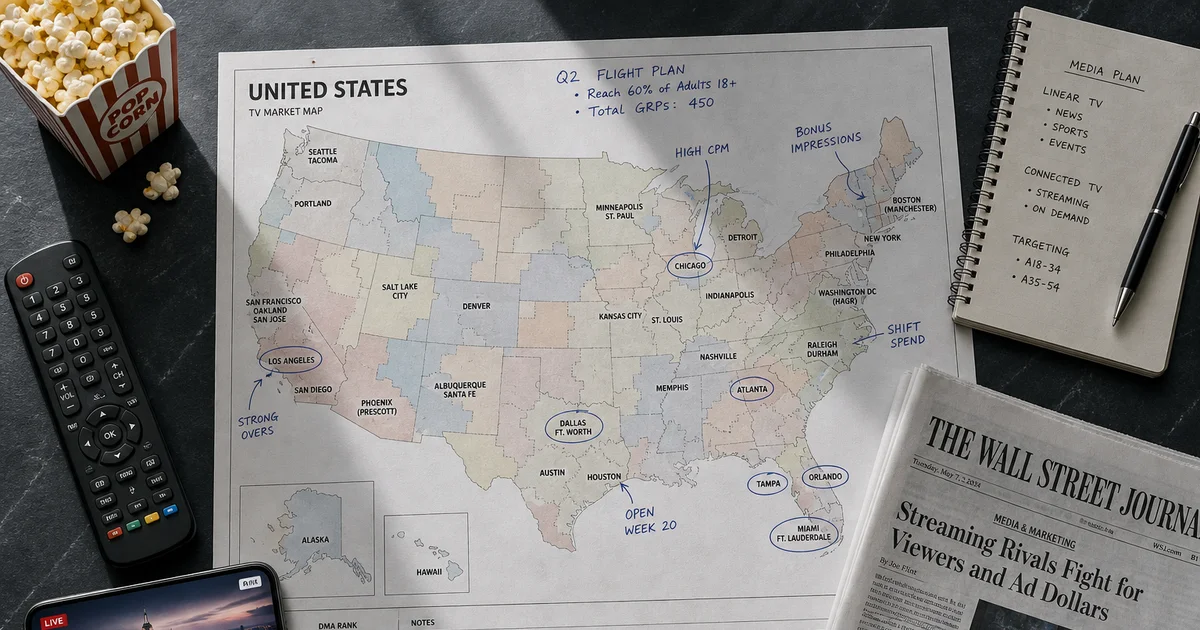
The US is also a multi-local market: television is divided into 210 Nielsen-defined local markets (DMAs), led by New York, Los Angeles and Chicago, with national network buying sitting alongside local spot buying through station affiliates. Local pricing varies widely by market, national and spot inventory carry different benchmarks, and record political demand lands precisely on local broadcast inventory. Radio is likewise measured and bought market by market. Plans that mix national and local money need both evidenced on their own basis.
Audience measurement
Nielsen remains the dominant national TV currency. Its Big Data plus Panel national measurement received MRC accreditation in January 2025. Alternative currencies occupy a secondary role: the US Joint Industry Committee, formed in 2023 by major programmers and OpenAP, certified Comscore, iSpot and VideoAmp, and re-certified all three in September 2026 for the 2026 to 2028 term.
Currency friction is documented. Paramount dropped Nielsen over pricing in late 2024 before agreeing a new multiyear deal in February 2025. The practical consequence for an advertiser is that the measurement basis for any television or connected TV deal is now a negotiable contract matter. State the chosen currency per deal and hold it consistent across planning and post-analysis. Inconsistency between the planning currency and the post-analysis currency is among the most common sources of inflated reported performance in US television.
The digital ecosystem
Digital is the dominant channel, but its transparency is uneven. Google abandoned cookie deprecation in Chrome; a federal court found Google liable for monopolising publisher ad servers and exchanges in April 2025, with behavioural remedies imposed in September 2026 and final judgment still pending. TikTok moved to a US-controlled joint venture in January 2026 and remains available to advertisers. Platform-reported, third-party-measured and modelled figures must be distinguished per platform.
Audio channels
Radio and podcasts remain meaningful reach channels. Nielsen Audio measures radio through electronic meters in large markets and diaries in others. Podcasts follow IAB measurement guidelines with third-party certification, though methodology and comparability across shows vary. Audio’s strength lies in contextual targeting and local reach; its limitation is measurement depth relative to digital.
Print media
Print newspapers are a small and declining advertising channel in the US, though audience claims for surviving titles vary significantly in source and date. Titles audited by the Alliance for Audited Media offer a verifiable readership baseline. For campaigns targeting specific geographic communities or credibility-sensitive environments, print retains selective relevance.
Out-of-home media
Out-of-home advertising spans traditional billboards, transit, street furniture and rapidly growing digital formats. Geopath provides the standard audience measurement methodology for the channel. In March 2026, Geopath and the OAAA selected Ipsos to pilot a next-generation measurement system, with transition planned from 2027. During that transition, the measurement basis per deal should be stated explicitly in contracts rather than assumed.
Regulation
US advertising regulation operates at federal and state levels simultaneously, and category-specific rules add a third layer.
At the federal level, the Federal Trade Commission enforces against deceptive advertising across all media and categories. Its revised Endorsement Guides, updated in June 2023, apply directly to influencer and affiliate arrangements, and its rule against fake reviews and testimonials has been in force since October 2024. The FCC regulates broadcast, including children’s television advertising limits and political file requirements, and state attorneys general are active enforcers.
There is no comprehensive federal privacy law. Around 20 states have comprehensive consumer privacy laws, most in effect by the end of 2026, led by California’s CCPA and CPRA with a dedicated regulator and opt-outs of sale and sharing; sensitive-data targeting such as health and precise location is an active enforcement area. The updated COPPA rule, fully in force since April 2026, requires opt-in parental consent for targeted advertising to children under 13, and a wave of state age-verification and minor-safety laws further constrains targeting minors. Campaigns that use behavioural data must be reviewed against the applicable state frameworks for every market where the campaign runs.
Category-specific restrictions apply to alcohol, pharmaceuticals, financial products, gambling, political advertising and children’s advertising, among others. Political advertising disclosure requirements differ by state and by medium. Direct-to-consumer prescription drug advertising is legal and regulated by the FDA, subject to fair balance requirements; in September 2025 the administration announced an enforcement push against misleading drug ads and planned rulemaking to tighten broadcast risk disclosure, which had not been formally proposed as of late 2026. Alcohol is self-regulated under industry codes, and sports betting is legal state by state with varying advertising rules, with a federal bill restricting gambling advertising proposed but not passed. There is no federal AI-content labelling law for advertising; the FTC enforces against deceptive AI claims. Advertisers in regulated categories should confirm compliance requirements at the briefing stage, before creative is developed. This article provides orientation, not legal advice. Rules change, and local legal verification is required before any campaign goes live.
Buying structure and transparency
The US transparency debate is unusually well documented by the advertiser side. The ANA’s 2016 independent study found non-transparent practices, including cash rebates, to be pervasive in the US media-buying ecosystem. Its 2023 programmatic transparency study found that only about 36 cents of every dollar entering a demand-side platform effectively reaches the consumer, with made-for-advertising websites accounting for about a fifth of impressions and roughly 15 percent of spend. Its 2024 report on principal media documented the rapid growth of principal-based buying, in which agencies resell inventory they own rather than act as agents, and its 2026 benchmark found the practice touching over half of media budgets, concentrated in television. Those practices have not disappeared.
Omnicom’s acquisition of Interpublic concentrates a substantial share of US media spending within a single holding structure. That concentration increases the importance of clear contractual terms around inventory sourcing, principal trading and rebates.
Three contractual provisions reduce principal trading exposure: a requirement that the agency buys as agent on the advertiser’s behalf, explicit disclosure of any principal inventory the agency proposes, and an audit right covering all media expenditure. Programmatic supply chains carry their own verification burden. MFA (made-for-advertising) inventory, undisclosed reselling and domain spoofing are documented risks in US programmatic markets. Supply-path optimisation and a pre-approved supply list are reasonable baseline requirements for any programmatic programme.
Assessing a plan
A credible US media plan should specify the measurement currency for each channel, particularly for television and connected TV. It should distinguish between platform-reported and third-party-verified reach and frequency figures for digital. It should identify whether any inventory is sourced on a principal basis. And it should account for the impact of the 2026 midterm cycle on broadcast availability and pricing in the relevant markets.
Plans that cannot answer these questions by channel are not ready for approval.
Finding and managing a media agency
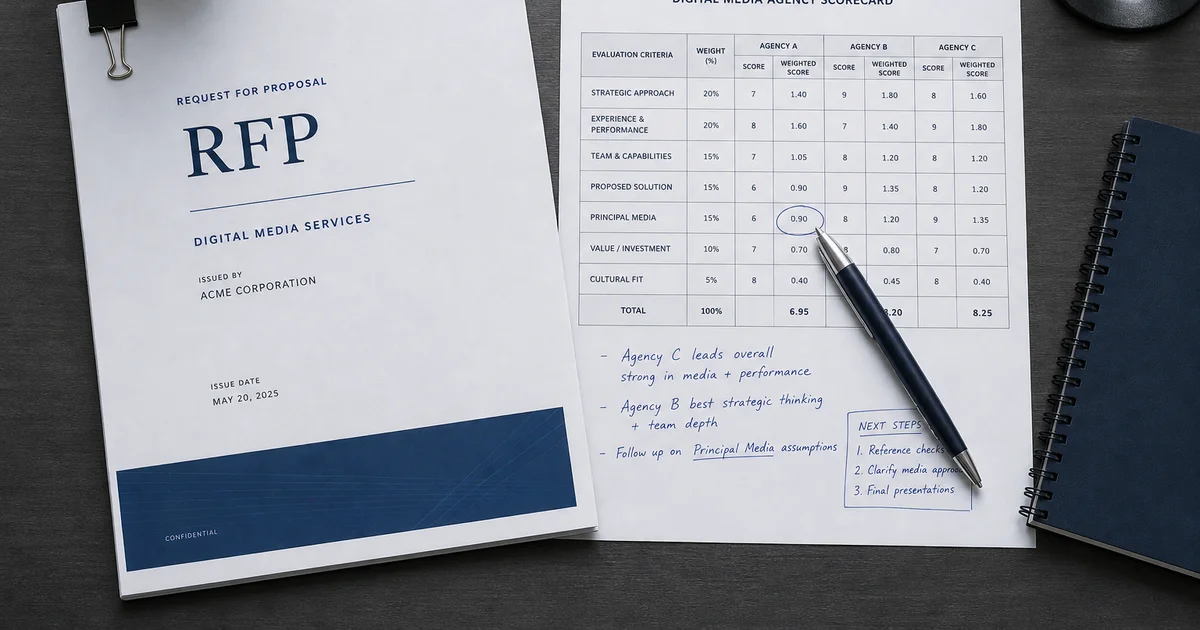
Selecting a US media agency is a structured process. The typical timeline runs from ten to sixteen weeks between the decision to go to market and contract signature, with a further four to eight weeks for transition before the agency is operational. The ANA and the 4A’s both publish process guidance for agency reviews. Advertisers new to the US market, or those reconsidering existing arrangements in the context of the Omnicom-Interpublic consolidation, will find how to select and manage a media agency in the United States a useful starting point for structuring the process. For a broader perspective on agency selection methodology, the media agency selection practice area covers the process independent of geography.
Frequently asked questions
What share of US ad spending goes to digital channels? Roughly four in five US ad dollars go to digital channels, according to eMarketer. Retail media is among the fastest-growing components of that share, with Amazon accounting for the large majority of retail media revenue. The remainder is distributed across television, audio, print and out-of-home.
How does the 2026 midterm election cycle affect media buying? AdImpact projects approximately 11.6 billion dollars in political advertising during the 2026 midterm cycle, a midterm record. Political spend competes directly for broadcast inventory in battleground markets. Advertisers with fourth-quarter broadcast schedules in competitive states should plan for constrained availability and higher prices, and should secure inventory earlier than in a non-election year.
What is the current status of TV measurement in the US? Nielsen remains the dominant national currency following MRC accreditation of its Big Data plus Panel system in January 2025. The US Joint Industry Committee has certified Comscore, iSpot and VideoAmp as alternative currencies, re-certified in September 2026. The measurement basis for each television or connected TV deal is now a contract negotiation matter, not a default assumption.
How should advertisers respond to the Omnicom-Interpublic merger? The merger, completed in November 2025, created the world’s largest marketing services holding company. Advertisers whose agency relationships sit within either holding company should review their contracts for principal trading terms, audit rights and rebate disclosure provisions. Concentration at the holding company level does not change the advertiser’s legal rights, but it does increase the importance of exercising them.
Closing
Advertising in the United States rewards preparation. The market’s scale, its contested measurement environment, its documented transparency issues and its political advertising cycles all create conditions where an uninformed buyer pays more and measures less accurately than an informed one. Agree the measurement currency and its dates before the plan is approved, know whether your inventory is bought by an agent or sold by a principal, and verify rather than trust. Canada offers a useful comparison market for advertisers operating across North America, and is covered separately within this series. Vendor-MGT works with advertisers in the United States on agency selection, media audits and ongoing vendor management, independently, on the advertiser’s side.