 United States
In this article
Selecting a media agency in the United States follows the same discipline as any structured review: a clear brief, a scored pitch, and a contract that protects your commercial position. What makes the US market distinct is that the risks are on the record. Advertiser-side studies have measured pervasive rebates, programmatic waste, and the growth of principal trading. The holding-company market became more concentrated with the completion of the Omnicom and Interpublic merger in November 2025. US advertisers do not have to guess what can go wrong. The record is public, and the contract can be written against it.
This article sets out what to test in the pitch, what the contract must fix, and how to manage the relationship after appointment. If you want a step-by-step overview of how a structured review works in general, The media agency selection process, step by step covers the mechanics from brief to appointment. For context on the broader US advertising environment, see Advertising in the United States: the media landscape.
What to test US agency candidates on during the pitch
A structured selection process in this market should probe four areas in writing, with each candidate answering on the record.
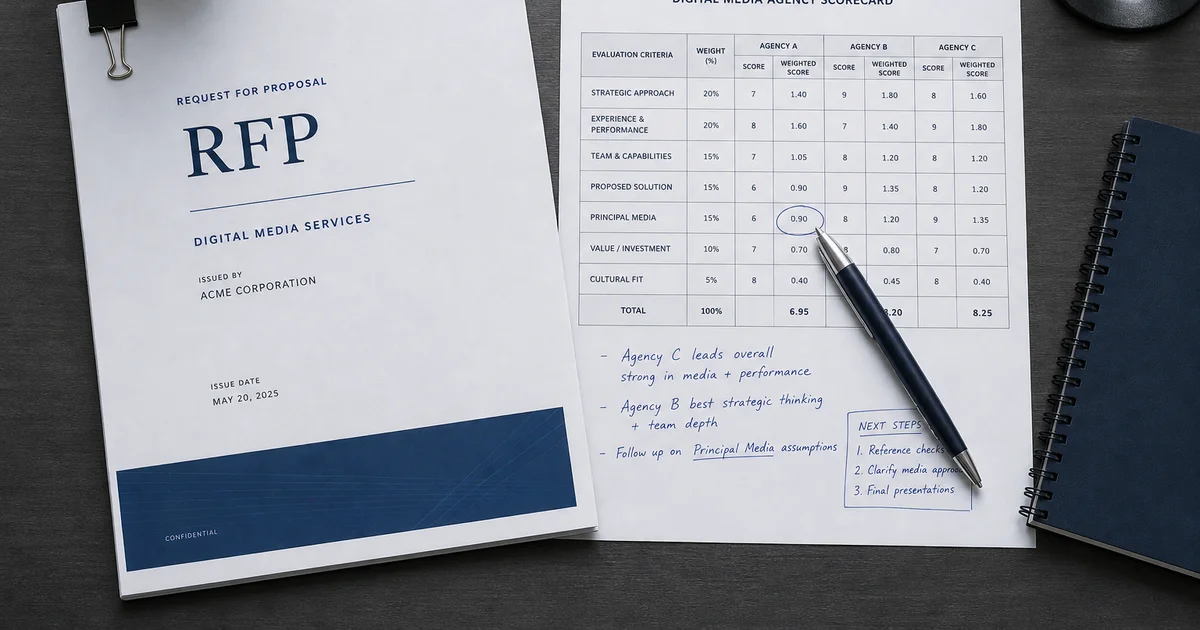
The first is agent versus principal. The ANA’s 2024 report on principal media documented the rapid growth of principal-based buying, in which agencies resell inventory they own rather than act as your agent. Conflicts of interest, audit rights, and opacity were central to the findings. The ANA’s 2026 benchmark found the practice touching over half of media budgets, concentrated in television. Ask every candidate which inventory it or its group would sell to you as principal, how principal positions are disclosed, priced, and benchmarked against agent-bought equivalents, how rebates and incentives are treated, and whether it accepts audit rights that reach group level. In the most consolidated holding-company market in the world, this is the first sorting question.
The second is programmatic supply-chain discipline. The ANA’s 2023 programmatic transparency study found that only about 36 cents of every dollar entering a demand-side platform effectively reaches the consumer. Made-for-advertising websites accounted for roughly a fifth of impressions. Ask candidates for log-level data access, inclusion lists rather than open exchange buying by default, named fees at every hop in the supply chain, and a clear explanation of how made-for-advertising inventory is excluded. Ask also how the remedies emerging from the Google ad-tech antitrust case are tracked as they continue to reshape the exchange landscape.
The third is measurement currency discipline. Nielsen’s Big Data plus Panel measurement, MRC-accredited since January 2025, is the dominant national television currency. The US Joint Industry Committee has certified Comscore, iSpot, and VideoAmp through 2028. Streaming exceeded broadcast and cable combined in 2025, so connected television carries a growing share of television budgets. Ask candidates which currency each deal trades on, how planning and post-analysis stay on the same basis, how CTV reach and frequency are deduplicated, and whether digital figures are platform-reported, third-party-measured, or modelled. For plans with fourth-quarter 2026 weight in battleground states, ask directly how record political demand is handled in pricing and inventory availability.
The fourth is compliance capability. Approximately 20 states have comprehensive privacy laws, led by California, with no federal equivalent. Sensitive-data targeting is an active enforcement area. The updated COPPA rule, fully in force since April 2026, requires opt-in parental consent for targeted advertising to children under 13. The FTC’s Endorsement Guides and its fake-reviews rule, in force since October 2024, govern influencer and review content. Sports betting advertising rules vary state by state. Ask every candidate who owns compliance for your specific category and how state-by-state variation is managed in targeting and creative clearance.
What the US media agency contract must pin down
A well-drafted contract in this market is not a formality. It is the mechanism through which the commercial risks identified in the pitch become enforceable obligations. Four areas must be addressed in writing.
First, agent versus principal: a declaration per channel of what is bought as your agent and what is sold to you as principal, disclosure and benchmarking rules for principal positions, full rebate and incentive transparency, and audit rights that extend to group level.
Second, supply-chain transparency: log-level data rights, named fees at every hop in the programmatic chain, made-for-advertising exclusion standards, and the right to commission independent programmatic audits without requiring the agency’s prior approval.
Third, the measurement basis per deal: the named currency for each television and CTV deal, consistency between the planning basis and post-analysis methodology, and a requirement that digital figures are clearly labelled as platform-reported, third-party-measured, or modelled.
Fourth, compliance allocation: named responsibility for state privacy obligations, COPPA and minors’ rules as they apply to targeting, endorsement and review compliance under the FTC rules, and clearance procedures for regulated categories.
These four areas reflect the specific documented risks in this market. A contract that leaves any of them to verbal understanding is a contract that will be tested.
Managing the agency relationship after appointment
Appointment is the beginning, not the end, of the commercial relationship. How the ongoing management is structured determines whether the contractual protections hold in practice.
Agree performance yardsticks before the contract is signed, with the measurement bases and currencies written into the agreement. If the benchmarks are not fixed at the outset, they will be contested when performance is reviewed. That is a conversation worth avoiding.
Review principal-position declarations and rebate disclosures at each major buying cycle, not annually. Re-run programmatic supply-chain checks at least once a year. The supply chain changes, new intermediaries appear, and inclusion lists that were clean at the start of the year may not be clean at the end of it.
Ongoing reviews should recognise outperformance as readily as they identify shortfalls. An agency that receives only corrective feedback has less commercial incentive to bring you its best thinking. For advertisers who want a structured framework for this, Vendor management: keeping the promise after the pitch sets out how to run the relationship systematically over time.
Advertisers who operate across multiple markets may also find that US contract terms inform what is achievable elsewhere. The documentation of principal trading and programmatic waste in the United States is among the most detailed in the world, and the contractual remedies developed here often travel.
Running a US media agency selection with independent support
For advertisers planning a media agency selection in the United States, Vendor-MGT runs agency selections and pitches independently, on the advertiser’s side. A well-structured process in this market typically runs ten to sixteen weeks from the decision to review to contract signature, with the agency transition adding a further four to eight weeks. The time investment is significant. But a longer runway produces a better result: it gives the commercial negotiations the room they need and strengthens your position on the issues that matter most in this market.
The Pitch describes how Vendor-MGT structures an independent agency selection, from brief through scored pitch to signed contract.
Frequently asked questions
What should a media agency contract in the United States cover? A US media agency contract should cover four areas: agent-versus-principal declarations per channel with benchmarking and audit rights to group level; supply-chain transparency including log-level data rights and named fees at every hop; the named measurement currency for each television and CTV deal; and compliance allocation for state privacy laws, COPPA, FTC endorsement rules, and category-specific clearances.
What should I test US agency candidates on during a pitch? Test every candidate in writing on four areas: their agent-versus-principal practice and how principal positions are disclosed and benchmarked; programmatic supply-chain discipline including log-level data access and made-for-advertising exclusion; measurement currency for each channel and how planning and post-analysis are kept consistent; and compliance capability for state privacy obligations, COPPA, and the FTC’s Endorsement Guides and fake-reviews rule.
What is principal media and why does it matter in the United States? Principal media is a buying practice in which an agency purchases inventory on its own account and resells it to the advertiser, rather than acting as the advertiser’s agent in the open market. The ANA’s 2024 report on principal media documented the rapid growth of this practice, with the 2026 benchmark finding it touching over half of media budgets in the United States, concentrated in television. It matters because the agency’s commercial interest in selling its own inventory can conflict with the advertiser’s interest in the best available deal, and because standard audit rights may not reach the group-level positions where the inventory originates.