 Malaysia
In this article
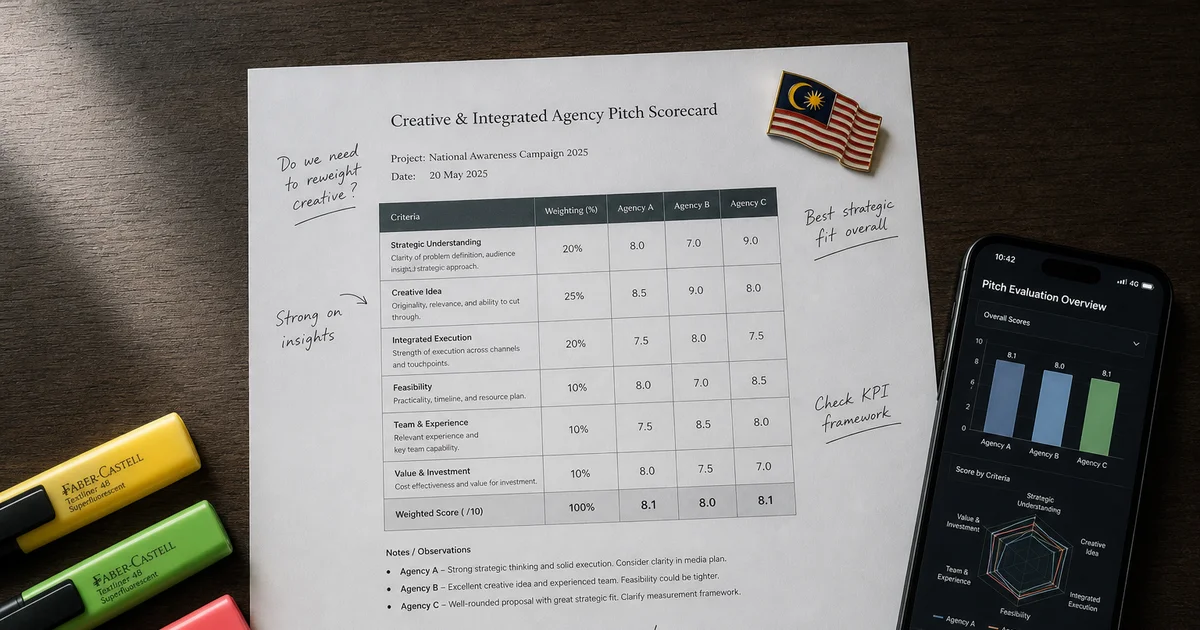
Selecting a media agency in Malaysia follows the same discipline as any structured agency review: a clear brief, a scored pitch process, and a contract that protects the advertiser’s interests. What changes in Malaysia is what you test candidates on and what the contract must pin down to reflect the specific commercial, regulatory, and measurement realities of this market. This article covers exactly that. For the universal process, including process durations and pricing guarantees, refer to The media agency selection process, step by step.
What to test Malaysian agency candidates on
A pitch that does not probe the local specifics will not surface the differences that matter. Four test areas are essential when selecting a media agency for Malaysia.
TV and audience measurement
Malaysia operates two parallel television measurement systems. Nielsen runs an industry panel covering free-to-air and pay TV. Astro has commissioned separate Kantar measurement for its own subscriber base. The two systems produce different audience figures for overlapping dayparts and demographics, and the two broadcasters’ sales teams operate independently against their respective currencies.
Ask every candidate which measurement system underpins each plan they submit, how they buy across both sales operations, and how they would handle a transition if the industry’s Single Audience Measurement framework is adopted during the contract term. A vague answer here is a red flag.
Language and geography
Malaysia’s advertising landscape spans Malay, English, Chinese, and Tamil language ecosystems, each with distinct media channels, audience behaviours, and creative conventions. Ask candidates which specialist planning resources they deploy per ecosystem and how those resources are structured internally. Not as a box-ticking exercise, but to understand whether genuine multi-language capability exists or whether one language receives less rigour than the others.
East Malaysia is a separate planning challenge. Sabah and Sarawak have different media consumption patterns, distinct language communities, and their own regulatory context. An agency that plans only for the Peninsula is not planning for Malaysia.
Digital and retail media
Platform self-reported figures and independently verified figures are not the same thing. Ask candidates which numbers in their digital plans are independently validated and which are taken directly from platform dashboards. Malaysia’s retail media landscape, Shopee, Lazada, TikTok Shop, has grown rapidly, and spend flowing into these environments must be visible in reporting with the same transparency standards applied to conventional display and video. Candidates should also be able to describe their working practice under the amended Personal Data Protection Act.
Regulatory compliance
Malaysia’s compliance requirements are substantive, established national policy, and non-negotiable. Ask candidates for their documented track record on the following: Medicine Advertisements Board approvals, with the KKLIU number displayed in all applicable materials; alcohol advertising restrictions, including the requirement that alcohol communication must not be directed at Muslims; the full tobacco and vape advertising ban under the Control of Smoking Products for Public Health Act 2024; Bahasa Malaysia requirements in outdoor media, which apply across DBKL-controlled sites and beyond; and Ramadan planning capability, where scheduling and messaging conventions differ materially from the rest of the year. The Advertising Standards Authority Malaysia and the Content Forum both play roles in enforcement. Agencies that treat compliance as an afterthought create liability for the advertiser.
What a Malaysian agency contract must pin down
The pricing guarantees and contractual protections covered in The media agency selection process, step by step apply here in full. Malaysia adds three local specifics that the contract must address explicitly.
Measurement currency per channel, with a migration clause
Name the measurement system that governs each channel in the contract. Because Malaysia is actively building a unified industry currency through the Single Audience Measurement framework, include a clause that specifies how reporting obligations and performance benchmarks are adjusted if that framework is adopted mid-contract. Without this clause, a measurement transition creates an ambiguity that favours the agency.
Net pricing, rebate treatment, and audit rights
Monitored market figures in Malaysia are largely rate-card based. Net prices, after discounts, bonuses, and rebates, can differ materially from published figures. The contract must state how all forms of commercial consideration are treated and must include enforceable audit rights. These rights are not a statement of distrust. They are the mechanism by which the advertiser can verify the value they are receiving. Agencies that resist audit rights deserve scrutiny.
Allocated compliance responsibility
Pre-approvals, category-specific rules, language requirements, and documentation processes must be assigned to a named party with a clear process. Shared responsibility for compliance is, in practice, no responsibility at all. If a Medicine Advertisements Board submission is late or a Bahasa Malaysia requirement is missed, the contract must make clear where accountability sits.
Managing the Malaysian agency relationship after appointment
Appointment is the beginning of the working relationship, not its conclusion. The standards by which the agency will be assessed should be agreed in advance and signed by both sides before the first campaign brief is issued. A periodic review structured around those agreed standards can surface outperformance just as readily as it can identify underdelivery. An agency that welcomes that scrutiny is generally a better long-term partner than one that does not.
Trust is a reasonable foundation. Verification is better, and it is better for both sides: it gives the agency a clear mechanism to demonstrate performance, and it gives you the oversight that your organisation’s governance requires.
For markets beyond Malaysia, a multi-market agency selection is a different exercise with its own considerations, covered elsewhere on the site for those managing media landscapes across Southeast Asia.
How Vendor-MGT supports agency selection in Malaysia
Vendor-MGT runs agency selections and pitches for advertisers, independently and on the advertiser’s side, including for Malaysia briefs. If you are in or approaching an agency review, get in touch to discuss how we structure that process.
Frequently asked questions
What should a media agency contract in Malaysia cover? The contract should name the measurement currency per channel, with a clause covering how benchmarks adjust if the unified Single Audience Measurement framework is adopted mid-term. It should state net pricing with the treatment of discounts, bonuses, and rebates, and include enforceable audit rights. Compliance responsibility must be allocated explicitly, covering KKLIU approval processes, alcohol and tobacco advertising rules, Bahasa Malaysia requirements, and pre-approval documentation.
What should I test Malaysian agency candidates on during a pitch? Test candidates on four areas: which measurement system underpins each TV plan and how they manage the two separate sales operations; how they plan across the Malay, English, Chinese, and Tamil language ecosystems and whether they cover East Malaysia; how they distinguish independently verified digital figures from platform self-reported data, and how retail media spend on Shopee, Lazada, and TikTok Shop is reported; and their documented compliance track record across category rules, KKLIU approvals, and language requirements.
Should I use a local Malaysian agency or an international network? There is no universal answer. What matters is demonstrable buying clout with both the Nielsen-measured free-to-air camp and the Astro-Kantar camp, genuine multi-language planning capability that includes East Malaysia, and documented Malaysian regulatory compliance capability. A well-structured selection process is designed to test exactly those factors. Whether a local independent or an international network scores better on them depends on the candidates in the room, not on the category they belong to.