 Canada
In this article
- What makes selecting a media agency in Canada different
- Four areas to test Canadian agency candidates on
- Two-market capability
- Counterparty fluency in a reshuffled landscape
- Measurement fluency
- Compliance capability
- What the Canadian agency contract must pin down
- Managing the agency relationship after appointment
- Running a Canadian pitch with independent support
- Frequently asked questions
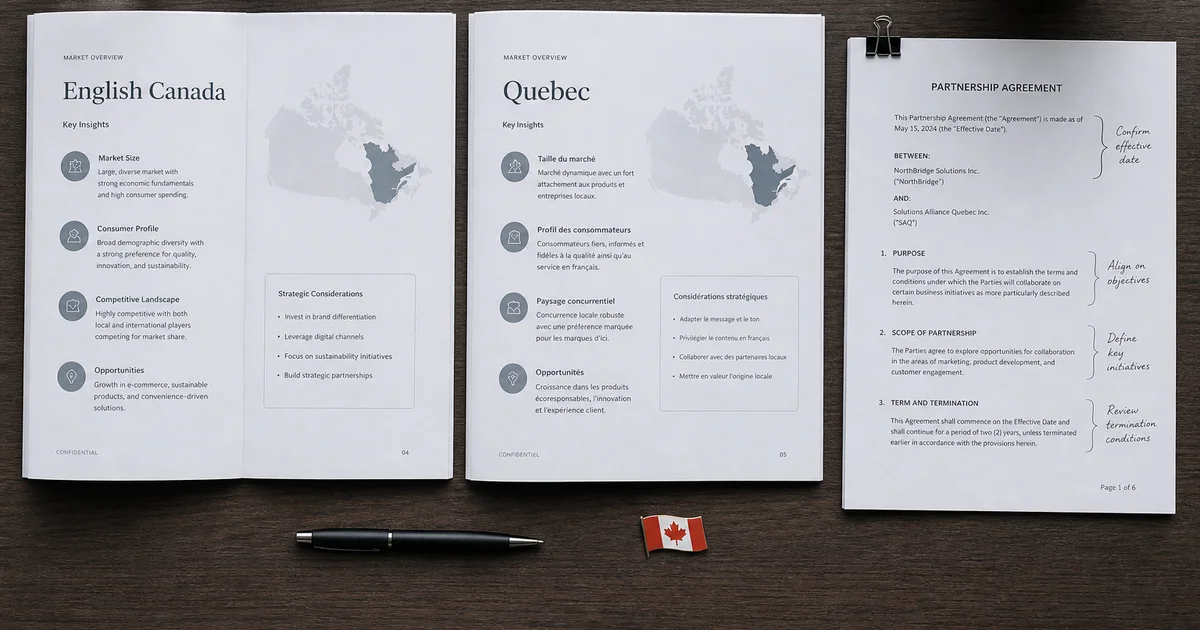
Selecting a media agency in Canada follows the same discipline as any structured review: a clear brief, a scored pitch, and a contract that protects your commercial position. What distinguishes the Canadian process is that you are effectively appointing for two distinct markets at once. English Canada and Quebec, each with its own rules, ownership dynamics, and regulatory baseline, in a year when the broadcast ownership map has been redrawn, cross-platform measurement only just launched, and regulatory requirements shift province by province. The pitch must test for all of it. The contract must hold it.
This article takes you through what to test, what to contract for, and how to manage the relationship once the appointment is made. For the structural mechanics of running a pitch, the guide The media agency selection process, step by step covers the process in full. The sections below focus on what is specific to Canada.
What makes selecting a media agency in Canada different
Canada is not one advertising market with a French-speaking province attached. Quebec operates under distinct language legislation, its own consumer protection rules, its own privacy law, and a separate media ownership structure anchored by Quebecor. An agency that plans Quebec as a translated copy of the English-Canada plan is the single most common failure mode in this market.
Broadcast ownership across English Canada has also shifted materially. Corus, owner of Global, completed a lender-led recapitalization in 2026 that transfers control to its creditors, approved by the CRTC in September 2026. The Warner Bros. Discovery lifestyle brands moved from Corus to Rogers in January 2025. Rogers became majority owner of MLSE in July 2025, concentrating sports media and sponsorship leverage in one holding group. These changes affect who your agency is actually negotiating with, and at what leverage.
For a broader view of the Canadian media landscape, the page Advertising in Canada: the media landscape provides the structural context behind each of these channels.
Four areas to test Canadian agency candidates on
Two-market capability
Ask every candidate for its dedicated Quebec team, Quebec client references, and its documented compliance process for the province. French-language advertising must be in French or with French markedly predominant, under rules tightened in June 2025. Commercial advertising directed at children under 13 is prohibited in Quebec. Quebec’s Law 25 imposes consent requirements around profiling and targeted advertising, with penalties up to the greater of 25 million Canadian dollars or four percent of worldwide turnover.
Ask how strategy, creative adaptation, and consent management differ between the two markets in practice, not in principle. The distinction matters.
Counterparty fluency in a reshuffled landscape
Ask candidates to map their trading deals onto the current ownership structure. What leverage do they actually hold with Bell, Rogers, the recapitalized Corus, and Quebecor? How are sports properties priced against the concentration that Rogers now controls through MLSE? An agency whose negotiating position is built on a pre-2025 ownership map is working from outdated assumptions. That gap costs money.
Measurement fluency
Numeris provides television and radio measurement in Canada. Its national cross-platform Video Audience Measurement (VAM) launched in late 2025, with Prime Video, YouTube and Snapchat among subscribers. VAM is a meaningful step toward a single cross-platform number, but it is not yet an established trading standard.
Ask candidates which basis each video claim rests on and how they bridge linear and streaming figures in the meantime. Ask whether digital numbers are platform-reported, third-party-measured, or modelled. Ask how out-of-home claims relate to COMMB measurement, and whether pass-through platform surcharges, such as the Google Canada surcharge that applied from October 2024 to July 2025, are itemised on invoices. These are not pedantic questions. They determine whether you can compare one agency’s numbers to another’s.
Compliance capability
The Canadian regulatory environment is category-specific and province-specific. Meta has blocked news links for Canadian users since August 2023, which changes reach planning and brand-adjacency decisions around news content. Cannabis promotion is severely restricted. Direct-to-consumer prescription drug advertising is prohibited. Gambling advertising rules differ per province: Ontario bans athletes and celebrities with minor appeal from igaming advertising; Alberta opened its own regulated market in July 2026 with its own standards. Alcohol advertising requires preclearance under the CRTC code plus provincial rules. CASL requires explicit consent for commercial electronic messages. At the federal level, PIPEDA applies, with a successor privacy bill tabled in 2026.
Ask candidates who owns compliance per province and per category. Ask for documented examples, not assurances.
What the Canadian agency contract must pin down
A contract that does not address the specifics of this market will leave commercial exposure on the table.
Commercial transparency should cover the treatment and return of rebates and incentives, a declaration of any principal positions held by the agency or its holding company, audit rights that reach group level, and consent to independent benchmarking. The ACA’s media agency contract best-practice guide is a useful reference for the expected standard.
The measurement basis per channel should be stated explicitly. Video claims should identify whether they rest on Numeris panel data, VAM figures, or platform-reported numbers. Digital figures should be labelled platform-reported, third-party-measured, or modelled. Out-of-home claims should reference their COMMB basis. Any platform pass-through surcharges should be itemised.
Two-market allocation should name the individuals accountable for Quebec, specify compliance with the language requirements and the under-13 prohibition, and set out the Law 25 consent process for targeting and CRM-driven media.
Change management provisions should address how the contract adapts as the Corus recapitalization settles, the streaming contribution framework is reworked, and the federal privacy bill progresses. Without these provisions, either party may seek to relitigate the deal mid-term when the regulatory or ownership picture shifts.
Managing the agency relationship after appointment
Agree performance yardsticks before the contract is signed, with the measurement bases written into the agreement. This prevents later disagreements about what the benchmark was.
Review deals against the current ownership map at each major planning cycle. Counterparties and the leverage behind them shifted repeatedly through 2025 and 2026, and a deal structure built for one ownership configuration may not hold its value under the next.
Review the Quebec leg on its own merits each cycle. Treating it as a line item under the national plan is how compliance exposure accumulates and performance gaps go unnoticed.
One more thing worth noting: ongoing reviews should recognise outperformance as readily as they identify shortfalls. An agency that receives only corrective feedback has less commercial incentive to bring you its best thinking.
For advertisers who want a structured framework for managing agency relationships beyond the selection itself, Vendor management: keeping the promise after the pitch sets out the ongoing governance model in detail.
Running a Canadian pitch with independent support
For advertisers planning a media agency selection in Canada, Vendor-MGT runs agency selections and pitches independently, on the advertiser’s side. A well-structured process in this market typically runs ten to sixteen weeks from the decision to review to contract signature, with the agency transition adding a further four to eight weeks. If you are approaching that decision, The Pitch explains how Vendor-MGT structures and runs that process.
Frequently asked questions
What should a media agency contract in Canada cover? A Canadian agency contract should address four areas: commercial transparency, including rebate treatment and audit rights to group level; the measurement basis per channel, with video, digital and out-of-home claims each labelled by source; two-market allocation, naming Quebec accountability for language compliance, the under-13 advertising prohibition and Law 25 consent requirements; and change management provisions that allow the contract to adapt as the regulatory and ownership environment evolves.
What should I test Canadian agency candidates on during a pitch? Test candidates on four capabilities: their dedicated Quebec team, references and compliance process; their actual trading leverage with Bell, Rogers, the recapitalized Corus and Quebecor given the current ownership structure; their ability to explain the measurement basis behind each media claim, including how they bridge linear and streaming figures under the current VAM framework; and their documented compliance capability by category and by province, covering cannabis, prescription drugs, gambling, alcohol and privacy legislation.
Why does Quebec need its own approach in a Canadian agency relationship? Quebec is a distinct market under Canadian law. Advertising must be in French or with French markedly predominant under rules tightened in June 2025. Commercial advertising directed at children under 13 is prohibited. Quebec’s Law 25 imposes consent and data governance requirements around profiling and targeted advertising that differ from federal PIPEDA obligations, with penalties up to the greater of 25 million Canadian dollars or four percent of worldwide turnover. Television is led by Quebecor’s TVA rather than the English-Canadian networks. An agency that manages Quebec as a translation of the English-Canada plan rather than as a separately managed market is the most frequent point of failure in Canadian media agency relationships.