




Media agency selection is the structured process by which an advertiser evaluates, compares, and appoints the media agency best suited to deliver its media strategy, buying efficiency, and business outcomes. A media agency shapes the strategy behind your media investment, plans and buys the media, negotiates the conditions, and evaluates the results - which makes the selection one of the most consequential commercial decisions a marketing organisation takes. Run well, independently facilitated and with criteria fixed before the first proposal arrives, it protects your media investment, establishes accountability from day one, and builds a partnership that can compound value over time. The five guides below cover every dimension of that process.
The selection process, step by step
The media agency selection process, step by step maps the full sequence, from the decision whether a review is actually necessary, through the RFI, RFP, chemistry meetings and case round, to scoring, contract negotiation, and the transition to the new agency. A single-market selection typically runs three to five months from briefing to signature, and a multi-market review three to eight, depending on the number of markets involved. The order of the stages matters as much as their content: each step narrows the field using progressively deeper criteria, so that by the time you sit in a pitch room you are comparing genuinely strong candidates.
The media brief: where every selection starts
The media brief: the foundation of an agency selection covers the document that determines the quality of everything that follows. A vague brief attracts vague responses; a brief that articulates business objectives, budget parameters, audience priorities, and scope allows agencies to demonstrate real strategic thinking - while protecting commercially sensitive information in a process where a few of the participating agencies will not win the account. The guide sets out what a strong brief contains, who inside your organisation needs to contribute, and how brief quality translates directly into negotiating leverage.
Selection criteria and scoring
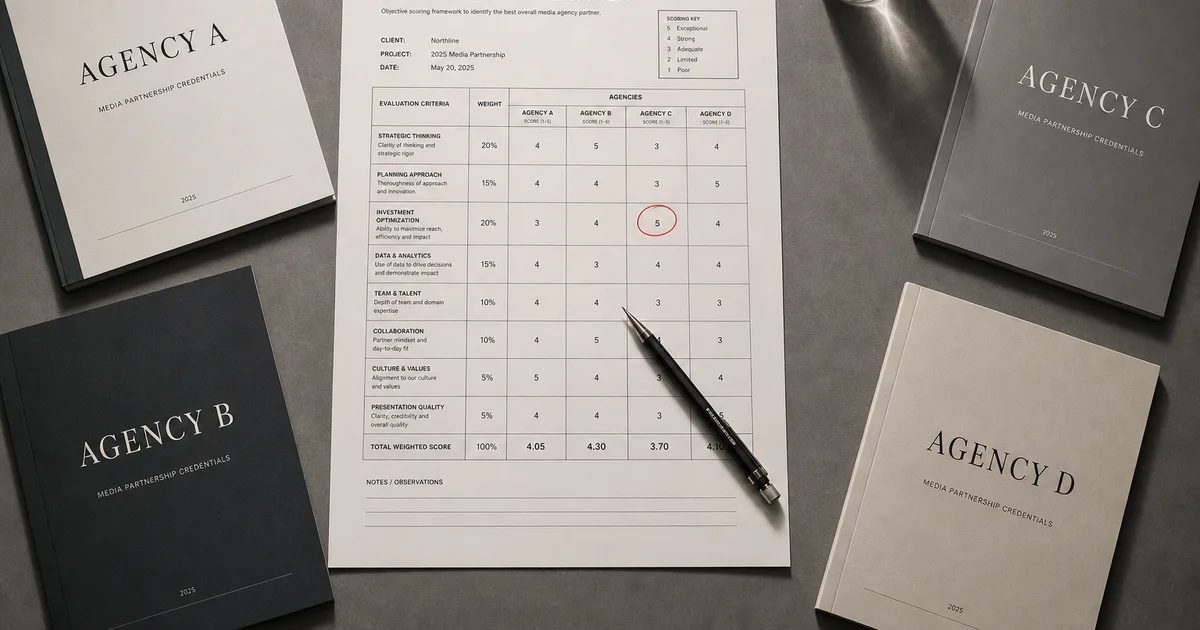
Media agency selection criteria: what predicts a good partnership addresses the question of what to measure. Presentation quality is the easiest dimension to prepare for; financial transparency, anticipated media rates, data infrastructure, and the stability of the team that will run your account day to day require deeper evidence - and those are the factors that predict how the relationship performs at month eighteen. The guide sets out the six criteria categories that matter, how to weight them, and why fixing the scorecard before the first presentation is seen protects both the advertiser and the competing agencies.
Agency fees and commercial outcomes
Media agency fees and outcomes: what a selection should return explains how agency remuneration works: commission, FTE-based, output, and hybrid models, the difference between gross and net rates, and the question of which income streams related to your spend are defined and disclosed, and which sit at levels you have no line of sight into. A fair, transparent fee that lets the agency earn well from what you both signed is the goal; the guide shows which components are worth negotiating systematically and what a well-run selection can return beyond the fee itself.
Multi-market selection
Multi-market media agency selection: one review across markets tackles the added complexity when your media investment spans multiple countries. One review across ten markets is not a bigger version of a domestic pitch: it demands deliberate process architecture, a conscious choice between global, regional, and local agency models, and honest accounting of where value leaks between global deals and local buying. The guide also covers roster consolidation and the boundary between in-housing and agency delivery.
Frequently asked questions
What is media agency selection? Media agency selection is the process an advertiser uses to evaluate and appoint a media agency. It typically involves issuing a formal brief, running a competitive pitch with RFI and RFP stages, scoring agencies against criteria defined in advance, and negotiating commercial terms before making an appointment.
How long does a media agency selection process take?
For a single market, the process typically runs three to five months from internal briefing to contract signature. A multi-market review runs three to eight months, depending on how many markets are involved. The transition to the new agency adds further time after that. The process can run faster when circumstances require it, but a longer runway strengthens your negotiating position and almost always produces a better outcome.
What criteria should I use to evaluate media agencies? The most predictive criteria are financial transparency, anticipated media rates, terms and trading conditions, data and technology infrastructure, and the stability of the proposed account team. Strategic capability matters too, but it is a relatively easy dimension to prepare for in a pitch setting, which is worth reflecting in the weighting.
Do I need an independent consultant to run the selection? It is not strictly required, but independent facilitation removes the conflicts of interest that can affect internally managed processes, particularly when the incumbent agency is part of the review. A consultant paid solely by the advertiser has no financial relationship with any agency competing in the pitch.
How often should you run a media agency pitch? There is no fixed rule. Depending on the stakes and the situation, reviewing the relationship every two to four years tends to be a workable cadence, with obvious exceptions when something genuinely demands a review: a significant change in budget or strategy, a persistent performance problem, or a breakdown in transparency. Between pitches, structured vendor management keeps the relationship honest.