



In this article
Vendor management is an established business discipline with five building blocks: policies and procedures, people and training, technology and reporting, accountability and structure, and continuous improvement. Applied to media, it covers the same five. It is the standing mechanism that makes a media investment visible, comparable and steerable, through the year, not just at the moment a contract is signed.
The pitch establishes a level. What happens through the year determines whether the advertiser stays at that level, or moves above it.
You have signed the contract. The agency presented well, the commitments were clear, and the budget is confirmed. What most advertisers discover, in time, is that the pitch is the easier part of the relationship to manage. The year that follows is considerably harder.
This is not because agencies are unreliable as a category. It is because media inventory is not homogeneous, conditions shift between planning and execution, and the agency holds information the advertiser does not. A million litres of milk is bought with every specification established in advance. A million units of airtime is far harder to define, while the sums involved are significant. A house is bought with a structural survey; media investments of similar or greater size are frequently committed with considerably less due diligence. That difficulty is genuine, and it is the reason a structured discipline exists.
Vendor management in media does not invent a new function. It applies an established one.
What the five building blocks look like in practice
The first building block, policies and procedures, means the media process and the information regime belong to the independent party. The reporting structure, the formats, the standardised purchase orders, the moments at which information must arrive and in what form: these are set, not suggested. That is what makes comparison possible in the first place. It is also what separates a working programme from an advisory report.
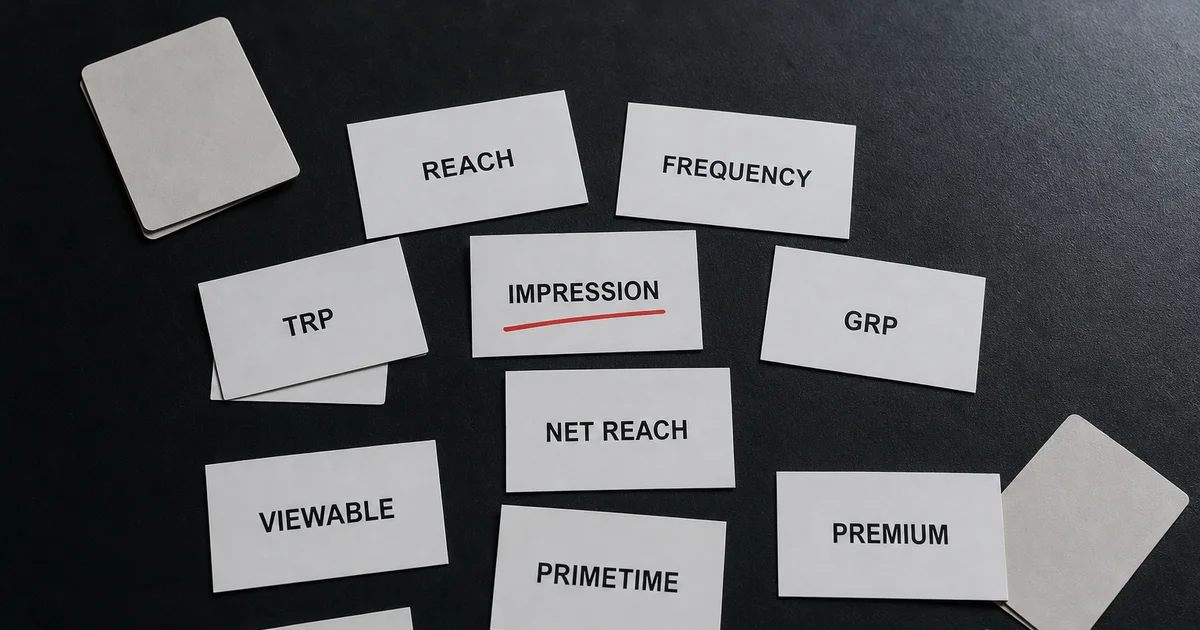
The second building block is people and training. The client team is trained in media itself: rating points, gross and net reach, impressions, how the buying platforms work. The purpose is that the advertiser becomes a capable counterpart rather than a passenger. There is a paradox worth stating plainly: this sells less dependence, not more. A client who understands the figures needs less consulting, because the numbers start speaking for themselves.
Technology and reporting is the third building block. It is the infrastructure that makes the previous two operational, the dashboards, the data flows, the standardised formats that allow one period to be measured against another.
The fourth building block is accountability and structure. The point of contact is usually the marketing lead, sometimes an in-house media team, and where the sums are large sometimes the CEO or owning family. The independent party is not a party to the relationship, so it does not carry accumulated history in either direction. Every question it asks is in service of performance. That is why there is no question it should not ask.
The fifth is continuous improvement. Ordinary market change is absorbed within the system, a different set of columns in the same mechanism. Fundamental change moves the system itself: new checks, different reporting fields, other relevant measures. Consider an advertiser shifting from classic target-group thinking to personas, and onwards from there. The question “what am I getting for my money” stays constant; how it is expressed does not.
These five are not independent. Policies without people produce documents nobody applies. Reporting without accountability produces data nobody acts on. Improvement without a stable process to improve produces change without direction. What the full programme provides is a standing mechanism, a working system rather than a report.
The year has a rhythm, and the programme runs on it. An annual briefing, often co-written with the client, sets the parameters. The agency’s annual strategy responds to it and is assessed on media strategy, media substance, and alignment with the objectives. Revisions follow, and then the strategy is locked. For each flight or campaign, the operational plan is assessed before approval: does it match the locked strategy, and are the expected conditions in order against the agreed reference - the pitch commitments, external benchmarks, or whatever was agreed with the client rather than fixed by the independent party. After each flight, an evaluation. At the end of the year, an annual evaluation, sometimes including a performance related incentive payment review.
The performance programme
A vendor management programme is more than a set of reports. It is a standing structure: what gets installed, what the advertiser has after the first months that they did not have before, and how that structure connects to what the agency is actually delivering against its commitments. Read what a media performance management programme consists of and how it is set up.
The information regime
Assessment is only possible when the information arrives in a fixed form at defined moments. Which information, in what format, and why a standardised purchase order and a fixed reporting structure are what make comparison possible at all - including the point that fixed expectations give the agency clarity too. Read what information you should receive from your media agency, and in what format.
The agency of record question
In industry vocabulary, much of what this programme provides is what an agency of record is expected to deliver - coordination, reporting coherence, governance across the spend - but without buying the media or owning the strategy. Read what an agency of record is, and whether you need one for agency oversight.
Independence is what makes the arrangement work: no agency relationships, no media bought, no interest in any outcome. Performance-related fees were deliberately abandoned, because an independent party paid on savings has an interest in finding them, which is not a neutral position. Money was left on the table to stay impartial.
Verification as a foundation for trust
Trust and verification are not opposites. An arrangement that cannot be checked is not a stable arrangement, for either side. Scrutiny can equally show an agency delivering better than it committed to, which deserves to be recorded exactly as a shortfall would. Good faith is the starting assumption; making the delivery visible is what keeps it there. Read why verification is the foundation of a working agency relationship, not a sign of suspicion.
The programme through the year
The annual cycle sketched above is where the discipline becomes concrete: what is assessed at each stage, what happens between the briefing and the lock, and why the moment before a flight is approved is the point at which something can still be changed. Read how a media performance management program actually runs through the year.
One rule holds across all five areas without exception: the advertiser always signs. The independent party assesses, advises and reports. The decision and the risk stay with the advertiser; what changes is that the decision is better informed.
For advertisers buying media across multiple markets, the same five building blocks apply in each, though the local media landscape and the information available in it will vary. The structure of the programme adapts; the discipline does not.
If you are earlier in the process, still deciding which agency to appoint before the question of managing them arises, media agency selection is where that work begins. And if you are weighing whether an audit is the right starting point rather than an ongoing programme, the media audit covers what that examination involves and what it costs.
The next step is to assess where the greatest gap sits: in the information you receive, in how it is interpreted, or in how decisions are made once the data is in front of you. Start there.
Frequently asked questions
What is vendor management in media? Vendor management in media is an established business discipline applied to agency relationships. It covers five building blocks: policies and procedures, people and training, technology and reporting, accountability and structure, and continuous improvement. Together these create a standing mechanism that makes a media investment visible, comparable and steerable through the year, not only at the point of contract.
Is vendor management the same as an agency of record? It delivers much of the governance an agency of record is expected to provide, without buying the media or owning the strategy. The media stays with the agency; the independent layer sets the information regime, coordinates reporting and verifies delivery. The two are compatible, and in many cases the programme operates alongside an existing agency of record arrangement.
Does the independent party approve campaigns? No. The independent party assesses, advises and reports. The advertiser always signs. The decision and the risk stay with the advertiser; what the programme changes is that the decision is better informed before it is taken.
Who is the typical point of contact on the advertiser side? Usually the marketing lead, sometimes supported by an in-house media team. Where budgets are significant the CEO or owning family may be directly involved. The structure of accountability on the advertiser side is part of what the programme maps at the outset, not assumed.
What happens when the market changes significantly? Ordinary market change is absorbed within the existing system: a different set of columns in the same mechanism. Fundamental change, a shift in channel mix, a new platform becoming dominant, a change in how the audience is defined, moves the system itself. The checks, reporting fields and relevant measures are updated accordingly. The question the programme answers stays the same; how it is expressed changes.