In this article
Many advertisers say they believe roughly half of their advertising budget is wasted, and that the difficulty is knowing which half. It is a remark people genuinely make, and it deserves a direct answer. The question is usually framed as a problem of hindsight, as though the waste can only be identified after the money has gone. Most of it can be seen in the plan, before anything is committed.
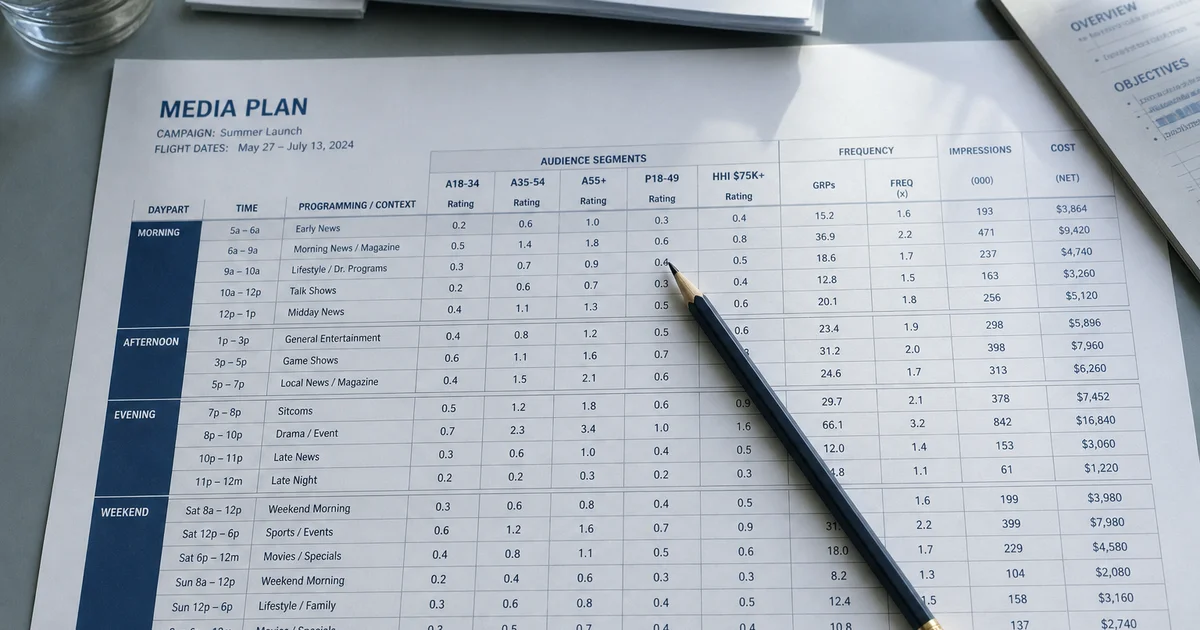
That is the argument of this article. The inefficient parts of a media plan are not hidden. They appear in the shape of the audience distribution: the people reached too rarely to meet the objective, and the people reached far past it. Both are visible before the plan runs, because the plan determines the shape. Someone reading that distribution against the objective before approval can take a substantial part of the waste out. Not all of it, this article will say so plainly. But a substantial part.
What media mileage actually measures
Media mileage is how much effective exposure a budget is converted into. Not total impressions, not average frequency. Effective exposure: the portion of the target audience reached at a level likely to produce the result the campaign was designed to produce.
A plan can reach a very large number of people and still deliver poor mileage, if most of those contacts fall below the threshold where they do anything useful, or accumulate so far beyond it that they become cost with no return. The shape of the distribution is what determines mileage, and the shape is a planning outcome. That is also what makes mileage improvable: the same budget, redistributed away from both tails, converts into more effective exposure. Measuring mileage establishes the current position; improving it is what the measurement is for.
This is why the question sits alongside the broader discipline of media measurement and mileage: more reach from the same budget. Mileage is not a post-campaign metric. It is something that can be influenced at the point when the plan is still a plan.
The point that determines everything else
Where no objective was fixed before the campaign, the question cannot be answered at all. Not because the data is missing, but because there is nothing to measure against.
Half a budget can only be called waste relative to a standard. If no standard was set before the campaign ran, any figure produced afterwards is an opinion dressed as an analysis. This is not a technical observation. It is a practical one. The yardstick has to be agreed in advance, stated in terms the plan can be assessed against: what working reach means for this advertiser, in what audience, at what frequency, over what period. Without that, the distribution cannot be judged as good or poor. It can only be described.
This is why the objective is not background information. It is the instrument the plan is read against. Setting it is the first step, and it belongs before the brief is written, not after the campaign closes.
What is needed to assess mileage
A working assessment of media mileage requires four things. Any one of them missing makes the others less useful.
An objective that states what working reach means, in what audience, at what frequency, and over what period. The plan itself, not a summary of it. For the post-campaign review, delivery data expressed in the same terms as the plan, so that the plan and the outcome can be placed side by side; for the pre-approval check, the projected distribution serves the same role. And a sense of what comparable plans achieve in that market, because a distribution can only be judged as good or poor relative to what the market allowed.
That last point is easy to overlook. A frequency distribution that looks reasonable in isolation may be poor relative to what the inventory available that quarter could have produced. And one that looks imperfect may be close to optimal given the conditions. Market reference is what makes the judgment possible.
For a deeper look at how frequency thresholds interact with this assessment, the article on frequency capping and where campaign waste hides covers that in detail. And the distinction between gross rating points and budget neutrality is relevant wherever reach and rating points are the currency the plan is expressed in.
The honest limit, and why it matters
Reading a plan before approval takes out part of the waste, not all of it. Two things cannot be planned away, and they deserve proper weight. Naming them is what makes the rest of the argument credible.
Markets move between the moment a plan is set and the moment it runs. Audiences shift. Competitors move. Programming changes. Delivery does not follow the projection exactly. These are not failures of the plan. They are conditions the plan was built under, and conditions that will have changed by the time the plan executes.
And the inventory a plan needs is not always available. The breaks or placements that would have shaped the distribution better may simply not be there to buy at that moment, at any price. A plan is the best construction possible under the conditions of the day. That is a genuine constraint, not a disclaimer.
This is why assessment continues after the campaign as well as before it. The plan check addresses what can be addressed. The post-campaign review addresses what could not be foreseen.
What changes when the plan is read before approval
The distribution is a planning outcome, which means the moment to influence it is while it is still a plan. A standing arrangement with an independent reviewer, rather than a one-time audit after a campaign that has already run, makes it possible to ask the question while the answer can still change.
This is what vendor management makes possible in practice: not a report on what went wrong, but a question asked at the point when the plan can still be adjusted. Agencies are not treated as suspects in this process. Waste in a distribution is almost always a planning outcome, often the result of optimising for a different variable. Reach at the lowest cost, for instance, rather than effective frequency across the target. Nobody looked because nobody asked, and there was no agreed standard to look against.
Both of those are fixable before the next plan is submitted.
Three questions you can ask right now
You do not need an external review to start. Three questions, put to your agency before the plan is approved, establish whether the plan can be assessed at all.
Ask for the frequency distribution, not the average. An average frequency of four contacts can mean very different things depending on how that four is composed across the audience. The distribution shows the shape the average conceals.
Ask what share of the target audience reached the agreed threshold. This turns the distribution into a number that can be compared against the objective. If the threshold was never agreed, this is the moment to agree it.
Ask which part of the delivery figure is measured and which is modelled. In most plans, both are present, and knowing which is which changes how much confidence the projection deserves.
These questions do not require a larger budget or a new contract. They require only that the objective was set in advance, which is where this article began.
Frequently asked questions
How do you measure media mileage? You need four things in place: an agreed objective that states what working reach means in what audience, at what frequency, and over what period; the plan itself; delivery data expressed in the same terms as the plan so the two can be compared directly; and a market reference that shows what comparable plans have achieved under similar conditions. Without all four, the assessment is incomplete.
Can you tell which half of a budget was wasted? Only against a standard set in advance. Without one, any figure produced afterwards is an opinion, not an analysis. The more useful observation is that most of what would be called waste is visible in the plan before it runs, in the portion of the audience reached below the effective threshold, and the portion reached well past it. Both are in the distribution before a budget is committed.
Can all the waste be avoided? No, and it would be misleading to suggest it. Markets move between the time a plan is set and the time it runs, and the inventory that would improve the shape of the distribution is not always available at that moment. A plan is the best construction under the conditions of the day. That is a genuine constraint. Reading the plan before approval addresses a substantial part of the problem, not all of it.
What is the difference between reach and media mileage? Reach is the share of the target audience exposed to the campaign at least once. Media mileage is about how much of that reach was effective, meaning it met the frequency threshold required to produce the intended result. A campaign can have broad reach and low mileage, if most contacts fell below the threshold where they do anything useful.
What does “social media mileage” mean? In the context of paid advertising on social platforms, it describes the same relationship: how much effective exposure the budget produced relative to what it could have produced. The mechanics differ across platforms: viewability standards, completion rates and audience targeting behave differently. But the underlying question is the same. The article on reach vs frequency across six media addresses how counting differs by channel.
The old remark about wasted budgets assumes the waste is unknowable. It is more accurate to say it was never looked for, because nobody was asked to look, and there was no agreed standard to look against. Both of those are fixable, and neither requires a larger budget. The yardstick is agreed in advance and signed by both sides, and a check can equally show an agency delivering better than it committed to. Trust is good. Verifying is better. And it is better for both sides.