 Thailand

In this article
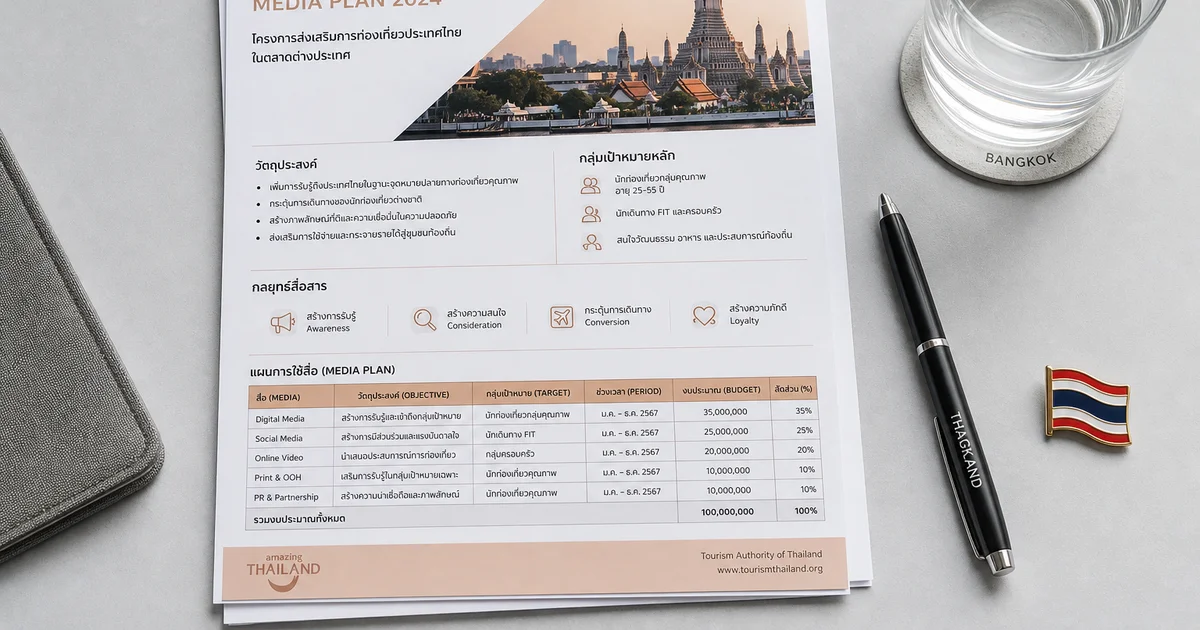
Advertising in Thailand means operating in a market where traditional broadcast still carries significant weight, yet digital and social media consumption ranks among the most intensive anywhere in the world. Television remains the single largest medium by spend, but digital is close behind. Out-of-home holds an unusually large share by international standards. Measurement is mature for television but fragmented across digital. And a regulatory framework with hard category restrictions catches international advertisers off guard more often than it should. Understanding how each channel is bought, measured and priced is the foundation of any sound plan here.
Thailand’s media landscape at a glance
| Your situation | Where to start |
|---|---|
| Building mass reach quickly | Television, still the broadest single medium |
| Reaching urban, mobile-first audiences | Digital and social, with LINE as a market-specific channel |
| Targeting Bangkok commuters and city dwellers | Out-of-home and transit advertising |
| Understanding what the rules allow in your category | Regulation section, before channel selection |
| Entering Thailand from another market | Agency selection and local structure |
Different industry bodies measure Thai ad spend using different methodologies. DAAT and Kantar survey agency-managed digital spend; Nielsen’s cross-medium monitoring is largely rate-card based for traditional media; MAAT publishes market-level forecasts. These sources are not comparable and must not be added together. With that caveat in place: television and digital together take the large majority of total spend, with television still the single largest medium and digital close behind. Out-of-home holds a share roughly double the global norm. Print has collapsed to a residual level and is now broadly flat. Radio holds a small share.
Television
Television in Thailand operates on digital terrestrial (DVB-T2) licences issued by the NBTC, the national regulator. The current commercial DTT licences expire in 2029. Whether they will be renewed or re-auctioned is a live question, and one that shapes broadcaster strategy today. The leading commercial free-to-air broadcasters, including BBTV Channel 7, BEC World (Channel 3), Amarin TV, Mono29, Workpoint and One31, each sell their own airtime. There is no shared national TV sales house. Advertising minutage is capped by licence type, which keeps prime inventory scarce and negotiating dynamics tight. Nielsen Thailand operates the de facto ratings currency. A cross-platform product covering linear TV plus broadcaster streaming launched in 2022, commissioned by ADTEB and funded by the NBTC. Thailand does not have a classic advertiser-led JIC.
Digital, social and influencer
Internet penetration in Thailand sits above ninety percent of the population, placing it among the world’s most intensive markets. Meta is the clear largest platform by measured digital ad spend, though its share is gradually declining. TikTok has grown fast and now competes with YouTube for second place. Together these three account for more than half of measured digital spend. LINE is a feature that distinguishes Thailand from most other markets: a messaging platform used by the large majority of Thai internet users, with its own advertising ecosystem that international planners focused only on Meta and Google routinely underweight. Influencer marketing is a substantial, established channel, not a niche.
Worth noting: DAAT and Kantar measure digital spend on an agency-survey basis. Spend placed directly with platforms by advertisers and SMEs, including much retail media on e-commerce platforms, sits largely outside these figures. There is no independent cross-platform digital currency, so measured versus modelled has to be established per platform.
Out-of-home
Out-of-home is more important in Thailand than its global share would suggest. Concentrated in Bangkok’s dense urban and transit environment, it accounts for a share roughly double the global norm. The market is dominated by two listed companies: Plan B Media and VGI, which holds the BTS Skytrain advertising concession. Since 2025, Plan B sells and markets VGI’s inventory under a multi-year management agreement. In practice, this means the market effectively runs through one dominant sales point for any buyer. JCDecaux is also present, though at a smaller scale. Transit inventory is concession-based, with exclusive rights per transport system. There is no independent audience currency; delivery claims are operator-based. This concentrated structure has direct implications for negotiating position.
Radio and audio
Radio holds a small share of Thai ad spend. It is rarely the primary vehicle in a national plan, though it retains a role in local and regional coverage. Buying runs through individual stations and networks rather than a shared structure.
Print and magazines
Print in Thailand has contracted sharply and now accounts for a residual share of total spend, broadly flat at a low level. Within that residual share, magazines serve a limited set of consumer categories where editorial context is part of the buy. For most national plans it is a tactical addition rather than a structural component.
Regulation and category restrictions
Thailand’s advertising regulatory environment is materially stricter in certain categories than international advertisers expect. And the rules change. Alcohol advertising is essentially prohibited under the Alcoholic Beverage Control Act, with criminal penalties. Only tightly constrained corporate-image communication is possible, and recent amendments mean current legal advice is not optional.
Advertising for health products, food supplements and foods carrying health claims requires pre-approval from the Thai FDA before publication. This is a pre-clearance requirement, not a post-publication review. Cosmetics work differently: no advertising licence is required, but claims are policed after the fact and must stay within what the product notification allows.
Royal imagery and references are off limits in commercial creative under lèse-majesté law, and national mourning periods can suspend normal programming and campaigns at short notice. Thailand’s data protection law, the PDPA, has been enforced since 2022 and affects digital targeting and data-driven marketing programmes. This article provides orientation, not legal advice. Category rules change, and local legal verification is required before any campaign goes to market.
Assessing a plan in Thailand: the right questions
When an agency or partner presents a Thai media plan, these are the questions worth pressing on before signing off.
On television: which part of the TV figure is panel-measured and which is modelled or streaming-based, given that the cross-platform product launched only in 2022?
On digital: which figures come from agency-reported data and which from platform self-reporting? Is retail media included at all, or sitting outside the DAAT survey entirely?
On LINE: is it in the plan? If not, why not, given its reach among Thai internet users?
On out-of-home: what audience basis underlies the delivery claim, given that figures are operator-based? And what does the concentrated sales structure mean for your negotiating position?
On pricing: what is the gap between rate card and net price in this plan, and who keeps the difference? Cross-medium monitoring in Thailand is largely rate-card based, which materially overstates what advertisers actually pay, particularly in TV. The distinction between monitored spend and actual investment is significant here, as it is in comparable Southeast Asian media landscapes.
On compliance: are all planned categories and creative executions compliant with Thai advertising regulation, and where pre-approval is required, has it been obtained?
On cross-channel totals: definitions of spend must be fixed before anything is added up. Measured versus modelled, agency-reported versus platform-reported, rate-card versus net, these distinctions apply in every market. But in Thailand the gaps are wide enough to materially change how a plan reads. The same discipline applies when comparing Thailand against other markets in the region, where measurement conventions differ considerably.
Finding and managing a media agency in Thailand
Selecting the right local partner is the structural decision that shapes everything downstream. Thailand has a well-developed agency market, but the right agency for a global FMCG client differs from the right agency for a regional challenger brand entering Bangkok. The questions of independence, buying power, transparency and local versus network structure all apply here. The guide to selecting a media agency in Thailand covers the selection process, evaluation criteria and what to look for in a local or regional partner.
Frequently asked questions
Who measures TV audiences in Thailand? Nielsen Thailand operates the de facto ratings currency for television. A cross-platform product covering linear TV plus broadcaster streaming launched in 2022, commissioned by ADTEB (the association of digital terrestrial broadcasters) and funded by the NBTC. Thailand does not have a classic advertiser-led Joint Industry Committee; the currency is broadcaster-commissioned.
What are the biggest advertising platforms in Thailand? Television remains the single largest medium by spend. In digital, Meta is the clear largest platform by measured spend, though its share is gradually declining; TikTok and YouTube compete closely for second place, and together these three account for more than half of measured digital ad spend. LINE is a distinctive market-specific platform with its own advertising ecosystem that international planners frequently underweight.
Why is out-of-home advertising so prominent in Thailand? Bangkok’s density, its extensive transit network and the presence of concession-based exclusive rights per transport system create a structurally large OOH market. The share of total spend is roughly double the global norm. The sales structure, effectively concentrated through one dominant point since 2025, reinforces the medium’s visibility in agency plans.
Is digital ad spend in Thailand fully measured? No. The DAAT and Kantar annual survey captures agency-managed digital spend, but money placed directly with platforms by advertisers and SMEs, including much retail media spend on e-commerce platforms, sits largely outside those figures. There is no independent cross-platform currency; platform self-reported figures and agency reporting dominate, and measured versus modelled must be verified per platform.
What advertising restrictions should I know about before planning in Thailand?
The most material are: the near-total prohibition on alcohol advertising under the Alcoholic Beverage Control Act (criminal penalties apply); mandatory Thai FDA pre-approval for health product and food supplement advertising before publication, with cosmetics instead subject to strict post-publication claim enforcement; restrictions on royal imagery under lèse-majesté law; and enforcement of the PDPA data protection law since 2022, which affects digital targeting. Category rules change; local legal verification is required before any campaign goes live.
Agree the measurement yardstick before the plan is approved, in the currency of this market. Thailand’s blend of strong broadcast, intensive digital, a distinctive OOH sector and a strict regulatory environment rewards advertisers who ask precise questions early. Trust is good; verifying is better. Vendor-MGT works with advertisers in Thailand on agency selection, media audits and ongoing vendor management, independently, on the advertiser’s side. Contact us to discuss your situation.