 Singapore
In this article
Advertising in Singapore takes place across a compact, high-income, largely English-language market where digital now accounts for the majority of spend, yet a single national network still delivers the broadest mass reach on television and radio. Singapore also functions as a regional headquarters hub: many campaigns planned here are traded inside regional agreements, which directly shapes pricing, accountability and what your agency’s terms actually mean at the local level. Understanding how each channel is structured, bought and measured is the foundation of any sound media plan.
According to We Are Social and Meltwater’s Digital 2026 Singapore report, advertising in Singapore reached approximately US$2.8 billion in 2025, with digital accounting for 76 percent of that total. These are year-end projections. One important caveat: Singapore has no industry-owned adex. Monitored expenditure figures from Nielsen Ad Intel reflect gross rate-card values, not net spend, while digital estimates draw on commercial sources and platform self-reporting. These bases are not comparable and cannot be added together to produce a reliable total.
At a glance: which channel fits your situation
| Your situation | Where to start |
|---|---|
| Mass reach quickly | Television and radio via the national network |
| Mobile-first consumers | Digital and social |
| Shoppers at point of purchase | Retail media |
| Understanding category rules | Regulation section first |
| Entering Singapore as a regional hub | Agency selection and contract structure |
Television
Mediacorp is Singapore’s national media network and the sole free-to-air television broadcaster, operating Channel 5, Channel 8, Channel U, Suria, Vasantham and CNA. It is wholly owned by Temasek, a Singapore-headquartered investment company. For advertisers, the practical consequence is straightforward: free-to-air airtime has a single seller. That makes independent benchmarks and precisely defined guarantees more important, not less.
Audience measurement runs through SG-TAM, launched in 2016 and operated by GfK in partnership with the Infocomm Media Development Authority (IMDA). SG-TAM 2.0 rolled out progressively from October 2024, adding cross-screen measurement that covers streaming and social platforms including Netflix, Prime Video, Disney+, YouTube, Facebook and TikTok. There is no advertiser-led joint industry committee.
Trading is on negotiated and packaged terms, including audience-based upfront deals; indicative rates are a starting point, not what buyers pay. Pay TV plays a small advertising role; in October 2025 StarHub and Mediacorp announced a partnership bringing StarHub TV+ content packs to mewatch with targeted live TV ad insertion.
Digital, social and retail media
Internet penetration in Singapore is near-universal, which makes digital a reach medium as well as a performance channel. WhatsApp is the most-used platform, followed by Facebook and YouTube; Instagram and TikTok also carry substantial reach. Influencer marketing is well established.
Retail media deserves a dedicated line in any plan. Shopee and Lazada are both headquartered in Singapore and sell on-platform advertising. Amazon.sg operates locally. And in 2025, FairPrice Group launched FPG Advantage, an omnichannel retail media network spanning around 570 retail and dining touchpoints. There is no independent cross-platform digital currency, planning relies on platform self-reporting and commercial estimates, so the distinction between measured and modelled must be established per platform.
Out-of-home
Out-of-home in Singapore is structured by concession. Stellar Ace, the media arm of SMRT, sells rail transit media. Its affiliate Stellar Experience holds the Land Transport Authority’s consolidated street furniture concession, covering bus and taxi shelters and approximately 120 overhead bridges, underpasses and linkways, from 1 January 2024 for ten years, with a six-year extension option. Moove Media, ComfortDelGro’s media arm, covers buses and taxis. JCDecaux holds the Changi Airport concession, renewed and extended in 2023. Programmatic DOOH platforms are active in the market.
There is no independent OOH audience currency. Delivery claims are vendor-based, which makes verification a standing point in any plan.
Radio and audio
Radio reach in Singapore runs through two FM operators: Mediacorp, with 11 domestic stations, and SPH Media, with five stations including Kiss92, ONE FM 91.3 and Money FM 89.3. So Drama! Entertainment’s stations left FM and became online-only on 31 October 2025. Audiences are measured by the Nielsen Radio Survey, a weighted survey of approximately 2,000 residents aged 15 and over, published in roughly annual waves.
Newspapers
In 2021, Singapore Press Holdings transferred its media business to SPH Media Trust, a not-for-profit company limited by guarantee, with government funding support of up to S$900 million over five years disbursed against agreed targets. Titles include The Straits Times, The Business Times, Lianhe Zaobao, Berita Harian and Tamil Murasu. Print circulation has declined while digital subscriptions have grown, and print buys are increasingly bundled with digital inventory. Singapore’s four official languages, English, Mandarin, Malay and Tamil, mean that language targeting remains a practical planning consideration.
Regulation and category rules
Singapore’s advertising governance combines self-regulation with category-specific statutory rules. The Advertising Standards Authority of Singapore (ASAS), an advisory council under the Consumers Association of Singapore (CASE), administers the Singapore Code of Advertising Practice, which applies to all advertising including online. Broadcast advertising follows IMDA’s Television and Radio Advertising and Sponsorship Code. Category rules that frequently catch advertisers:
-
Nutri-Grade: Grade D beverage advertising is prohibited. The ban applied to pre-packaged beverages from 30 December 2022, to freshly prepared beverages from 30 December 2023, and extends from mid-2027 to prepacked salt, sauces, seasonings, instant noodles and cooking oil.
-
Financial services: MAS guidelines from January 2022 restrict digital payment token providers to promoting through their own corporate channels. MAS Guidelines on Standards of Conduct for Digital Advertising Activities, issued September 2025, take effect 25 March 2026 and apply to all financial institutions and their digital marketers.
-
Healthcare: services may only be advertised by licensees under the Healthcare Services Act, with factual, verifiable claims and restrictions on testimonials. Health products fall under the Health Sciences Authority.
-
Tobacco and e-vaporisers: tobacco advertising is completely banned; e-vaporisers are prohibited entirely, including their advertising.
-
Alcohol: advertising is permitted subject to content rules: no targeting of minors, no linking alcohol to social success, no encouragement of excessive consumption.
-
Gambling: advertising is broadly prohibited under the Gambling Control Act 2022; only licensed or exempt operators may advertise under stated conditions.
-
Data and direct marketing: the Personal Data Protection Act 2012, amended in 2020, and the Do Not Call registry constrain direct marketing and targeting.
This article provides orientation, not legal advice. Category rules change, and local legal verification is required before any campaign goes live.
The right questions to press on before approving a plan
Before signing off a media plan in Singapore, a disciplined advertiser should establish several things. Which television figures are SG-TAM-based, and which rest on broadcaster or platform data? What does the single free-to-air seller structure mean for pricing, and why do defined guarantees matter here? Does retail media appear as its own line, or is it absorbed into a blended digital total? What audience basis underlies OOH delivery claims?
Beyond those channel-specific questions: what is the gap between monitored gross adex and net prices actually paid, and who keeps the difference? Do regional deal terms apply to this Singapore buy, and how does that affect local accountability? And do all planned categories clear the applicable rules?
Advertisers planning across the region will find useful context in the overviews of advertising in Malaysia and advertising in Indonesia, where several of these structural questions arise in comparable but distinct forms.
Agency selection and management
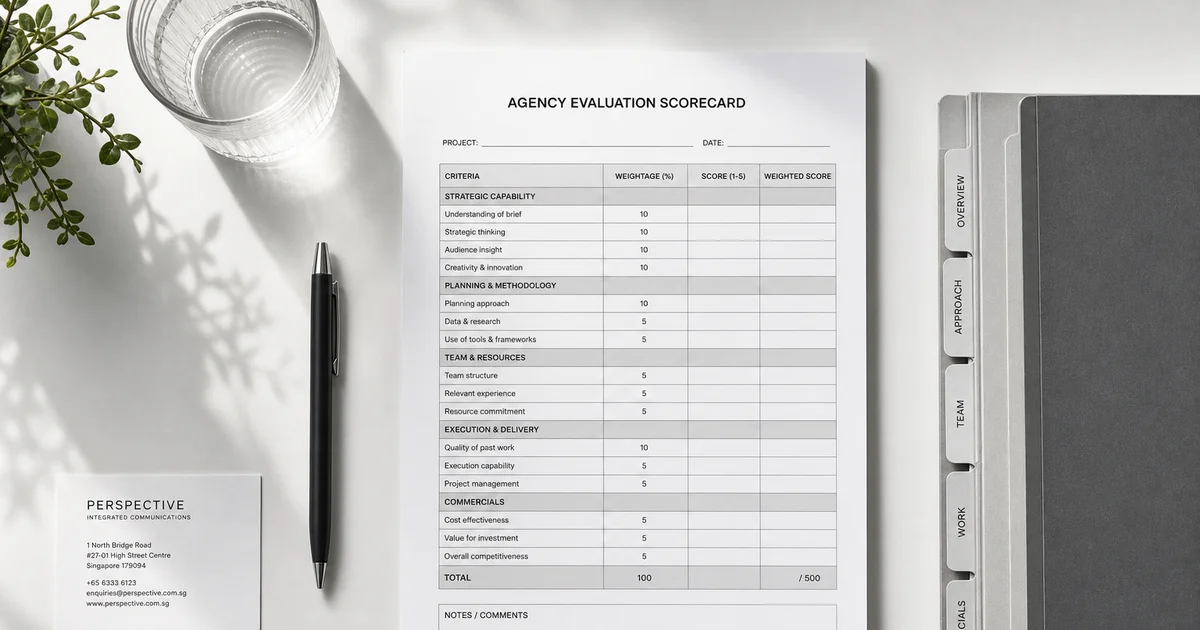
Selecting the right partner is the structural decision that shapes everything downstream. In Singapore, the agency question is frequently also a regional question. Many agencies propose Singapore within a broader regional structure, and the contract terms, trading agreements and accountability frameworks that apply at the regional level will determine what local performance can realistically be measured and verified. The guide on selecting and managing a media agency in Singapore covers the selection process and evaluation criteria in full.
Frequently asked questions
Who measures TV audiences in Singapore? Television audiences in Singapore are measured by SG-TAM, operated by GfK in partnership with IMDA. SG-TAM 2.0 has rolled out progressively since October 2024, adding cross-screen measurement of streaming and social platforms including Netflix, Prime Video, Disney+, YouTube, Facebook and TikTok. There is no advertiser-led joint industry committee overseeing the currency.
What are the biggest advertising platforms in Singapore? Digital dominates overall spend. WhatsApp is the most-used platform among residents, followed by Facebook and YouTube; Instagram and TikTok also hold substantial reach. For broadcast mass reach, Mediacorp’s free-to-air television network remains the broadest single channel available to advertisers.
Is digital ad spend in Singapore fully measured? No. Singapore has no industry-owned adex and no independent cross-platform digital currency. Planning relies on platform self-reporting and commercial estimates from sources such as We Are Social and Meltwater. Retail media spend is often reported separately and may not appear in blended digital totals. The distinction between measured and modelled figures should be established per platform before a plan is finalised.
What advertising restrictions should I know about before planning in Singapore? Key rules include the Nutri-Grade Grade D advertising prohibition (pre-packaged beverages from December 2022, freshly prepared beverages from December 2023, and further categories from mid-2027); MAS restrictions on digital payment token promotion from January 2022 and new MAS digital advertising conduct guidelines effective March 2026; healthcare advertising limited to licensed operators; a complete ban on tobacco and e-vaporiser advertising; alcohol content rules; and a broad prohibition on gambling advertising under the Gambling Control Act 2022. The PDPA and Do Not Call registry govern direct marketing and targeting. Rules change; verify locally before any campaign goes live.
Advertising in Singapore rewards advertisers who establish the measurement yardstick before the plan is approved, in the currency of this market. Singapore’s combination of a single free-to-air seller, near-universal digital penetration, concession-based out-of-home and precise category rules means that asking exact questions early is not optional, it is the work. Trust is good; verifying is better. Vendor-MGT works with advertisers in Singapore on agency selection, media audits and ongoing vendor management, independently, on the advertiser’s side. Contact us to discuss your situation.