 Philippines
In this article
- The Philippine market at a glance
- Television
- Digital, social and influencer channels
- Out-of-home
- Radio and regional reach
- Magazines
- Regulation and category restrictions
- What to check when you assess a Philippine media plan
- Working with a media agency in the Philippines
- Frequently asked questions
Advertising in the Philippines means operating in one of Southeast Asia’s most media-intensive markets. The numbers alone set the scene: a population of over 110 million, some of the world’s highest social media engagement, a free-to-air television landscape materially reshaped since 2020 and reshuffled again in early 2026, a dual-currency television measurement market without a joint industry committee, industry self-regulation with mandatory pre-screening in several advertising categories, and election cycles that move inventory and pricing in ways that can catch an unprepared advertiser off guard. This page maps each of those dynamics so you can assess a media plan with your eyes open.
The Philippine market at a glance
| Your situation | Most relevant medium | Where to read more |
|---|---|---|
| Reaching mass audiences nationally | Free-to-air television via GMA and partner channels | Television section below |
| Building reach outside Metro Manila | Regional radio and local press | Radio and print section below |
| Digital-first or e-commerce campaign | Social platforms, YouTube, TikTok Shop, Shopee/Lazada retail media | Digital, social and influencer section below |
| High-visibility brand presence in Metro Manila | Out-of-home along EDSA and urban corridors | Out-of-home section below |
| Premium or business audiences | Magazine and quality print titles | Print and magazine sections below |
| Selecting or reviewing a local media partner | Agency assessment, pitch and audit | Agency selection section below |
One anchored reference point: the Philippines had around 98 million internet users in late 2025 (DataReportal, 2026). Facebook and Messenger approach universal reach among online Filipinos; YouTube, TikTok and Instagram follow. Digital captures the majority of spend on current forecast estimates, while gross rate-card monitoring still shows television ahead. That gap between gross and net is itself the most important lesson about how this market operates.
Plans and trading are typically conducted in English, which makes the Philippines unusually accessible to international advertisers. Mass-market creative is usually in Filipino or Taglish, with English reserved for upscale segments.
Television
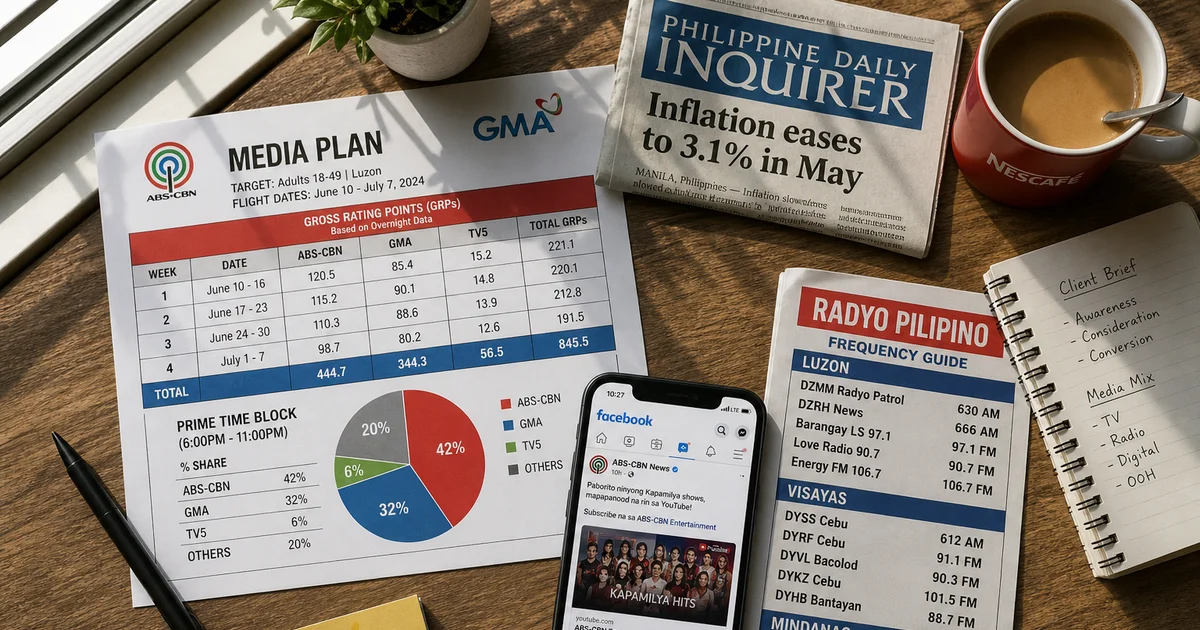
Free-to-air television in the Philippines has a structural feature that distinguishes it from most markets: blocktime and channel-partnership arrangements sit at the heart of how content and audiences are bought. ABS-CBN’s 25-year legislative franchise expired on 4 May 2020, and in July 2020 the House of Representatives committee on legislative franchises voted not to grant a new one. The network ceased free-to-air broadcasting and has since operated as a content producer and licensor, distributing programming through channel partnerships with other licensed broadcasters, pay TV, and digital platforms.
For advertisers, the practical consequence is straightforward: ABS-CBN audiences are now bought through partner channels and digital properties rather than a single ABS-CBN broadcast schedule. That partnership map changed again recently. ABS-CBN and TV5 ended their channel partnership in December 2025, and ABS-CBN’s flagship entertainment programming moved to ALLTV from January 2026. ALLTV is operated by Advanced Media Broadcasting System, part of the Villar group, which holds the frequency ABS-CBN formerly used. ABS-CBN’s arrangement with A2Z (ZOE Broadcasting) continues.
GMA Network has been the dominant free-to-air broadcaster since 2020. TV5, part of the MediaQuest/PLDT group, is the other significant commercial broadcaster; state broadcaster PTV also exists. Broadcasters sell their own airtime, and there is no shared national sales house.
Television measurement is a dual-currency market without a joint industry committee. Nielsen and Kantar Media Philippines both operate ratings services, and the major networks have historically subscribed to different providers. The currencies are not reconciled. Which measurement a plan is reported in must be agreed explicitly before any buying begins.
Gross rate-card monitoring is the main source of advertiser spend comparisons, with substantial negotiated discounts off rate card in practice. Gross monitoring figures and net budgets must never be mixed when assessing a plan.
Digital, social and influencer channels
The Philippines is consistently among the world’s heaviest social media markets, and advertising in the Philippines increasingly means prioritising digital planning from the outset. Beyond the dominant social platforms, retail media on Shopee, Lazada and TikTok Shop is fast-growing and largely outside standard reporting. That matters: it can be invisible in a conventional media plan even when it is consuming a meaningful share of budget.
There is no local platform equivalent to LINE in Thailand or Zalo in Vietnam. Global platforms dominate. Influencer and KOL marketing is a major established channel, with deceptive-advertising rules under the Consumer Act and industry guidelines applying to commercial content. Targeting and data-driven marketing are governed by the Data Privacy Act (Republic Act 10173, 2012), overseen by the National Privacy Commission, with additional obligations under the Internet Transactions Act of 2023 and its 2024 implementing rules.
Out-of-home
Metro Manila’s EDSA corridor is the iconic out-of-home inventory in the country. But the market is fragmented across many operators, and permits run through local government units rather than a central authority. Structural safety regulation of billboards has applied since 2006. There is no independent OOH audience currency; delivery claims are operator-based, though third-party digital OOH verification services are in use and digital OOH is growing.
Radio and regional reach
Radio remains a key reach medium in the provinces, with fragmented local AM and FM networks that a Metro Manila-centric plan will simply miss. National plans that are in practice only Metro Manila plans under-deliver significantly outside the capital. That distinction matters when your brand needs genuine national penetration. Regional and provincial radio also offers a more affordable entry point for locally relevant messaging.
Print is a smaller part of the overall mix today, but quality newspaper titles retain influence among business and political audiences, and the category carries credibility for certain brand communications. Monitored print spend is compiled on gross rate-card values, so the same caution about gross versus net applies here as in television.
Magazines
Magazine advertising in the Philippines serves upscale, lifestyle and category-specialist audiences where contextual alignment and longer dwell time justify the placement. The sector is smaller than it once was. Titles in beauty, business, food and travel retain engaged readerships that do not always overlap with mass television or social audiences.
Regulation and category restrictions
The Ad Standards Council operates industry self-regulation, and its clearance is a practical precondition for broadcast advertising through member media. For digital promotional materials, pre-screening has been under a moratorium since May 2024. Mandatory categories still require it, however: over-the-counter medicines and home remedies, food supplements, Milk Code products, alcohol, and superiority or comparative claims all need ASC clearance regardless. Since July 2025, all gambling-related advertising must also pass ASC pre-screening under an agreement with gaming regulator PAGCOR.
Additional category restrictions to plan around: tobacco advertising has been banned since the Tobacco Regulation Act was fully phased in (2008), with point-of-sale exceptions; vaporised nicotine products are regulated under the 2022 vape law with their own advertising restrictions; alcohol is permitted subject to FDA guidelines and mandatory ASC screening; food, drug, cosmetic and health product advertising falls under FDA oversight; the Milk Code (Executive Order 51, 1986) restricts marketing of breast-milk substitutes.
Election advertising is regulated by COMELEC under the Fair Election Act: airtime is capped at 120 minutes of television and 180 minutes of radio per candidate per station during campaign periods, with per-voter spending limits. Election cycles materially move inventory and pricing. The next presidential election is in 2028. Advertising aired before candidacy filing is not counted against the statutory limits. This article is informational and does not constitute legal advice; local legal verification is required before any campaign goes live.
What to check when you assess a Philippine media plan
Every market has its verification layer. The Philippines has several that sit outside standard international practice.
Television currency and partner channels. Which measurement service does the plan’s reporting rest on, Nielsen or Kantar Media Philippines, and is that named in the contract? When ABS-CBN content is being bought, which licensed channel actually carries it, and how is that reported?
Digital visibility. Which figures are platform self-reported, and is retail media anywhere in the plan? If Shopee, Lazada or TikTok Shop activity is running, it should be visible in budget allocation and reporting, not absorbed into a blended digital line.
National versus Metro Manila. Does the plan deliberately cover the provinces through radio, regional media or localised digital, or is it a Metro Manila plan presented as national?
Category compliance. For restricted categories, is ASC clearance obtained where it is still required, including the mandatory digital categories and gambling pre-screening that came into effect in July 2025?
Election-period exposure. Around election cycles, how does the plan handle inventory pressure and pricing? Are political-adjacency considerations built into placement guidelines?
Rate card versus net. What is the gap between rate card and net in this plan, and who keeps the difference? Gross monitoring is not a substitute for understanding what the advertiser actually pays and what arrives in media.
Cross-channel definitions. Are totals built on consistent definitions, measured versus modelled, gross versus net, fixed before anything is added up? The same discipline that applies across any media landscape applies with particular force in the Philippines, where the absence of a unified adex currency makes conflation easy and expensive.
Compared to neighbouring markets such as advertising in Indonesia or advertising in Vietnam, the Philippines presents a distinctive combination of high digital penetration and a structurally complex broadcast market. It is a combination that rewards advertisers who verify the foundations before committing budget.
Working with a media agency in the Philippines
Finding an agency with genuine local market knowledge, and holding it accountable to the commitments made at pitch, is a distinct exercise in the Philippine market. The dual-currency measurement environment, the partner-channel structure in television, and the absence of a unified adex benchmark all mean that governance and verification need to be built into the agency relationship from the start, not retrofitted after the first campaign. For a structured approach to evaluating, selecting and managing a local partner, read How do you select and manage a media agency in the Philippines?
Vendor-MGT supports advertisers in the Philippines across agency selection, media auditing and ongoing vendor management, independently, paid solely by the advertiser, without buying or selling media. If you are assessing a plan or preparing a pitch in this market, contact Vendor-MGT to discuss how we can help.
Frequently asked questions
What makes advertising in the Philippines different from other Southeast Asian markets? The Philippines combines one of the world’s heaviest social media user bases with a structurally complex free-to-air television market shaped by blocktime arrangements and channel partnerships, and a dual-currency audience measurement system without a joint industry committee. There is no single authoritative cross-medium advertising expenditure currency, and election cycles materially affect inventory and pricing in ways that require deliberate planning.
Which television measurement service should a media plan in the Philippines use? Nielsen and Kantar Media Philippines both operate ratings services, and major networks have historically subscribed to different providers. The currencies are not reconciled; the decision on which measurement the plan will be reported in must be agreed explicitly before buying begins and should be named in the contract.
Does industry pre-screening of advertising still apply in the Philippines? The Ad Standards Council’s pre-screening of digital promotional materials has been under a moratorium since May 2024, but mandatory categories still require clearance: over-the-counter medicines, home remedies, food supplements, Milk Code products, alcohol, and superiority or comparative claims. Since July 2025, all gambling-related advertising must also pass ASC pre-screening. Broadcast advertising through member media continues to require clearance.
How do election periods affect media buying in the Philippines? Under the Fair Election Act, airtime for candidates is capped at 120 minutes of television and 180 minutes of radio per station per candidate during campaign periods, with per-voter spending limits. Election cycles create measurable inventory pressure and price movement for commercial advertisers; plans built around election years should account for this in both scheduling and budget modelling. The next presidential election is in 2028.
Is a national media plan in the Philippines the same as a Metro Manila plan? Not in practice. Metro Manila dominates monitored spend and many agency plans default to it, but the provinces represent a substantial share of the population. Radio and regional media are the primary instruments for reaching provincial audiences; a plan that does not deliberately address them is a Metro Manila plan, whatever the brief says.