 New Zealand

In this article
Advertising in New Zealand means operating in a small, concentrated and fast-moving market. The country reaches 96.2 percent of its population online, digital channels capture over seven in ten advertising dollars, and ownership of television, radio and out-of-home has reshuffled materially in the past eighteen months. The practical consequence for any advertiser is the same: the negotiating counterparties behind a plan drawn up last year may not be the ones you are actually buying from today.
At a glance
| Topic | Where to find it |
|---|---|
| Television and broadcast | TV and BVOD section below |
| TV audience measurement | Measurement and currency section below |
| Digital, social and influencer | Digital section below |
| Radio and audio | Radio and audio section below |
| Print and news brands | Print and news section below |
| Out-of-home | OOH section below |
| Regulation and category rules | Regulation section below |
| Assessing a media plan | Plan assessment section below |
| Finding and managing a media agency | Agency section below |
Market context
New Zealand had 5.06 million internet users in October 2025, equal to 96.2 percent of the population (DataReportal, Digital 2026 New Zealand). Digital channels take over seven in ten advertising dollars, according to the ASA Advertising Turnover Report, the standard market-size source. IAB New Zealand reports digital revenue quarterly; Guideline SMI agency-bookings data is published through the Comms Council. The market is large enough to require a dedicated strategy, and small enough that consolidation among media owners carries genuine commercial consequences for every buyer.
Television and BVOD
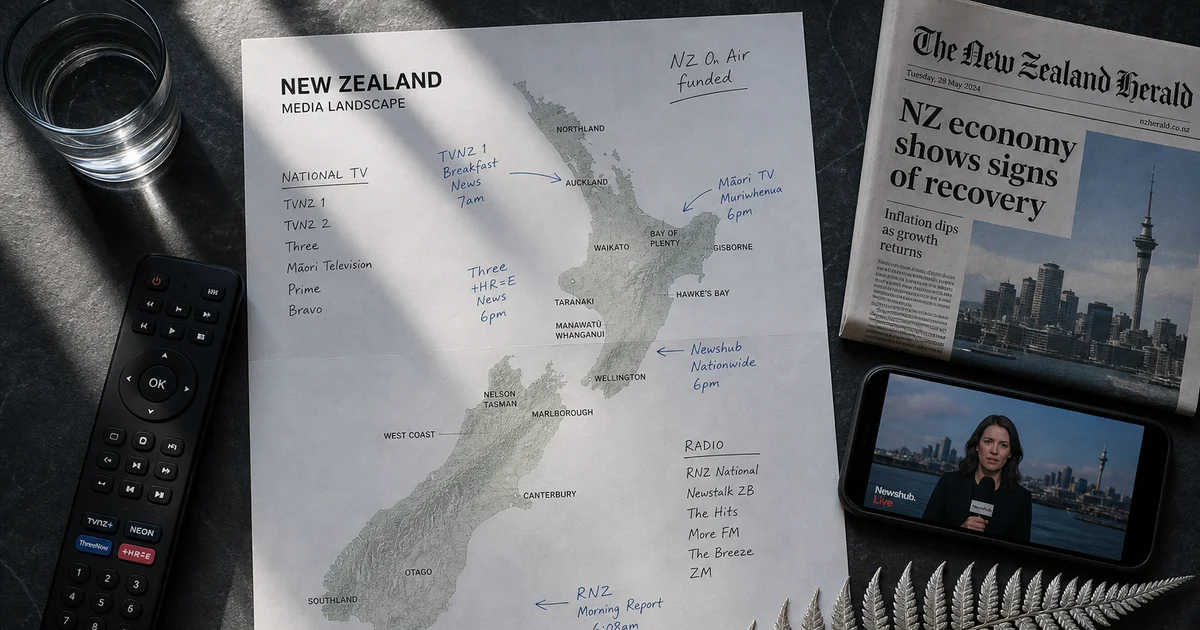
Free-to-air television in New Zealand is now a two-group negotiation. TVNZ is state-owned but fully commercial, running TVNZ 1, TVNZ 2, Duke and the TVNZ+ BVOD service. In August 2025, Sky Network Television completed its purchase of Discovery NZ from Warner Bros. Discovery for one New Zealand dollar. The free-to-air unit now operates as Sky Free, running six channels including Three and Sky Open, alongside Sky’s pay-TV business, with the 6pm ThreeNews bulletin produced by Stuff Digital. Whakaata Maori is predominantly Crown-funded, with advertising revenue of minimal scale.
Measurement and currency
Nielsen remains New Zealand’s TV ratings provider: TVNZ and Sky extended its contract through June 2027. There is no single integrated total-TV currency combining broadcast and BVOD; streaming viewing is reported largely through broadcasters’ own census data. Cross-screen claims in a plan therefore need their measurement basis stated per source. Any plan that aggregates broadcast and BVOD into a single reach figure deserves a direct question about where each number originates.
Digital, social and influencer channels
The global platforms operate freely in New Zealand. Campaign reporting is largely platform-reported, and no single cross-platform currency exists. The distinction between platform-reported, third-party-measured and modelled figures must therefore be established per platform. Unlike advertising in Australia, New Zealand has no under-16 social media ban: a government bill was introduced in 2026 but stalled before its first reading ahead of the November 2026 election.
Radio and audio
GfK conducts the commercial radio audience surveys for the Radio Broadcasters Association. The two major commercial groups are NZME, home to Newstalk ZB and others, and MediaWorks, running The Rock, More FM, The Breeze, The Edge and Mai. In August 2026, Australia’s Sports Entertainment Group agreed to acquire MediaWorks’ radio business. At the time of writing this transaction is agreed but not completed, and buyers should confirm ownership status before contracting.
Print and news brands
The main news brands are NZME (NZ Herald, BusinessDesk, OneRoof), Stuff, RNZ (public and non-commercial), 1News, The Spinoff and Newsroom. In 2025, Trade Me acquired half of Stuff Digital, covering stuff.co.nz and ThreeNews; Stuff’s printed mastheads remain under separate ownership. Readership figures come from two rival sources, Nielsen and Roy Morgan, so any readership claim in a media plan requires its source attributed. A Fair Digital News Bargaining Bill is currently on hold.
Out-of-home
The major OOH operators are oOh!media, JCDecaux, QMS (which absorbed MediaWorks’ out-of-home business in October 2025), LUMO and Go Media. Calibre is the industry’s shared OOH audience measurement platform, co-owned by operators and rolled out across most of the market’s assets. Because it is operator-owned rather than independently commissioned, delivery claims remain a verification point. Facial-analysis and audience-analytics applications in retail and digital OOH fall under the biometrics rules described in the regulation section below.
Regulation and category rules
Advertising content in New Zealand is largely self-regulated through the Advertising Standards Authority’s codes. The Commerce Commission enforces the Fair Trading Act against misleading advertising, and the Broadcasting Standards Authority covers broadcast content standards. Several category rules are distinctive and require active verification before a campaign goes live.
Prescription medicines: New Zealand and the United States are the only developed countries that broadly permit direct-to-consumer advertising of prescription medicines, under the Medicines Act with mandatory content rules and voluntary industry pre-vetting. The government confirmed in October 2025 that this will continue under forthcoming legislation, and the ASA’s updated Therapeutic and Health Advertising Code applies to all advertisements from 1 July 2026.
Gambling: advertising online casino gambling to New Zealanders is prohibited. The Online Casino Gambling Act 2026, in force since 1 May 2026, imposes penalties of up to NZ$5 million that reach influencers and affiliates. Up to 15 licensed operators are expected to be permitted to advertise under restrictions once licensed, expected early 2027; detailed advertising rules will be set by regulation. Plans in this category must check the status at the time of booking.
Alcohol, tobacco and vaping: alcohol marketing runs under the ASA’s self-regulatory Alcohol Advertising and Promotion Code. Tobacco and vaping advertising is banned under the Smokefree Environments and Regulated Products Act, with only narrow exceptions after the in-store display exceptions for specialist vape retailers expired in June 2025.
Privacy and data: the Privacy Act 2020 applies, without a GDPR-style consent regime. Since 1 May 2026, IPP3A requires notifying individuals when their personal information is collected indirectly, which directly affects list acquisition and third-party data in marketing programmes. The Biometric Processing Privacy Code is in force, covering facial recognition and similar processing, and is relevant to retail media and DOOH analytics.
This article provides orientation, not legal advice. Rules change, and local legal verification is required before any campaign goes live.
Assessing a media plan
A credible New Zealand media plan should be able to answer six questions. Which measurement basis does each TV and BVOD claim rest on, given there is no integrated total-TV currency? Which of the two readership sources supports any print claim? Are digital figures platform-reported, third-party-measured or modelled? How is OOH delivery evidenced, given operator-owned measurement? Do the plan’s counterparties reflect the current ownership map, not last year’s? And are category rules, from therapeutic pre-vetting to the online casino regime and IPP3A, cleared for the plan’s specific dates?
Finding and managing a media agency
Choosing a media agency is the structural decision that shapes everything downstream. In New Zealand, the specific issue is concentration: with two television groups, two radio groups, and a small pool of senior planning talent, conflicts of interest and negotiating leverage require explicit handling from the outset. A selection process should surface these issues before appointment, not after. For a guide covering the full selection process, agency assessment criteria and ongoing vendor management in this market, see How do you select and manage a media agency in New Zealand?
The same issues of concentration and measurement gaps that apply in New Zealand appear, in different configurations, across other media landscapes worldwide. Advertisers running regional or global activity alongside a New Zealand presence may find it useful to compare how measurement gaps and ownership concentration play out in markets such as advertising in Australia or advertising in Southeast Asia.
Frequently asked questions
Who measures TV audiences in New Zealand? Nielsen measures TV audiences in New Zealand under a contract extended by TVNZ and Sky through June 2027. Nielsen provides broadcast ratings, but there is no single integrated currency combining broadcast and BVOD viewing. Streaming data is reported through broadcasters’ own census-based systems, so cross-screen reach figures require source attribution per component.
Who are the biggest advertising channels and platforms in New Zealand? Digital channels account for over seven in ten advertising dollars (ASA Advertising Turnover Report). Within broadcast, TVNZ and Sky (including Sky Free’s free-to-air channels) are the two television groups. NZME and MediaWorks are the two main commercial radio groups. Major OOH operators include oOh!media, JCDecaux and QMS. The global digital platforms operate freely and are reported separately by IAB New Zealand.
What advertising rules should I know before planning in New Zealand? Self-regulation under the ASA’s codes is the primary content framework, alongside the Commerce Commission’s enforcement of the Fair Trading Act and BSA oversight of broadcast standards. Category-specific rules apply to gambling (the Online Casino Gambling Act 2026), therapeutic products (the ASA’s updated code from 1 July 2026), tobacco and vaping (banned with narrow exceptions), and data collection (Privacy Act 2020, with IPP3A in force since 1 May 2026). Local legal verification is required before any campaign goes live.
Is advertising prescription medicines allowed in New Zealand? Yes. Direct-to-consumer advertising of prescription medicines is permitted in New Zealand under the Medicines Act, with mandatory content rules and voluntary industry pre-vetting. New Zealand and the United States are the only developed countries that broadly allow this. The government confirmed in October 2025 that this will continue under forthcoming legislation, and the ASA’s updated Therapeutic and Health Advertising Code applies to all advertisements from 1 July 2026.
Closing
Advertising in New Zealand requires three disciplines before a plan is approved: agree the measurement yardstick for every channel on the plan, know who actually owns the media you are buying this quarter, and verify category compliance rather than assume it. Ownership has moved, measurement has not kept pace, and the regulatory calendar for 2026 and 2027 is active.
Vendor-MGT works with advertisers in New Zealand on agency selection, media audits and ongoing vendor management, independently and on the advertiser’s side. If you are reviewing an existing agency relationship or planning a new one, vendor-mgt.com is the starting point.