 Japan
In this article
Selecting a media agency in Japan follows the same discipline as any structured review: a clear brief, a scored pitch, and a contract that protects your commercial position. What changes in Japan is that the market’s structure itself becomes the first selection question. Agencies here customarily serve directly competing clients, can hold selling rights to the broadcast inventory they recommend, and operate in a market where the measurement currency is part-owned by the largest agency group, with no public net price benchmarks in sight. None of this is hidden, and none of it is a reason not to work with Japanese agencies. It is a reason to run the selection, and write the contract, with open eyes.
The generic mechanics of a structured pitch are documented in The media agency selection process, step by step. This article covers what is specifically different in Japan: what to test candidates on, what the contract must pin down, and how to manage the relationship after appointment.
What to test Japanese agency candidates on
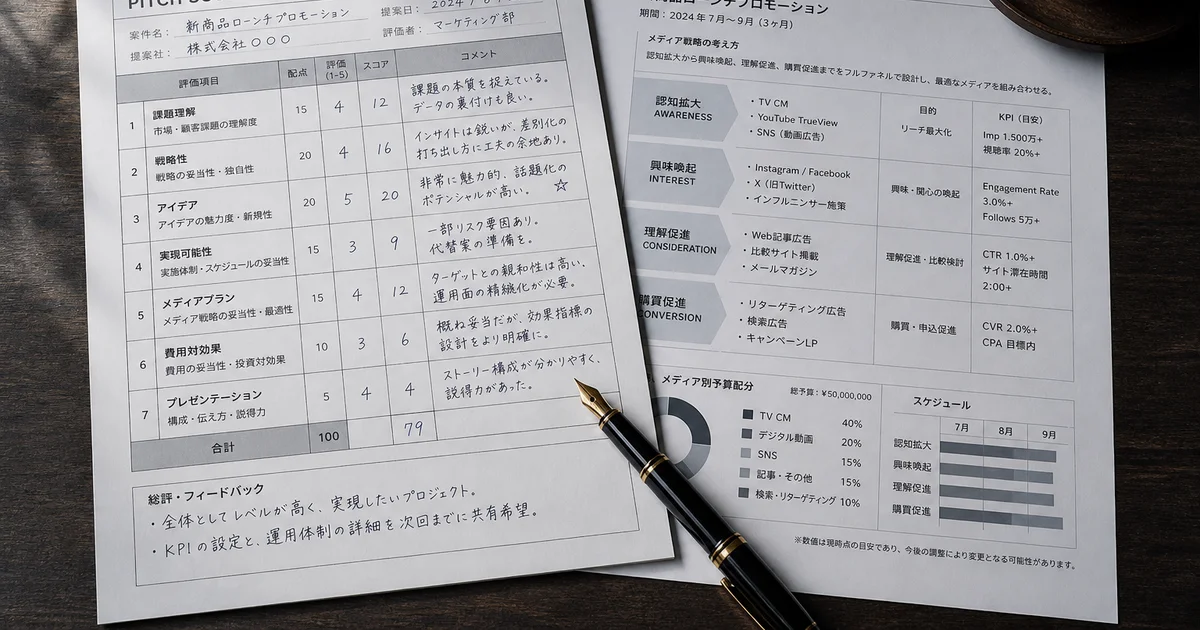
A pitch in Japan must probe four areas that are either Japan-specific or weighted differently here than in most other markets. For a broader view of how Japan fits within the wider regional advertising environment, the overview of advertising in Japan and the wider media landscape provides useful context.
Role and conflict disclosure. Ask every candidate to disclose, per media line, whether it holds selling rights to or ownership interests in the inventory it proposes, and how its remuneration is structured: commission on billings, a fee, or a combination. Ask how the agency separates your account from directly competing clients it serves, and what information protections apply. In Japan these questions are not accusations. They describe documented market structure, and a professional candidate answers them in writing without hesitation.
Measurement fluency. Ask which ratings basis applies to each broadcast area in the plan. Kanto spot trades on P+C7 (individual ratings plus commercial playback within seven days), while conventions differ by area, and TVer streaming inventory trades on impressions. Ask how the candidate evaluates delivery across those bases, and how it treats the fact that Video Research, the sole TV ratings currency, is jointly owned by broadcasters and the largest agency group. A planner who cannot state which basis settles which buy is not ready to report television in Japan.
Regional planning capability. Spot is contracted per broadcast area across 32 areas, and the Kanto area alone holds over a third of the national population. Ask candidates whether your brand needs a national plan at all, or whether buying only the areas where your distribution sits is more efficient. Ask for cases of regional-only campaigns, and for their record with time sponsorship versus spot in your category. A candidate who defaults to national buys without a regional analysis has skipped a structural question that this market specifically rewards.
Compliance capability. Since 1 October 2023, undisclosed paid promotion constitutes a misleading representation under Japanese law, and liability rests with the advertiser rather than the influencer. Ask candidates how they ensure disclosure across influencer and advertorial work, and for documented examples. For health, cosmetics and device categories, ask how claims are cleared under the Pharmaceuticals and Medical Devices Act. Ask who owns compliance for your category and how regulatory change is monitored.
What the Japanese agency contract must pin down
The selection earns you a shortlist. The contract is where the structural facts of this market are translated into enforceable obligations. Four points require explicit treatment.
Disclosure obligations. The contract should require the agency to state, per media line, whether it holds selling rights or ownership interests in the inventory it is recommending, and to disclose its remuneration basis throughout the relationship. This obligation should be ongoing, not a one-time declaration. Inventory arrangements can change between contract signature and the next planning cycle, and a single upfront disclosure does not cover that.
Net pricing and benchmarking. The treatment of commissions, discounts and incentives must be stated explicitly. Audit rights must be accepted in writing, and independent benchmarking should be agreed as a standard mechanism. No public net price benchmarks exist in the Japanese market. That makes contractual audit rights and the right to commission an independent benchmark more important here than in markets where rate transparency is available externally. If you want to understand what this kind of oversight costs and returns, media agency fees and outcomes covers the economics in detail.
Measurement basis per area and per platform. The currency that settles guarantees must be named per broadcast area and per platform in the contract. Measurement conventions differ across Japan’s 32 broadcast areas, and streaming and linear settle on different bases. Leave this undefined and you create ambiguity that tends to resolve in the agency’s favour at reconciliation.
Information protection and compliance allocation. The contract should specify how your data is separated from competing accounts the agency serves, who reviews influencer and advertorial disclosure before publication, and who clears regulated-category claims. Compliance responsibility should be named, not assumed.
Managing the relationship after appointment
A well-managed agency relationship in Japan starts with alignment, not trust. Agree performance yardsticks before signature, with both parties on the same measurement framework from day one and the per-area bases written down. A governance rhythm that lacks this foundation produces reviews in which each side arrives with different numbers for the same campaign.
Periodic reviews should revisit the disclosure obligations as plans evolve. Inventory with agency selling rights can enter a plan at any renewal, sometimes without a deliberate decision on either side. A scheduled disclosure review prevents this from accumulating silently over contract cycles.
But reviews should also recognise outperformance as readily as they identify shortfalls. A relationship in which the agency feels that strong results go unacknowledged while misses are escalated will underperform a relationship built on consistent two-way accountability. Trust is a sound foundation. Verification makes it sustainable.
If you are planning a Japanese pitch and want independent support, you can read more about how Vendor-MGT runs agency selections and pitches, independently, on the advertiser’s side, including in Japan.
Frequently asked questions
What should a media agency contract in Japan cover? The contract should require per-line disclosure of selling rights and ownership interests, with the agency’s remuneration basis stated explicitly. Net pricing should be addressed with commissions, discounts and incentives defined, audit rights accepted, and independent benchmarking agreed. The measurement basis should be named per broadcast area and per platform. Information separation between competing accounts should be specified, and compliance responsibility for influencer disclosure and regulated-category claims should be allocated to a named party.
What should I test Japanese agency candidates on during a pitch? Four areas require specific attention in Japan: written disclosure of selling rights and conflicts per media line, measurement fluency across the per-area ratings bases and streaming currency, regional planning capability including whether a national buy is actually warranted, and documented compliance capability covering influencer disclosure and regulated-category claims. A candidate who cannot address all four in writing is not ready to manage media in this market.
Should I use a Japanese agency or an international network in Japan? There is no universal answer. Japanese agency groups bring unmatched access to inventory and established broadcaster relationships. International networks bring governance models and reporting structures that may be more familiar to a global advertiser. What matters in either case is written role disclosure, measurement fluency across the per-area bases, demonstrated regional planning capability, and a documented compliance record. A well-designed selection tests exactly these factors, regardless of the agency’s origin.