 Indonesia
In this article
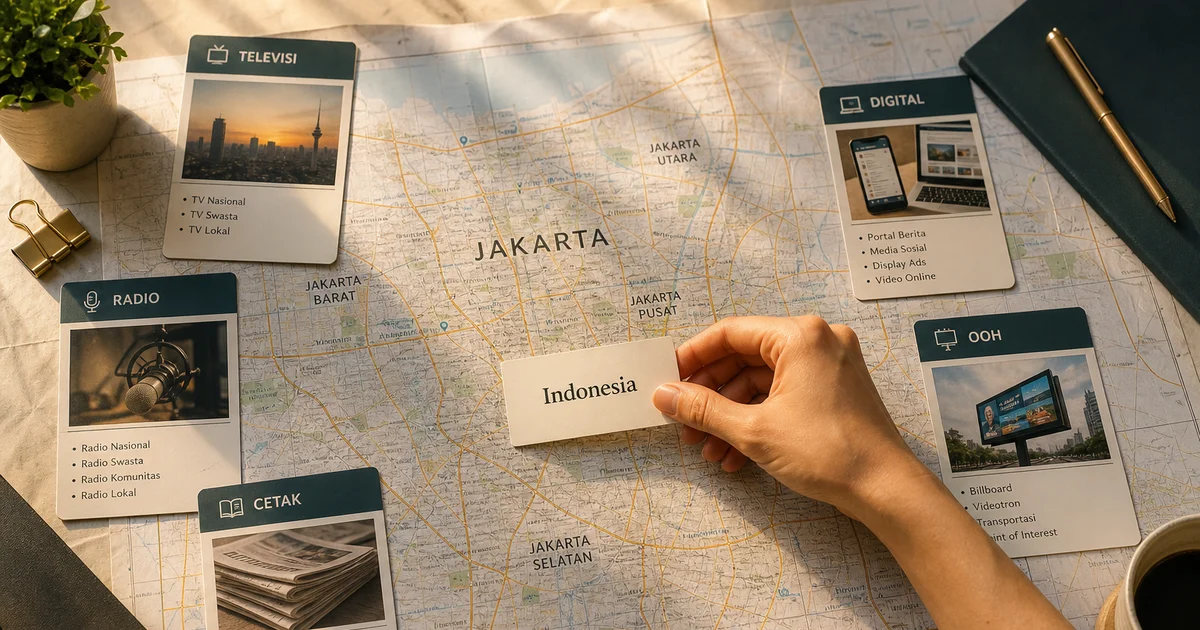
- Media channels at a glance
- Television reach and buying
- Print and newspapers
- Magazines and vertical media
- Radio and audio
- Out-of-home and ambient media
- Digital, social, influencer and retail media
- Measurement and market data
- Regulation and category restrictions
- Assessing a media plan for Indonesia
- Selecting and managing a media agency
- Where to go from here
- Frequently asked questions
Advertising in Indonesia means operating in one of the world’s most complex media environments: a vast, mobile-first archipelago of more than 270 million people, served by dominant free-to-air television groups, a digital ecosystem led by global platforms, measurement that is urban-panel based in a market with a large rural population, and a regulatory framework that is active, fast-moving and enforced. No other market in Southeast Asia combines these characteristics in quite the same way. And few reward careful preparation as consistently.
Media channels at a glance
| Channel | Who it reaches | Key planning consideration |
|---|---|---|
| Television | Mass urban and peri-urban audience | Urban panel; digital switch-off changed economics |
| Digital and social | Mobile-first population across age groups | Global platforms; gross vs net; no authoritative adex |
| Retail media | Shoppers on e-commerce platforms | Fast-growing; largely outside standard reporting |
| Out-of-home | City populations, Jakarta dominant | Fragmented; no independent audience currency |
| Radio and audio | Local and regional audiences | Permits and markets vary by city |
| Print and magazines | Specialist and upper-income segments | Declining circulations; targeted use cases remain |
Television reach and buying
Free-to-air television remains the broadest mass-reach channel in Indonesia. Large private media groups operate it: MNC Media, Emtek, Trans Media, Media Group and the group behind tvOne and ANTV, alongside public broadcaster TVRI. Each sells airtime through its own sales operations, with no shared national sales house. Indonesia completed its analogue switch-off in stages across 2022 and 2023. That transition fragmented audiences and changed the economics of the medium in ways that directly affect how television weight should be planned.
Print and newspapers
Print advertising in Indonesia serves specialist and upper-income segments rather than mass audiences, with circulations that have declined steadily. National titles reach urban professional readers; regional papers serve local markets across the archipelago. The channel remains relevant for certain categories and for advertisers whose audiences align closely with print readership. But it occupies a smaller share of total budgets than it once did.
Magazines and vertical media
Magazine advertising in Indonesia is concentrated in lifestyle, fashion, business and specialist verticals, reaching defined professional and consumer segments that are harder to address cost-efficiently on mass channels. Titles operate in both print and digital editions, with the balance between the two varying by publisher.
Radio and audio
Radio in Indonesia operates across a fragmented landscape of local and regional stations, with reach that varies considerably by city and province. The medium suits brands with local or regional strategies, or those seeking to complement television and digital campaigns with contextual frequency. Audio streaming is an adjacent and growing channel worth considering alongside traditional broadcast.
Out-of-home and ambient media
Out-of-home advertising in Indonesia is permit-driven at local government level and fragmented across many operators. Jakarta is the dominant market, and digital OOH is growing rapidly in major cities. There is no independent audience currency. Delivery claims rest on operator-supplied data, which makes independent verification important when OOH carries significant budget weight.
Digital, social, influencer and retail media
Indonesia is one of the world’s largest social media markets, with WhatsApp, Instagram, TikTok, Facebook and YouTube all commanding substantial reach. There is no single dominant local platform equivalent to LINE in Thailand or Zalo in Vietnam. The local layer that matters most is the e-commerce ecosystem: TikTok Shop now operates through Tokopedia following the majority stake completed in 2024, while Shopee and Lazada run their own advertising ecosystems. Retail media is a major and fast-growing channel that sits largely outside standard industry reporting, and influencer and KOL marketing is an established discipline at scale.
Measurement and market data
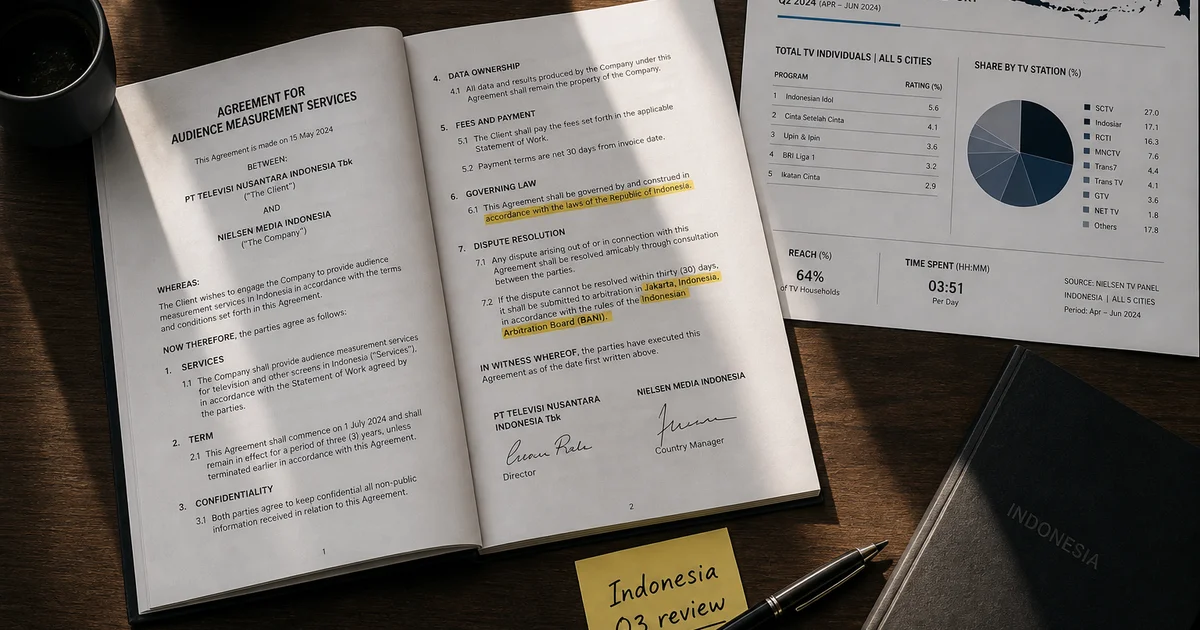
Understanding the numbers in Indonesia requires clarity about what each source actually measures. Nielsen’s television audience measurement panel, expanded in early 2023 to more than twelve thousand metered homes representing roughly 130 million urban viewers (Nielsen, 2023), is the de facto buying currency. But it is designed to represent urban viewers. Audiences outside those covered urban areas are not directly measured.
Nielsen’s cross-medium ad spend monitoring is compiled on gross rate-card values and excludes negotiated discounts by design, making it not comparable to net spend estimates. These two sources measure different things. Combining them without adjusting for the difference produces figures that do not reflect actual market economics. For advertising in Southeast Asia more broadly, this gross-versus-net distinction recurs across markets and warrants a consistent methodology.
Regulation and category restrictions
Indonesia’s regulatory environment is active, enforced and changing. Some of the most material rules for advertisers are these:
Alcohol advertising is banned from broadcast and mass media. Tobacco advertising remains permitted on television within a restricted window of 22:00 to 05:00 under the 2024 health regulation PP 28/2024, subject to strict content rules that prohibit showing the product or depicting smoking. This makes Indonesia one of the few markets where tobacco can still reach broadcast audiences at all. The 2024 regulation also banned tobacco and e-cigarette advertising on social media outright and extended the rules to e-cigarettes. Further implementing rules are in progress, and the current position must be verified with local counsel before any campaign is planned.
Medicines, traditional medicines, supplements and health-claim foods require pre-approval and registration through BPOM, the food and drug authority. Prescription medicines cannot be advertised to the public. Creative must generally use Bahasa Indonesia under language legislation, with mixed-language executions common in practice.
The Personal Data Protection Law (2022) has applied in full since October 2024, affecting targeting and data-driven marketing. Supervisory authority and implementing regulation were still being finalised after that date, and compliance practice continues to settle. Online platforms must register as Electronic System Operators (PSE) with Komdigi, the Ministry of Communication and Digital Affairs; access termination is the consequence for unregistered operators.
The government is running a large-scale enforcement campaign against illegal online gambling, blocking sites and advertising at scale. For advertisers, this raises brand-safety and influencer-vetting considerations, since placements and KOLs associated with gambling content draw enforcement. A revision of the Broadcasting Law is also under parliamentary discussion; its scope may extend toward digital platforms and is worth tracking as pending legislation.
Ramadan is the peak advertising season, and religious considerations, including halal positioning, materially shape creative strategy and placement decisions across channels.
Assessing a media plan for Indonesia
When a media plan lands on your desk, a number of questions are worth asking before anything is approved. Which part of the television audience figure rests on the urban panel, and how does the plan treat the population outside those measured areas? Is each spend figure reported gross or net, and are the definitions fixed before totals are aggregated across channels? Are placements and influencers vetted against the gambling enforcement environment, and is that process documented?
Is retail media included in both the plan and the reporting, and on what measurement basis? For restricted categories, such as the tobacco broadcast window and BPOM pre-approval requirements, who verifies compliance before material goes to air? What is the gap between rate card and net cost in this plan, and where does that difference go? Gross and net reporting does not mix. Definitions should be agreed in writing before the first number is presented.
Selecting and managing a media agency
Agency selection in Indonesia involves choosing between local independents, regional networks and global groups with local operations, each with a different proposition on pricing, data access and cross-market co-ordination. The right structure depends on whether your Indonesia business operates standalone or as part of a wider multi-market media remit. Benchmarking net prices against rate card, and verifying that measurement methodology is consistent across what the agency reports, are central to responsible vendor management in this market. Read how to select and manage a media agency in Indonesia
Where to go from here
The sections above point to each medium in detail. A realistic starting point for an advertiser new to Indonesia is to fix definitions first: gross versus net, measured versus modelled, urban versus national. Get those agreed before comparing any numbers across sources or agencies. Trust is a reasonable basis for a relationship. Verifying the numbers is what makes that relationship sustainable.
Vendor-MGT supports advertisers operating in Indonesia with independent analysis of media plans, agency selection and ongoing vendor management. Our work is paid exclusively by the advertiser; we do not buy or sell media. If you are building or reviewing a media strategy for Indonesia, visit our services page to see how we work.
Frequently asked questions
Who measures TV audiences in Indonesia? Nielsen operates the television audience measurement panel that functions as the de facto buying currency. After a two-phase expansion completed in early 2023, the panel covers more than twelve thousand metered homes representing roughly 130 million urban viewers. The panel is designed to represent urban audiences; viewing outside those covered areas is not directly measured. There is no advertiser-led Joint Industry Committee equivalent.
What are the biggest advertising channels in Indonesia? Global platforms, including WhatsApp, Instagram, TikTok, Facebook and YouTube, dominate digital reach. Television remains the primary mass-reach broadcast medium, operated by large private media groups. The fastest-growing local layer is e-commerce retail media, which sits largely outside standard industry reporting.
Can you advertise tobacco or alcohol in Indonesia? Alcohol advertising is banned from broadcast and mass media. Tobacco advertising is permitted on television only within the 22:00 to 05:00 window under the 2024 health regulation PP 28/2024, with strict content rules prohibiting any depiction of the product or smoking. Tobacco and e-cigarette advertising on social media is banned outright. The 2024 regulation tightened the regime significantly, and further implementing rules are in progress; the current position should be verified with local legal counsel before any campaign is planned.
Is digital advertising spend in Indonesia fully measured? No. There is no authoritative local industry adex survey, and estimates vary widely depending on the source and methodology. Nielsen’s cross-medium monitoring is compiled on gross rate-card values and excludes negotiated discounts, making it not directly comparable to net spend estimates. Retail media on e-commerce platforms is a substantial and fast-growing channel that sits largely outside standard reporting frameworks.
What is the PSE registration requirement for digital platforms? Online platforms operating in Indonesia must register as Electronic System Operators (PSE) with Komdigi, the Ministry of Communication and Digital Affairs. Unregistered operators can face access termination, and takedown obligations apply. Advertisers should confirm that the platforms they use are registered, particularly when working with smaller or newer digital channels.