 China
In this article
- At a glance: which channel suits your situation
- Market context
- Television: structure and reach
- Television measurement: two currencies
- Print: newspapers and the party press
- Radio and audio: a four-tier structure
- Out-of-home: urban scale and elevator media
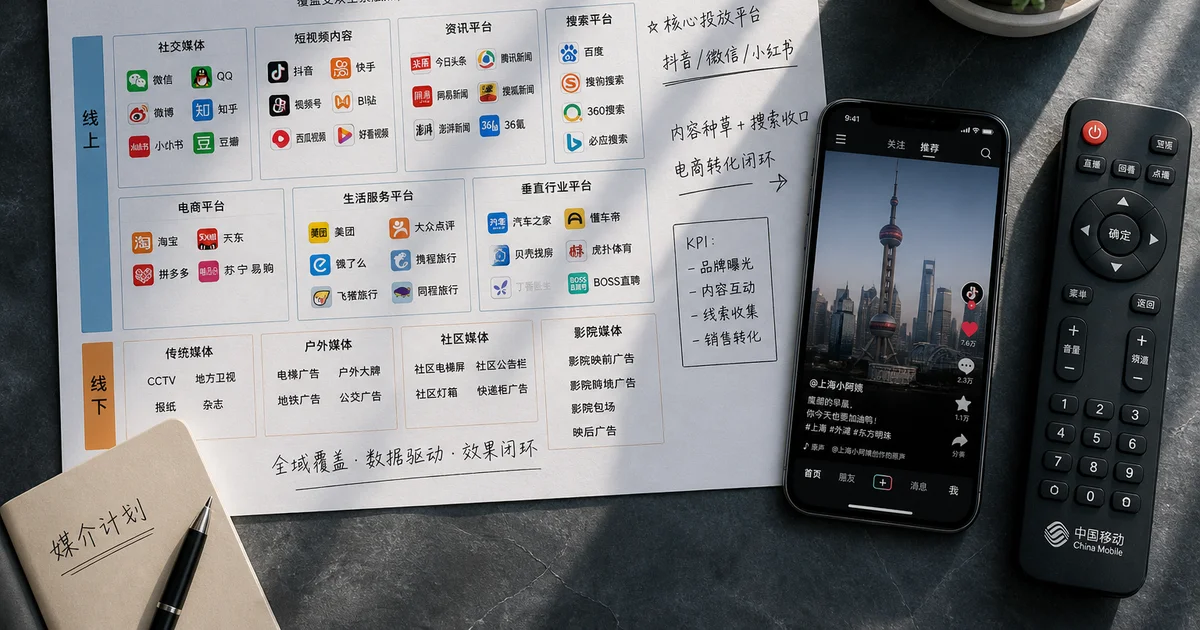
- Digital, social and influencer: closed ecosystems
- Regulation: what every advertiser must know before going live
- Buying transparency: what the structure means for your contract
- Assessing a media plan: questions to press on
- Selecting and managing a media agency in China
- Frequently asked questions
Advertising in China means operating in the world’s second-largest advertising market, and one of its most structurally distinctive. Digital channels account for roughly four fifths of total ad spend. Television operates under strict time rules that have pushed significant money into sponsorship formats. Two separate television measurement currencies coexist. And media buying runs through intermediary layers that make contractual transparency a first-order operational concern, not something to address after the fact.
At a glance: which channel suits your situation
| Your situation | Where to start |
|---|---|
| Building national mass reach | Television through CCTV and the provincial satellite channels |
| Reaching daily digital life | Douyin, WeChat and the major platforms |
| Understanding who sits between you and the media owner | The buying transparency section below |
| Understanding what TV audience numbers mean | The television measurement section below |
| Entering China from abroad | Agency selection and contract structure |
Market context
China had 1.30 billion internet users in October 2025, equal to 91.6 percent of the population (DataReportal, Digital 2026 China). Digital channels account for roughly four fifths of Chinese ad spend, according to dentsu projections. Commerce platforms, led by Alibaba, JD and Pinduoduo, are among the largest advertising sellers in the world. That digital dominance shapes how every other channel is positioned, priced and measured.
For context on how neighbouring markets compare, advertising in Japan and advertising in South Korea each present structural particularities worth reviewing alongside China.
Television: structure and reach
Chinese broadcasting is organised in four administrative tiers: central, provincial, city and county, dating from a 1983 policy decision. For a national advertiser, the practical map is CCTV, the provincial satellite channels distributed nationally via cable and IPTV, and provincial terrestrial and city channels for regional coverage.
Broadcast rules in force since 2010 cap commercial advertising at 12 minutes per hour, with an 18-minute ceiling across the 19:00 to 21:00 prime window. Since January 2012, drama episodes may not be interrupted by commercials. Partly as a result, sponsorship, programme naming rights and product placement became a major monetization route on variety shows and dramas, so a large share of television money sits in negotiated deals rather than rate-card spots, which raises its own valuation and audit questions.
Television measurement: two currencies
CSM Media Research provides the panel-based ratings currency, historically a joint venture between CTR Market Research and Kantar Media. The regulator NRTA separately launched China Audiovisual Big Data (CVB) in December 2019, drawing on census-style viewing data from more than 140 million cable TV and IPTV users.
These two systems can produce different numbers for the same programme. Any TV audience claim in a media plan needs its measurement basis stated explicitly before the plan is approved.
Print: newspapers and the party press
Print in China is organised along the same administrative tiers as broadcasting, and the party press remains institutionally significant at national, provincial and local levels. Newspaper readership has contracted with digital growth, but certain titles retain strong authoritative positioning with specific professional and government audiences.
Radio and audio: a four-tier structure
Radio follows the same four-tier administrative structure as television, with national, provincial, city and county stations. Digital audio and streaming services have grown substantially, shifting listenership patterns, particularly in urban and commuter contexts.
Out-of-home: urban scale and elevator media
Focus Media, China’s largest elevator-media operator, claims more than 3 million screen and poster terminals reaching some 400 million urban residents daily across more than 300 cities (company figures). Digital OOH is a significant channel, but delivery claims are operator-reported, and verification provisions should be addressed in contracts.
Digital, social and influencer: closed ecosystems
ByteDance’s Douyin is consistently ranked advertisers’ top platform. Tencent’s WeChat operates at near-universal daily reach. Baidu leads search. Google, Facebook, Instagram and YouTube carry no inventory reaching mainland users.
The large platforms operate as closed ecosystems with limited cross-platform independent measurement. Worth noting: advertising in Hong Kong operates under a separate regulatory and platform environment from the mainland.
Regulation: what every advertiser must know before going live
Advertising in China is governed by the Advertising Law (comprehensively revised in 2015, most recently amended in 2021), enforced by SAMR. Superlative terms such as “the best” or “highest level” are prohibited, with fines of RMB 200,000 to 1,000,000. Tobacco advertising is banned across mass media, public places, public transport and outdoor.
Ads for medical treatment, drugs, medical devices, health food and formula foods for special medical purposes require government pre-review before publication, online included. The Internet Advertising Management Measures (effective 1 May 2023) require that online ads be identifiable, that paid search results carry an advertisement marker, that pop-up ads close with one click, and that influencer posts with purchase links be labelled as ads.
Celebrity and influencer endorsements are separately regulated: since October 2022, endorsers must have actually used the product they endorse, are personally liable for false advertising, and are barred from endorsing several categories outright.
Live-streaming e-commerce is separately regulated by supervision measures effective 1 February 2026. AI-generated creative published online requires explicit labels under measures effective 1 September 2025. PIPL (effective 1 November 2021) governs personal data, with fines up to RMB 50 million or 5 percent of prior-year turnover for serious violations.
This article provides orientation, not legal advice. Rules change, and local legal verification is required before any campaign goes live.
Buying transparency: what the structure means for your contract
Media buying in China often runs through broker firms that pool budgets between agencies and media owners, with rebate arrangements set in confidential agreements. In March 2026, a Shanghai court sentenced the former chief investment officer of GroupM China to life imprisonment for accepting bribes in a case involving approximately RMB 1.2 billion, tied to broker-led media buying between 2017 and 2020; he is appealing. Court proceedings and trade-press reporting describe arrangements in which rebates were not fully passed back to advertisers.
That is the factual basis for why contracts in this market need explicit rebate, audit and disclosure provisions, agreed before any buying begins.
Assessing a media plan: questions to press on
Before approving a plan for this market, an advertiser should be able to answer the following. Which measurement basis does each television claim rest on: CSM panel or CVB big data? How are sponsorship and placement deals valued against rate-card inventory, given the 12-minute cap and prime-window rules? Which intermediaries sit between the agency and the media owner, and what rebate arrangements apply? Are digital figures platform-reported, third-party-measured or modelled, and how is invalid traffic handled? Are pre-review approvals in place for regulated categories? And does AI-generated creative carry the required labels?
If any of those questions go unanswered, the plan is not ready to approve.
Selecting and managing a media agency in China
Agency selection is the structural decision for any advertiser entering this market. In China, it carries a specific additional question: which buying layers and rebate arrangements sit behind a candidate’s pricing, and what audit and disclosure rights does the contract secure? The full process is covered in: How do you select and manage a media agency in China?
For a broader view of how media landscapes and agency selection interact across markets, the media landscapes overview and the media agency selection hub are the natural starting points.
Frequently asked questions
Who are the biggest advertising platforms in China? Douyin (ByteDance) is consistently ranked the leading platform for advertising investment. WeChat (Tencent) operates at near-universal daily reach. Alibaba (Taobao and Tmall), JD and Pinduoduo run large retail media operations. Baidu leads traditional search. Kuaishou, Xiaohongshu and Bilibili are significant for specific audience segments. Google, Facebook, Instagram and YouTube are not accessible in mainland China.
Who measures TV audiences in China? Two systems operate simultaneously. CSM Media Research provides the commercial panel-based currency, historically a joint venture between CTR Market Research and Kantar Media. The regulator NRTA launched China Audiovisual Big Data (CVB) in December 2019, drawing on census-style data from more than 140 million cable TV and IPTV users. The two systems can produce different audience figures for the same programme; every audience claim in a plan should state which basis applies.
What advertising rules should I know before planning in China? The Advertising Law prohibits superlative terms such as “the best,” with fines of RMB 200,000 to 1,000,000. Tobacco advertising is banned across mass media, public places, transport and outdoor. Pre-review by government authorities is required for medical, health food and certain other regulated categories before any publication, including online. Online ads must be clearly identifiable, and AI-generated creative requires explicit labels under measures in force since 1 September 2025. Local legal verification is required before any campaign goes live.
How does media buying transparency work in China? Buying often runs through broker intermediaries between agencies and media owners, with rebate arrangements that have historically not always been fully disclosed to advertisers. The March 2026 Shanghai court case involving GroupM China illustrates the documented risk. The practical response is contractual: rebate disclosure, audit rights and clear reporting obligations should be agreed before any agency appointment or buying commitment is made.
Agree the measurement yardstick before the plan is approved, know who sits between you and the media owner, and verify rather than trust. Vendor-MGT works with advertisers in China on agency selection, media audits and ongoing vendor management, independently, on the advertiser’s side. If you are mapping your approach to advertising in China, visit vendor-mgt.com to understand how we work.