In this article
- Why these signs can exist at all: media is not a commodity
- Performance has stalled, and explanations have replaced solutions
- Transparency in reporting and buying has declined
- The team working on your account has changed
- Strategic value has been replaced by execution
- Seeing the signs early: what detection looks like in practice
- What to do with what you find: repetition is the dividing line
- Conducting the review: what the process looks like
- Frequently asked questions
The clearest signs to change your agency are a pattern of missed KPIs, declining transparency in reporting, unexplained team changes, and a relationship that has drifted from strategy to execution. But the more important question sits underneath: how early do you see them? A sign detected early is a correction. The same sign detected two years late is a crisis. The difference between the two is rarely luck - it is process.
You have probably felt it before you could name it. Reports arrive late, or the numbers look polished in a way that makes them hard to interrogate. Your budget has grown, but the strategic conversations have not kept pace. Perhaps the senior team that won the pitch has quietly changed. These are not isolated frustrations. They are data points - and whether they stay a vague feeling or become documented, actionable knowledge depends on how you watch the operation.
Why these signs can exist at all: media is not a commodity
There is no such thing as a kilo of airtime or a kilo of internet space. Every GRP comes with quality characteristics, and one impression is decidedly not the other: audience, context, position, moment and delivery all shape what a unit of media is actually worth. That is what makes media buying more complex than commodity purchasing - and, frankly, more interesting.
But that complexity is also the space in which signals can arise. Gross presented as net, primetime that turns out not to be primetime, an impression worth less than reported - none of this could exist in a true commodity market. Complexity is where value quietly leaks.
Which leads to a principle worth watching for: complexity is partly a choice. Media can be made simple - clear definitions, comparable numbers, reporting a non-specialist can follow - without denying the sophistication underneath. Simplicity is not just client-friendly; it closes off room for manoeuvre. And the reverse deserves attention too: the more complex something is made, the more can be earned in the folds of it. Not every complex explanation hides something - media genuinely is complex - but when explanations keep getting more complicated rather than clearer, that is a signal in its own right.
Performance has stalled, and explanations have replaced solutions
The most objective sign that a review is overdue is sustained underperformance against agreed KPIs. One weak quarter can have legitimate causes: a market shift, a competitive surge, an inventory constraint. Two consecutive quarters of the same story, with explanations that vary but conclusions that do not change, is a different matter entirely.
Watch for the pattern where your agency presents reach and frequency data with confidence, but becomes vague when you ask about business outcomes. Metrics such as impressions and share of voice are useful, but they should connect to revenue, leads, or brand equity in a traceable way. When that chain of evidence breaks down, it often signals that the agency is reporting what it can defend rather than what you need to know.
At this point, consider whether a formal media agency review - a pitch, a renegotiation, an audit, or a standing vendor management arrangement - is the right next step.
Transparency in reporting and buying has declined
Transparency is not a one-time declaration in a contract. It is demonstrated every month through the quality of data you receive, the ease with which you can verify it, and the willingness of your agency to show their working.
If your agency has become reluctant to share buying data, trading terms, or the methodology behind their planning decisions, that is a structural warning signal. The same applies when third-party verification is met with resistance rather than cooperation. A well-run agency welcomes scrutiny because it confirms the quality of their work.
This matters particularly for advertisers operating across multiple markets. Practices that are opaque in one market may indicate wider issues in how conflicts between trading interests and campaign objectives are managed. Reviewing your agency evaluation criteria against the current reality of the relationship is a practical way to identify where the gap has grown.
The team working on your account has changed
Senior attention at the pitch stage is not always what you receive once the contract is signed. Staff turnover at agencies is real and sometimes unavoidable. What matters is how it is managed: whether you are informed, whether incoming team members are briefed properly, and whether the strategic continuity of your account is maintained.
In practice this rarely announces itself. There is an explanation for one departure, then the person is gone, and a new face appears. Most advertisers give the new team the benefit of the doubt - often rightly so. The question is not whether you extend that chance, but whether you do it consciously: aware of how much has changed, what knowledge left, and what it is costing. When turnover is isolated and recorded as it happens, you can judge it on its merits - and sometimes even attach a number to it. When it accumulates unnoticed, you wake up one day no longer recognising the people in the room, with the institutional knowledge of your business gone and onboarding quietly become your problem instead of theirs.
Strategic value has been replaced by execution
A media agency relationship should evolve. In the first year, much of the value lies in building the foundation: audience frameworks, channel strategy, measurement architecture. By year two or three, you should be receiving proactive recommendations, scenario planning, and a genuine perspective on how your category is changing.
When strategic dialogue has been replaced by execution updates, when meetings become progress calls and your agency has stopped challenging your assumptions, the relationship has drifted into a commodity state. This is not always the agency’s fault. Sometimes the client side has allowed the relationship to narrow. But regardless of cause, the result is the same: you are paying for partnership and receiving administration.
For context on what a genuinely productive agency relationship looks like across its full lifecycle, the criteria set out in media agency selection criteria: what predicts a good partnership provide a useful reference point.
Seeing the signs early: what detection looks like in practice
Everything above assumes you notice. The uncomfortable truth is that without benchmarks and a fixed verification rhythm, most of these signs surface late - as a feeling first, as evidence much later. With a standing process, they surface as data, early, while they are still small. Three examples from practice, anonymised.
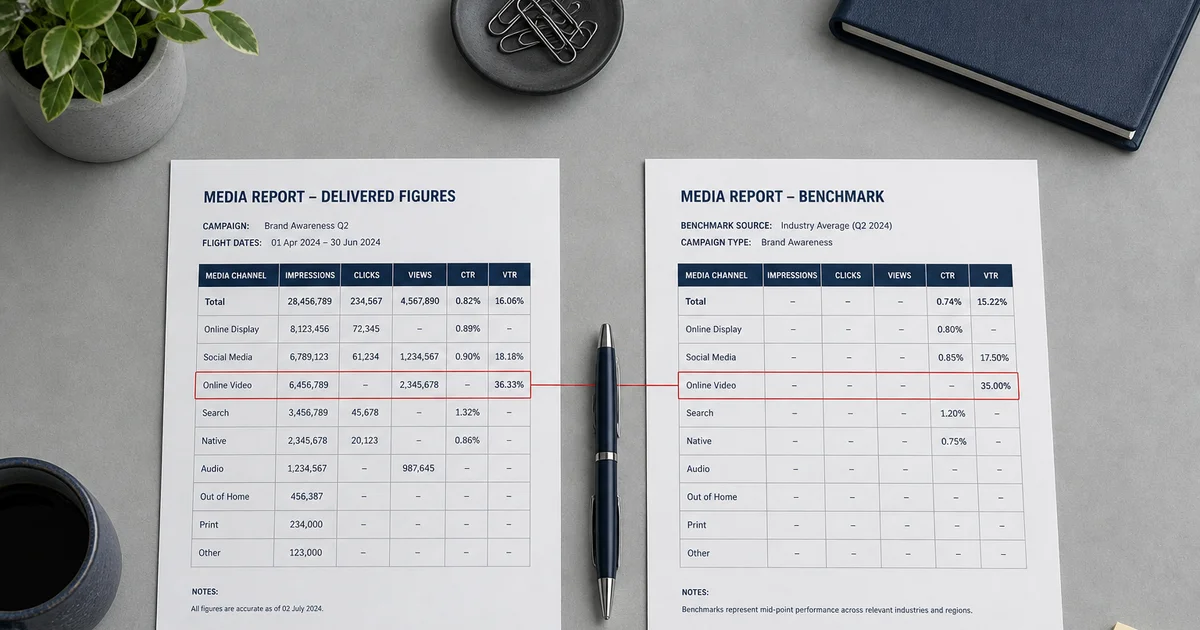
Gross presented as net. In one engagement, rates were repeatedly presented as net when the benchmarks clearly indicated they were gross - a difference of the classic fifteen percent. The question was asked once, twice, three times; each time the answer was that the figures really were net. When the evidence finally left no room, the explanation was that a colleague had made a mistake - the invoicing, fortunately, had been correct. No drama followed, and no pitch either. But the correction landed, and it did not happen again. The agency had learned something valuable: this client is alert, and the process brings things to the surface.
The taxi with the familiar dents. An advertiser bought taxi advertising and received proof-of-posting photographs showing, apparently, a fleet of different vehicles - different licence plates each time. Except the same dents kept appearing in exactly the same places. The probable reality: one taxi, many plates. And here the right question is not automatically “what is our agency doing” - it may well be the agency itself being deceived by its supplier. Early detection turned this into a joint conversation about the supply chain rather than a late-stage crisis of trust.
Primetime, inverted. An audit once found that a commitment of seventy percent primetime delivery had in reality been the exact reverse: thirty percent primetime, seventy percent off-peak. The numbers were simply flipped. Without the right process, a figure like that passes unchallenged for years - the reporting looks complete, and nothing in it invites the comparison that exposes it.
What these cases share is not the irregularity - it is the calm. When the record does the work, a finding is established almost drily: here is the benchmark, here is the delivery, here is the gap, what happened? That composure is not indifference. It is what a good process buys you: findings become manageable conversations instead of confrontations, and the concerning cases - because some of them are genuinely concerning - are caught while they are still correctable.
What to do with what you find: repetition is the dividing line
A single error, corrected, is exactly that - an error. Agencies are organisations of people, and mistakes in your favour and against it will both occur. The dividing line is repetition: recurring errors that consistently land in your disadvantage require a different conversation.
Even then, the answer is rarely an immediate pitch. The emotional review is a trap: a review launched in anger negotiates from frustration, briefs from grievance, and the market sees it. What early detection makes possible is the unemotional version - the record turns a feeling into a file, and a file into a planned decision. In practice, the most common outcome is not “pitch tomorrow” but bringing the planned pitch forward: the review you intended for year four happens in year three. The relationship gets a genuine chance to right itself, and if the pattern repeats regardless, the decision has already ripened.
We have seen advertisers discover serious irregularities and still stay - resolving the matter firmly, continuing the relationship, and moving the next review forward rather than declaring war. That is not weakness. It is the recognition that switching agencies has real costs and real risks of its own, and that a decision this size deserves better than a reflex.
One honest note: no process finds everything. In our experience, a standing vendor management arrangement surfaces the large majority of issues early - roughly eight out of ten. That puts the statistics firmly on your side, but it is detection, not a guarantee. Which is precisely why the other instruments exist: the targeted audit for the suspicion the record cannot resolve, and the periodic pitch as the baseline reset you run regardless. No single instrument finds everything - the combination finds most of it.
Conducting the review: what the process looks like
Recognising the signs is the first step. Knowing what to do next is the second.
A review does not automatically mean a full pitch. Sometimes a structured performance conversation, a renegotiation of terms, or a targeted audit resolves the issue and resets the relationship on a stronger footing. When a formal pitch is necessary, expect the active process from brief to signed contract to run between ten and sixteen weeks. Allow more time if your budget or geographic footprint is complex.
Before you decide which route is appropriate, it helps to put a score on the relationship as it currently stands. An agency scorecard gives you a structured framework for doing exactly that - turning subjective discomfort into documented, defensible evidence that can support whatever decision follows.
The signs to change your agency are rarely dramatic. They accumulate gradually - and the advertisers who see them early are not the ones with better instincts. They are the ones with a better process.
Frequently asked questions
What are the most common signs to change your agency? The most common signs include sustained KPI underperformance without credible remedies, declining transparency in media buying and reporting, significant unexplained changes to the account team, a relationship that has narrowed from strategic to purely executional, and explanations that keep getting more complex rather than clearer. When two or more of these appear together, a structured review is justified.
How early can these signs realistically be detected? Far earlier than most advertisers assume - provided there is a process watching for them. With benchmarks and a fixed verification rhythm in place, discrepancies in rates, delivery and reporting tend to surface within the same campaign cycle, while they are still correctable. Without one, the same issues typically surface as an uneasy feeling first and as evidence only much later.
Does finding an irregularity mean I should change agencies? Not automatically. A single error, corrected, is an error - repetition in your disadvantage is the dividing line. Even then, the most common sensible outcome is not an immediate pitch but bringing the planned periodic review forward, giving the relationship a genuine chance to right itself while the decision ripens on evidence rather than emotion.
How do I resign from an agency relationship professionally? Give formal written notice according to the notice period in your contract, typically 30 to 90 days. Arrange a transition briefing so that incoming agency or in-house teams receive all data, creative assets, platform access, and audience files. Keeping the process structured protects your campaigns and your standing in the market.