In this article
- What each media agency review option actually solves
- Signs that point toward a pitch
- An agency review as a routine
- When renegotiation is the smarter move - and why it usually is not
- When an audit is the right instrument
- The fourth option: vendor management
- So which intervention do you need?
- Frequently asked questions
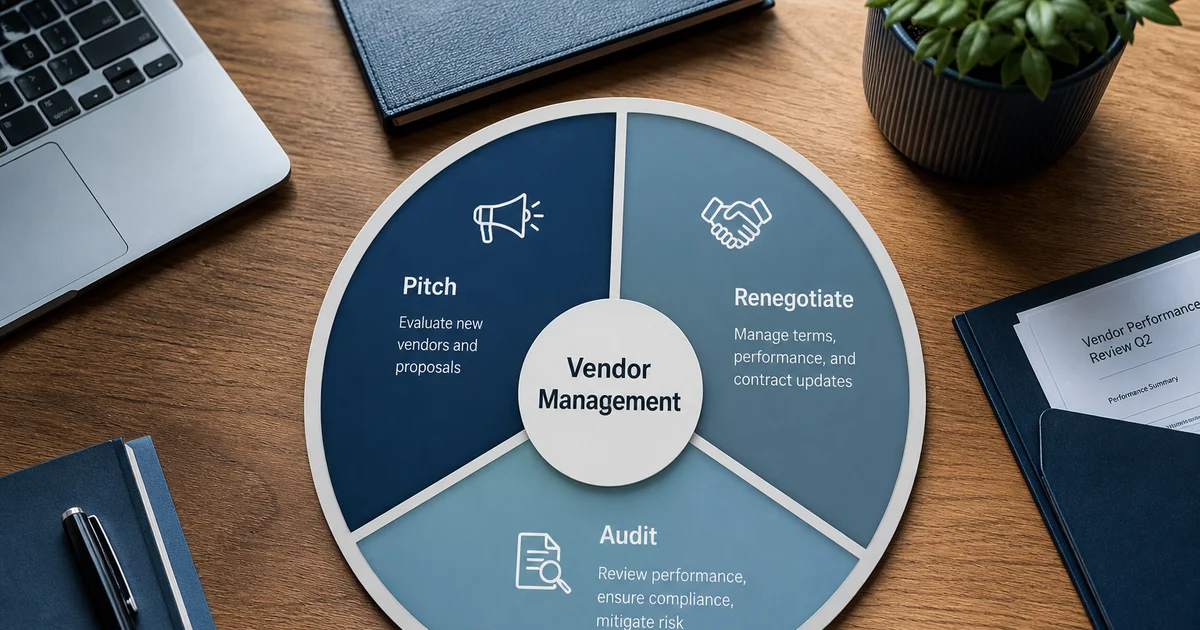
When performance slips or trust erodes, a media agency review option could provide the solution: a full pitch when the relationship is up for review, a renegotiation when the contract is the constraint, an audit when you need evidence on a specific problem, and vendor management as the standing practice in between. Choosing the wrong intervention wastes months and puts your next media cycle at risk.
Something feels off. CPMs are drifting upward, reporting feels thin, or your agency contacts keep changing. You know something needs to happen, but you are not sure whether you need a full pitch, a firm conversation about contract terms, or an independent review of what is actually being bought. These interventions may look similar from the outside but solve very different problems. Getting the diagnosis right before you commit to a path is the most valuable thing you can do. One principle sits above all of them: a periodic pitch is not optional. The real question is whether anything justifies moving it forward - or postponing it.
What each media agency review option actually solves
A pitch reviews the agency in a clear and transparent way. It is the right choice when the underlying relationship has broken down beyond repair, when the agency’s strategic capabilities no longer match your business, or when you have not run a competitive process during the last 2-4 years.
A renegotiation changes the commercial terms with the current agency. It is appropriate when the core relationship is working but the situation no longer reflects your reality, when fees have not been tracked against scope creep, or when buying conditions have shifted in the market and your current deal no longer reflects them.
An audit keeps the agency and the contract intact, at least initially and as an objective. It is an independent, evidence-based examination of whether the agency is delivering what it has promised: media pricing, inventory quality, transparency practices, competitive performance and compliance with the contract you already have. Audit findings sometimes lead to renegotiation, and occasionally they make the case for a pitch, but the audit itself is a diagnostic tool, not a verdict. The Audit and vendor management section covers this in detail. And there is a fourth option, covered below, that in many cases removes the need for an audit altogether: vendor management.
Signs that point toward a pitch
A pitch is warranted when you face a structural mismatch, not a contractual one. If the agency cannot support a channel you now need, if senior talent has left and been replaced by a team that does not understand your business, or if a merger has altered their capabilities or conflicts of interest, no amount of renegotiation fixes that.
An agency review as a routine
That said, a pitch does not have to start from a place of breakdown. We recommend holding a formal review of your agency relationship every two to four years as a matter of routine, and every five years at the very latest. Markets shift, your own business evolves, and the agency that was the right fit three years ago may simply not be the right fit today. A structured review keeps the relationship honest and ensures you are not drifting into complacency on either side. And keep in mind: an agency pitch does not automatically replace the incumbent. It is a fair and objective process to select the best fit media agency.
The same logic applies if you have never benchmarked your current setup. Many advertisers have been with the same agency for many years without ever running a formal review. That is not a sign of a great relationship. It is a gap in governance. If you do not know whether your agency is competitive, a pitch gives you that answer also if the incumbent ultimately wins.
Before you commit, read what the signs are that it is time to review your media agency, they are not always as obvious as they appear. A well-structured media agency pitch typically runs between three and five months. That timeline may have some implications for your media calendar.
When renegotiation is the smarter move - and why it usually is not
Renegotiation looks attractive on paper: keep the agency, fix the terms. In practice, it is the hardest of these options to pull off.
The reason is position. An incumbent agency, years into a contract, tends to feel entitled to the arrangement as it stands. Without genuine competitive pressure, there is little reason to move - and advertisers often discover that meaningful movement only comes with the machinery of a pitch behind the conversation. A renegotiation works when both sides are genuinely constructive, and that is rarer than it should be.
Where it does work well is when something external has changed that both parties can see: a media landscape shifting under the plan, or a channel mix that no longer resembles the one the contract was written for. Then the conversation is about adapting to reality rather than conceding ground, and an agency with a positive mindset can move.
The strongest position remains one supported by data. If you know your current CPMs against agency evaluation criteria and market benchmarks, and you can show the gap with evidence, the conversation moves from opinion to fact. Agencies respond well to evidence. They respond less well to pressure without proof.
But be honest with yourself about the more common scenario: by the time an advertiser feels the need to renegotiate, the trust required to do it constructively has often already thinned. In our experience, most advertisers who reach that point are better served by a structured pitch - which, it is worth repeating, does not automatically replace the incumbent. It gives the same conversation the framework it needs to produce a result.
When an audit is the right instrument
An audit is a serious, complex product - and precisely because of that, it is rarely the best first step. By the time an audit report is delivered, the period it examines is months behind you. It is a photograph: a high-resolution picture of one moment in the relationship, taken after the fact.
Where an audit genuinely earns its place is when you face a specific, targeted problem. When you find yourself thinking “I have a real challenge here, and I no longer understand what is happening” - that is when an audit is the right product. It examines against benchmarks, verifies that the inventory bought matches what was reported, checks fee structures against the contract, and reviews transparency practices around programmatic and third-party costs. It answers a defined question with documentation.
What it cannot tell you is whether the agency is the right strategic partner for the future. That is a qualitative judgment. And what it cannot do is watch the operation as it runs. For that, there is a better arrangement - and in our experience, it prevents the need for an audit in roughly eight out of ten cases.
The fourth option: vendor management
Vendor management does not fit the pitch-renegotiate-audit sequence, because it is not an event. It is a practice - and it is where the performance of your media investment is protected between pitches.
If an audit is a photograph, vendor management is the video. Instead of reconstructing what happened after the fact, you watch the operation as it runs: reporting, fees, buying conditions, media performance and compliance with what was agreed, reviewed on an ongoing basis rather than once every few years.
In practice, the rhythm follows the media activity. Campaign-based advertisers work per flight; always-on advertisers settle into a fixed cycle. Within that rhythm there are defined moments where the vendor manager joins the line: when the strategy lands, when plans come in for purchase approval, at evaluation after the activity, and - for longer campaigns - mid-flight. The agency remains fully responsible for the work. The advertiser, supported by the vendor manager, sets the course.
Three things make vendor management more than continuous checking.
Corporate memory. Marketing teams rotate, procurement contacts change, and with every departure, knowledge of what was agreed and why walks out the door. Agencies, meanwhile, remember everything. Vendor management builds that record on the advertiser’s side - commitments, deviations, explanations, patterns - so the relationship is governed by what was actually agreed, not by whoever happens to be in the room. A simple system of red, amber and green flags turns that record into decisions.
A buffer for the hard conversations. When difficult questions need asking - about rates, disclosures, or a number that does not add up - the vendor manager can ask them first, specialist to specialist. The relationship between advertiser and agency stays clean while the substance gets resolved where the expertise sits.
An on-the-job programme. Because the advertiser’s team runs the process - receiving strategy, approving purchases, leading evaluations, deciding what the agency does and does not need to report - they learn how to manage a media agency by doing it. The capability stays in-house and compounds.
For the agency, this is not a threat - provided they are constructive and have nothing to hide. Expectations are explicit, good performance gets recognised as visibly as problems do, and both sides know where they stand years into the cooperation. Vendor management is the professionalisation of the relationship, and done well, it helps both sides.
And when the operational picture does start to drift - rates creeping away from commitments, disclosures thinning, the same questions going unanswered - those signals surface early, while the operation runs. In roughly eight out of ten cases, this prevents the need for an audit altogether. And when an audit is warranted, it starts from evidence instead of a blank page. The video tells you when to take the photograph.
So which intervention do you need?
The logic is simpler than the four options suggest, because one of them is not optional.
The pitch is the baseline. Run a structured review every two to four years, five at the very latest. Signals from vendor management, audit findings, or a contract that no longer reflects the market can all justify bringing it forward. Nothing justifies skipping it indefinitely.
Renegotiate only when you are certain the pitch can wait. That means the relationship is genuinely good and constructive, the contract is reasonably current, performance is demonstrably sound, and something external - a shifted landscape, a changed mix - gives both sides a reason to move. If any of those is in doubt, the pitch is the better frame for the same conversation.
Audit when you have a specific, targeted problem. When you no longer understand what is happening in a defined part of the operation, an audit answers that question with documentation.
Vendor management is what runs in between. It protects performance, builds the memory, surfaces the signals - and tells you when any of the above needs to happen earlier than planned.
Frequently asked questions
What is an agency review? An agency review is a formal process in which an advertiser evaluates whether their current media agency continues to meet their commercial and strategic requirements. A periodic review is highly recommended: every two to four years, and every five years at the very latest.
How do you evaluate an agency? Evaluation depends on the question you are asking. A contract audit assesses whether commercial commitments are being met. A performance review compares delivery against agreed KPIs. A competitive pitch uses a structured scoring framework to compare the incumbent against alternatives. Each method requires different data and a different process. See how you score a media agency in a selection for the scoring framework.
Who are the big 6 media agencies? The six largest global media agency groups are WPP (GroupM), Publicis Groupe, Omnicom, IPG Mediabrands, Dentsu, and Havas. Most large advertisers work with holding-company agencies or their network brands. Independent specialist agencies are also a viable option, particularly for mid-market advertisers or those with specific channel or market requirements.
What are the 4 types of advertising media? In the US, the answer would be: print, broadcast (television and radio), out-of-home, and digital. Europe diversifies the categories further. In practice, modern media planning rarely treats these as separate silos. Programmatic buying, connected TV, and retail media have blurred the boundaries considerably. A competent media agency manages channels in an integrated framework.