In this article
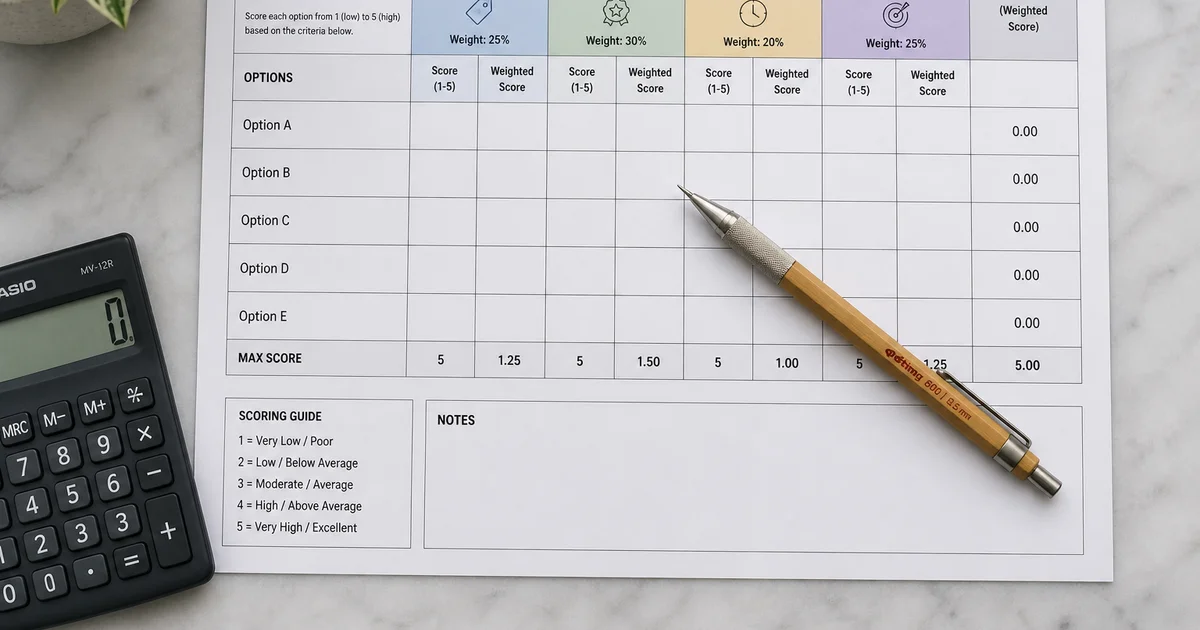
An agency scorecard is a structured evaluation grid that assigns numerical weights to predefined criteria, strategy, pricing, team, and transparency, so that every agency in your pitch is assessed on the same terms, by the same people, at the same moment. Without one, selection decisions default to whoever spoke most confidently in the room.
Most advertisers underestimate how much inconsistency creeps into a panel review when each evaluator works from instinct rather than a shared framework. One panelist ranks on creativity; another on rate cards; a third on the presenter’s energy. The scorecard removes that noise. It does not remove judgment. It channels it.
Why a scorecard matters
You can spend weeks building a tight agency shortlist and still arrive at a poor decision if the final comparison is handled informally. The shortlist determines who enters the room; the scorecard determines how fairly you compare what happens inside it. Accurate scoring is relevant for both the advertiser as well as the participating media agencies.
A well-designed scorecard does three things at once. It forces alignment on what your organisation actually values before the pitch begins. It gives every evaluator an identical reference point during presentations. And it produces a relevant record of how the decision was reached, which matters when internal stakeholders want to discuss the outcome, or when a losing agency asks why. It also enables the pitch director to collect any specific concerns, that may need to be addressed towards the prospective winner, when going in to the negotiations.
For multi-market organisations pitching across regions, a common scorecard also makes it possible to aggregate scores and spot divergence between local markets. A market that scores an agency 50 out of 100 while another scores the same agency 25 deserves a conversation. Were the criteria applied consistently, or does the local context genuinely justify the gap?
What belongs in an agency scorecard
The criteria in a scorecard should map directly to the agency evaluation criteria that your organisation identified as predictive of a good partnership. This combined with the key pre-agreed business objectives, can create a solid scorecard. Do not use a generic template borrowed from another industry.
That said, most effective scorecards for media agency selection share a common architecture.
Strategic thinking and brief response: does the agency demonstrate genuine understanding of your business problem, or does the response feel recycled from a previous pitch? This category typically carries a high weight (15% to 30%) because strategic alignment is the hardest thing to retrofit.
Media planning and channel expertise: how credibly does the agency address the specific channels, formats, and audiences & personas relevant to your markets? If you operate in markets with distinct media dynamics, where digital penetration and out-of-home spending diverge sharply from Western norms, for instance, local channel knowledge deserves its own sub-criterion.
Team and day-to-day accountability: who will actually work on your account, and how senior are they? Many scorecards fail here by evaluating the pitch team rather than the account team. Ask agencies to name the individuals who will be present on day ninety, not just on pitch day. Make sure you speak with them.
Pricing, commercial terms, and transparency: fee structures, rebate disclosure, principal trading arrangements and audit rights. This category is often underweighted in initial scorecards and then becomes the primary source of friction twelve months into a contract.
Anticipated media rates and trading conditions: at what prices does the agency expect to buy media on your behalf, and how specific are those commitments? This category is frequently left out of scorecards altogether, yet the rates submitted during the pitch become the reference point for compliance checks across the full contract term. Take control over the structure of the submission as well as the figures and ensure this chapter caters to alternate scenarios and future modifications (for example the media mix may change).
Culture, process, and ways of working: reporting cadence, escalation paths, responsiveness standards. Difficult to score in a pitch, but evaluators who have managed agency relationships know that misalignment here erodes value faster than almost any other factor.
How to weight the criteria without distorting the outcome
Weighting is where most scorecards go wrong. A common mistake is assigning equal weight to unequal priorities, producing a composite score that reflects averages rather than what the organisation genuinely needs.
A more robust approach is to agree on weights before you see any agency response. Run a brief alignment session with your evaluation panel, procurement, marketing, finance, and where relevant legal, and ask each person to allocate 100 points across the criteria independently. Average the results. Where there is disagreement of more than fifteen points on a single criterion, discuss it explicitly before the pitch begins.
That conversation is often more valuable than the scoring itself. It surfaces assumptions that would otherwise emerge as disputes after the decision is made.
A typical weighting might look like this: strategy and brief response 25%, commercial terms and transparency 20%, anticipated media rates and trading conditions 20%, media planning expertise 15%, team 15%, ways of working 5%. Shift the balance to match your situation, but keep the total at 100.
Running the scoring process consistently
Consistency across evaluators is as important as the criteria themselves. If panelists score in isolation and then average their numbers without discussion, you will miss meaningful disagreement. If they score in a group after each presentation, you risk anchoring: the first person to speak shapes everyone else’s score.
Our recommended approach is structured individual scoring immediately after each presentation, followed by a moderated calibration session after all agencies have been seen. In the calibration, focus discussion on criteria where the range between panelists is widest.
Outliers are informative. A panelist who scores an agency 9 out of 10 on transparency when everyone else scored 4 is either seeing something the others missed, or applying the criterion differently. Either way, it warrants a conversation. There is a potential caveat. If the team that is scoring is rather junior, further coaching on media knowledge may be warranted.
Document the calibrated scores, not just the final averages. Consider the business experience of the panelists when having a discussion. If the selection is ever questioned, by a losing agency, by a board, or by an internal stakeholders, the record of the process is what demonstrates that the decision was rigorous. The broader context of media agency selection criteria: what predicts a good partnership covers the upstream choices that make a scorecard meaningful: the criteria have to be right before the weighting and scoring can be.
From score to decision
A scorecard is a decision-support tool, not a decision-making tool. If agency A scores 44 out of 100 points and agency B scores 62, that 18-point gap does not automatically resolve the choice. The next question is: where does the gap sit?
If agency B outscores agency A on commercial terms and team but underperforms on strategic thinking, that is a different conversation than the reverse. Use the scorecard to surface the trade-off, then make the call with that information visible.
Once you have selected an agency, the scorecard criteria do not retire. The same dimensions, strategy, team, commercial terms, transparency, become the basis for ongoing performance reviews. Agencies that know how they were selected, and that those criteria will be revisited at regular intervals, tend to behave differently than agencies who believe the selection was a one-time audit. If you want to see how that ongoing framework is built, read more about the structured approach Vendor-MGT uses across pitch and vendor management engagements.
Frequently asked questions
What are agency scorecards? An agency scorecard is a structured evaluation framework that assigns numerical scores to predefined criteria, such as strategy, team quality, pricing, and transparency, so that multiple agencies can be compared on identical terms by a consistent panel of evaluators.
What is an example of a scorecard criterion in a media agency pitch? A typical criterion is “strategic thinking and brief response,” which asks evaluators to score how well the agency understood the advertiser’s business problem and whether the proposed approach addresses it, rather than relying on a generic or recycled media plan.
How many criteria should an agency scorecard include? Most effective scorecards include between four and seven main criteria. Fewer than four tends to oversimplify; more than seven dilutes the weighting and makes calibration between evaluators harder to manage consistently.
Should scorecard weights be set before or after the pitch? Weights must be agreed and documented before any agency presents. Setting weights after seeing responses introduces bias and undermines the integrity of the process, particularly if the decision is ever challenged internally or externally.